
Spatial-Territorial Aspects of Regional Development Planning: The Case of Borjomi Municipality
DOI:
https://doi.org/10.35945/gb.2026.21.004საკვანძო სიტყვები:
Regional development, spatial planning, tourism economyანოტაცია
This article analyzes the spatial-territorial structure of Borjomi Municipality through the lens of polycentric regional development, functional specialization, and seasonal economic dynamics. Drawing on qualitative field observations, semi-structured interviews, and the examination of municipal planning documents, the study evaluates how the municipality’s three dominant nodes—Borjomi–Likani, Bakuriani, and the seasonal corridor villages—shape local development patterns and influence the distribution of economic activity, mobility flows, and service accessibility. Findings show that tourism-driven functions are heavily concentrated within the two major nodes, while peripheral settlements remain dependent on short seasonal cycles and underdeveloped infrastructure. The research also identifies significant gaps in rural–urban value-chain integration, particularly the limited participation of local agricultural producers in the tourism supply system. These spatial and functional disparities underscore the challenges of achieving balanced and resilient development in mountainous regions. By situating the Borjomi case within broader theoretical discussions on polycentricity and place-based development, the study demonstrates how spatial coordination and targeted policy interventions can enhance territorial cohesion and support sustainable development in structurally diverse municipalities.
Keywords: Regional development; spatial planning; tourism economy.
Introduction
Efficient regional development planning in mountainous countries requires a clear understanding of spatial-territorial structures, functional linkages, and the internal logic of settlement systems. In contemporary economic geography, spatial development is increasingly conceptualized through the lens of polycentricity, agglomeration effects, and spatial cohesion.[1] These ideas have been broadly discussed in economic and regional development literature, including works by Georgian scholars who emphasize the role of territorial organization, functional specialization, and spatial efficiency in shaping development trajectories.[2] Although their approaches vary, the literature converges on the notion that spatial structure fundamentally conditions the distribution of population, economic activity, and investment potential.
In Georgia’s mountainous municipalities, spatial-territorial planning is linked not only to economic growth prospects but also to demographic sustainability, access to services, and the rational allocation of public resources.[3] Research on post-transition regional development shows that fragmented territorial policies and “one-size-fits-all” approaches often exacerbate disparities between central and peripheral settlements.[4] Likewise, studies on functional specialization and regional competitiveness argue that the concentration of infrastructure and economic functions in selected nodes can generate spillover benefits if the system is well connected but may deepen inequalities under weak institutional or infrastructural conditions.[5] Regional planning literature also underlines the importance of recognizing territorial heterogeneity and designing policies suited to specific functional zones, especially in tourism-led regions.[6]
Against this theoretical background, Borjomi Municipality represents a particularly informative case. Located in the Samtskhe–Javakheti region, Borjomi is one of Georgia’s most significant tourism destinations, distinguished by mineral springs, national parks, mountainous landscapes, and year-round recreational resources. Yet despite the municipality’s strategic importance, its spatial-territorial structure is uneven and highly seasonal, with substantial economic concentration in a limited number of settlements. For this study, Borjomi is conceptualized as a polycentric municipality composed of three dominant nodes: Borjomi–Likani as the administrative and service center, Bakuriani as a winter-specialized ski resort, and the seasonal villages along the Borjomi–Bakuriani corridor (e.g., Tsemi, Kimotesubani, Tsagveri), where economic activity fluctuates significantly between summer and winter tourism seasons.[7]
These nodes differ substantially in function, infrastructure, and economic potential. Spatial disparities between them shape the municipality’s overall development trajectory, influencing labor mobility, business activity, property markets, and the availability of services. Field observations and qualitative interviews conducted in Borjomi reveal that many peripheral settlements remain deeply dependent on seasonal flows and on the economic vitality generated within the main nodes.
The relevance of this research is strengthened by Georgia’s ongoing regional policy reforms, which aim to enhance territorial cohesion and support decentralized development. However, policy implementation often remains fragmented, with limited integration between spatial planning, economic strategies, and tourism development.[8] By examining Borjomi’s polycentric spatial structure, this study contributes to a more informed understanding of how functional nodes operate within mountainous municipalities and how targeted spatial interventions can generate more balanced and resilient development.
International literature offers extensive conceptual foundations for understanding spatial-territorial development in complex geographies such as mountainous regions. European spatial planning research widely emphasizes the role of polycentric development[9] as a mechanism for reducing regional disparities and supporting balanced territorial growth.[10] Theories of agglomeration and spatial clustering, grounded in the works of Fujita et al.,[11] highlight how economic activities gravitate toward nodes with superior accessibility and infrastructure, reinforcing both opportunities and inequalities within regional systems. At the same time, New Regionalism frameworks stress the importance of relational connectivity, local institutional capacity, and place-based policy approaches.[12] Tourism-dependent regions, particularly in mountainous settings, have been shown to experience structural seasonality, fragmented value chains, and uneven development trajectories when governance and spatial planning fail to integrate peripheral settlements effectively.[13] These international perspectives complement the Georgian context by underscoring that polycentricity, functional linkages, and spatially coordinated territorial policy are essential for building resilience and ensuring inclusive development across differentiated settlement systems.
Methodology
This study aims to analyze Borjomi Municipality’s spatial-territorial structure through the lens of polycentric development and to assess how functional nodes, seasonal patterns, and value-chain dynamics shape local economic outcomes. The research objectives include: (1) identifying the dominant spatial-functional centers within the municipality; (2) assessing their linkages and disparities; (3) examining seasonal fluctuations and settlement-level dependencies; and (4) evaluating the extent to which local producers participate in tourism-driven value chains. The methodology applies qualitative fieldwork conducted in Borjomi Municipality, including semi-structured interviews with residents and local business representatives, direct observations, and the interpretation of municipal planning documents and secondary statistical data. A comparative, place-based analytical framework is used to understand how spatial concentration and functional specialization generate uneven development patterns in mountainous regions.
Spatial–Territorial Structure and Functional Dynamics of Borjomi Municipality
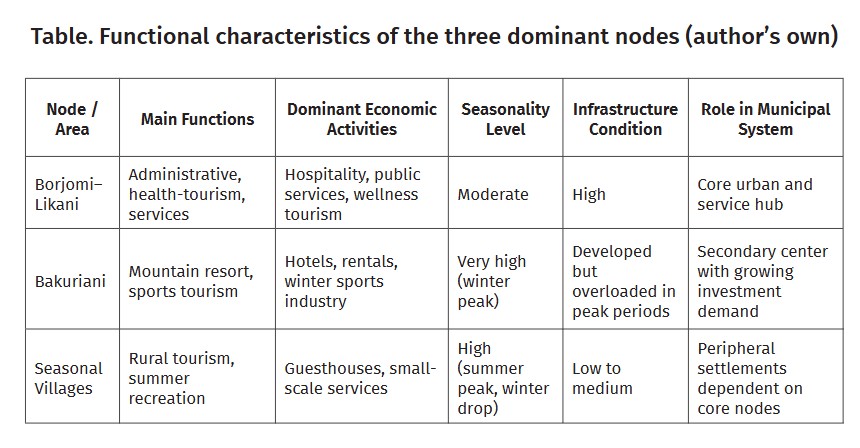
The spatial–territorial configuration of Borjomi Municipality reflects the interaction between mountainous geomorphology, transportation corridors, and a tourism-driven local economy. Field observations and qualitative interviews conducted during the research reveal that Borjomi operates as a polycentric settlement system, within which three dominant nodes—Borjomi–Likani, Bakuriani, and the corridor villages—perform distinct but interconnected functions. These nodes exhibit asymmetrical economic weight, divergent seasonal profiles, and varying degrees of infrastructural maturity, shaping the municipality’s internal spatial logic and development opportunities.
Borjomi–Likani as the Administrative, Service, and Health-Tourism Core: The Borjomi–Likani cluster constitutes the municipality’s most consolidated urban center, serving simultaneously as its administrative hub and its primary year-round tourism destination. The research indicates several defining characteristics:
- Concentration of administrative institutions, public services, and social infrastructure, which anchors stable employment opportunities and public-sector mobility;
- Developed hospitality and wellness sectors, supported by mineral springs, health resorts, and access to Borjomi–Kharagauli National Park;
- High density of commercial services, including hotels, guesthouses, retail, and dining establishments that attract both domestic and international visitors;
- Strong nodal influence, as residents from surrounding villages rely on Borjomi–Likani for education, healthcare, administrative procedures, and market access.
These attributes position Borjomi–Likani as the municipality’s primary functional center, generating regular commuter flows and acting as the infrastructural and economic “anchor” of the broader spatial system.
Bakuriani as a Rapidly Transforming Winter Resort Node: Bakuriani represents the municipality’s second major node, distinguished by its dynamic transformation into a winter-sport and recreational destination. The analysis reveals that:
- Winter tourism specialization—particularly ski infrastructure—remains Bakuriani’s dominant economic driver;
- Rapid urbanization and large-scale real-estate development have reshaped the built environment, often outpacing municipal planning capacity;
- Expanding but uneven year-round tourism potential is emerging due to new service offerings, although seasonality remains pronounced;
- High concentration of hotels, rental apartments, and tourism services, primarily catering to winter visitors.
These dynamics illustrate a tourism-intensive node heavily influenced by private investment and national-level infrastructural initiatives, yet still challenged by spatial seasonality and the need for diversified functional capacity.
Seasonal Villages along the Borjomi–Bakuriani Corridor: A third set of nodes—Tsemi, Kimotesubani, Tsagveri, and other settlements along the Borjomi–Bakuriani road—constitute the municipality’s most seasonally sensitive area. The research identifies several shared characteristics:
- Pronounced seasonal fluctuations, with peak economic activity during the summer season and significantly reduced demand during winter;
- Economic dependence on transit flows, with livelihoods tied to passing tourists and the tourism cycles of Borjomi–Likani and Bakuriani;
- Limited permanent employment opportunities and a reliance on small-scale hospitality, roadside commerce, or temporary migration;
- Underdeveloped physical and service infrastructure constrains their potential to function as autonomous development nodes.
These corridor villages operate as intermediary spaces within the municipality’s spatial system but lack sufficient functional specialization or investment to generate sustained economic activity.
Seasonal Dynamics and Implications for Local Livelihoods - Seasonality emerged as a central theme in the research, shaping household strategies, business operations, and spatial interactions:
- Summer constitutes the primary peak season in Borjomi–Likani, while winter dominates in Bakuriani, creating dual but unaligned seasonal cycles;
- Corridor villages rely heavily on short periods of tourism-driven demand, making income highly volatile;
- Mixed livelihood strategies, including temporary out-migration to Tbilisi or other urban centers, are widespread among working-age residents;
- Local agricultural producers face systemic barriers—including small production volumes, certification requirements, and logistical challenges—preventing them from entering tourism-related supply chains.
Consequently, a significant share of goods consumed in Borjomi and Bakuriani is imported from major cities, resulting in weak local value-chain integration and missed economic opportunities for rural households.
Functional Linkages, Mobility Patterns, and Spatial Interactions - The research highlights substantial disparities in the strength and direction of functional linkages among the nodes:
- Borjomi–Bakuriani mobility flows are strong but highly seasonal, reflecting the tourism calendar and road accessibility;
- Corridor villages benefit from transit flows, but their economic engagement remains marginal due to limited-service diversification;
- Backward linkages between tourism enterprises and rural producers are weak, diminishing potential multiplier effects within the municipality;
- Infrastructure quality and winter road conditions significantly influence the fluidity of spatial interactions, particularly between Bakuriani and smaller villages.
These patterns underline that spatial proximity does not automatically translate into functional integration—connectivity, economic incentives, and institutional support play decisive roles.
Structural Challenges to Balanced Spatial Development - The analysis identifies several structural barriers that hinder balanced development across the municipality:
- Strong dependence on tourism and narrow functional specialization create vulnerability to seasonal and external shocks;
- Insufficient year-round employment opportunities outside Borjomi–Likani, contributing to labor out-migration;
- Demographic pressures, including seasonal depopulation and long-term population decline in smaller settlements;
- Fragmented territorial planning processes often lack strategic coordination between economic, tourism, and spatial development policies;
- Weak integration of rural production systems into urban tourism markets is limiting the emergence of local value chains.
These challenges collectively constrain the municipality’s ability to strengthen its polycentric structure and develop resilient functional zones.
Conclusion
The research demonstrates that Borjomi Municipality’s development trajectory is fundamentally shaped by its polycentric but asymmetrical spatial structure, where three dominant nodes—Borjomi–Likani, Bakuriani, and the seasonal corridor villages—perform distinct and unequally developed functions. Field observations, interviews, and comparative spatial analysis reveal that while the municipality possesses strong tourism assets and significant economic potential, these benefits are distributed unevenly across the territory. Borjomi–Likani functions as a consolidated year-round administrative and service center, while Bakuriani has evolved into a rapidly transforming, investment-driven mountain resort with strong winter specialization. In contrast, the corridor villages remain structurally peripheral, with livelihoods tied to highly seasonal demand and insufficient integration into municipal development processes.
Seasonality emerged as the most influential factor shaping economic activity, mobility patterns, and household strategies. Divergent seasonal cycles between Borjomi–Likani (summer peak) and Bakuriani (winter peak) create temporal fragmentation within the municipality, limiting opportunities for stable year-round employment and reinforcing dependency on short peak periods. This, in turn, contributes to temporary migration, income volatility, and uneven service provision. Furthermore, the research highlights a major structural challenge: the weak integration of local agricultural producers into tourism-sector value chains. Despite strong theoretical potential for rural–urban economic synergies, empirical evidence shows persistent logistical, quality-standard, and institutional gaps that prevent local producers from supplying hotels and restaurants in either main node.
The findings also reveal that functional linkages between nodes—although geographically proximate—are insufficiently coordinated. Transport connectivity, road quality, and winter accessibility affect mobility patterns, while fragmented planning processes and limited inter-sectoral coordination weaken opportunities for integrated spatial development. Together, these dynamics underscore that Borjomi’s current spatial configuration is neither fully cohesive nor economically optimized. Strengthening polycentricity therefore requires more than the existence of multiple nodes—it requires policy instruments that enhance their complementarities, reduce disparities, and support functional diversification across the municipality.
Overall, the study contributes to regional development literature by empirically illustrating how spatial organization, functional specialization, and seasonality jointly produce uneven development outcomes in mountainous municipalities. A place-based, polycentric planning approach presents a viable path forward, but only if supported by targeted interventions that address structural constraints and promote more balanced territorial development.
Recommendations
Based on the research findings, several policy and planning recommendations emerge that could support more equitable and resilient spatial development in Borjomi Municipality. These recommendations emphasize the need for integrated territorial strategies, diversified economic functions, and strengthened local value chains[14].
Strengthen Functional Polycentricity through Coordinated Spatial Planning - The municipality should adopt a more explicit polycentric development framework, recognizing the differentiated roles of Borjomi–Likani, Bakuriani, and the corridor villages. Strategic spatial planning should ensure:
- coordinated investments across nodes rather than isolated, project-based interventions;
- development of complementary functions rather than duplication of services;
- balanced allocation of infrastructure and public services to reduce peripheral disadvantage.
Reduce Seasonal Vulnerability through Economic Diversification - Given the dual and unaligned seasonal cycles, the municipality should promote activities capable of providing year-round income. This includes:
- expanding wellness, eco-tourism, and cultural tourism in Borjomi–Likani beyond peak periods;
- supporting off-season tourism offerings in Bakuriani to extend its economic calendar;
- incentivizing small-scale, experience-based tourism (e.g., agro-tourism, homestays) in corridor villages to stabilize local incomes.
Improve Rural–Urban Value Chain Integration - To address weak backward linkages between tourism enterprises and local producers, the following measures are recommended:
- establishing aggregation, storage, or logistics centers to consolidate small farm outputs;
- supporting producers in meeting certification and quality standards required by hotels and restaurants;
- creating municipal partnership programs that connect farmers directly with tourism businesses (e.g., “Buy Local Borjomi” initiatives);
- introducing training programs on processing, packaging, and supply-chain management.
Enhance Transport and Mobility Infrastructure - Reliable connectivity is essential for spatial cohesion. Investments should prioritize:
- improved winter road maintenance between Borjomi and Bakuriani;
- upgraded public transport options to strengthen functional mobility between villages and main centers;
- accessibility enhancements in corridor villages, enabling them to participate more actively in tourism flows.
Address Demographic Pressures and Support Peripheral Settlements - Smaller settlements require targeted interventions to mitigate depopulation and ensure long-term resilience. Recommended actions include:
- decentralizing select administrative or social services into larger villages;
- improving digital infrastructure to support remote work and small service businesses;
- providing incentives for young households and entrepreneurs to remain in or relocate to peripheral areas.
Strengthen Institutional Coordination and Strategic Governance - The research identifies fragmented planning as a major constraint. To overcome this:
- municipal authorities should integrate spatial, tourism, agricultural, and economic strategies into a unified development framework;
- inter-agency and public–private cooperation should be enhanced to ensure coherent policy implementation;
- Data collection and monitoring systems should be improved to enable evidence-based decision-making.
References:
- Amin, A. (2004). Regions unbound: Towards a new politics of place. Geografiska Annaler: Series B, Human Geography, 86(1). <https://doi.org/10.1111/j.0435-3684.2004.00152.x>;
- Barca, F. (2009). An agenda for a reformed cohesion policy: A place-based approach to meeting European Union challenges and expectations. European Commission;
- Bedianashvili, G. (2018). Culture as a factor of knowledge economics with paradigmatic changes in systemic institutional context. Globalization and Business, 4(6). <https://doi.org/10.35945/gb.2018.06.007>. (in Georgian);
- Bedianashvili, G. (2022). The problem of assessing the expected consequences of economic policy. Globalization and Business, 7(13), 17–24. <https://doi.org/10.35945/gb.2022.13.002>. (in Georgian);
- Bedianashvili, G., Ivanov, Y. B., Paientko, T. V. (2019). Tax reforms in Ukraine and Georgia: Changing priorities. Journal of Tax Reform, 5(2), 107–128. <https://doi.org/10.15826/jtr.2019.5.2.063>;
- Briedenhann, J., Wickens, E. (2004). Tourism routes as a tool for the economic development of rural areas—Vibrant hope or impossible dream? Tourism Management, 25(1). <https://doi.org/10.1016/S0261-5177(03)00063-3>; (2019). ESPON Policy Brief: The territorial dimension of future EU policies. European Spatial Planning Observatory Network;
- Fujita, M., Krugman, P., Venables, A. J. (1999). The spatial economy: Cities, regions, and international trade. MIT Press;
- Jibuti, M. (2025). Enhancing regional development in Georgia: Integrating functional spatial planning and land use modeling for sustainable economic growth. International Journal of Social Sciences, 14(1), 23–34. <https://doi.org/10.52950/SS.2025.14.1.002>;
- Jibuti, M. (2021). On the usage of old and modern technologies for economic sustainability. Globalization and Business, 6(11), 97-100. <https://doi.org/10.35945/gb.2021.11.013>;
- Jibuti, M. (2019). Administrative division, regions of Georgia and their characteristics. Globalization and Business, 4(8). <https://doi.org/10.35945/gb.2019.08.016>;
- Keshelashvili, G. (2016). General strategies of Georgian winemaking companies’ management in the conditions of integrated development. In Proceedings of the 23rd International Academic Conference, Venice (pp. 242-251). <https://doi.org/10.20472/IAC.2016.023.049>;
- Keshelashvili, G. (2017). Characteristics of management of agricultural cooperatives in Georgia. In Proceedings of the 32nd International Academic Conference, Geneva (pp. 207–218). IISES. <https://doi.org/10.20472/IAC.2017.032.020>;
- Keshelashvili, G. (2018). Value chain management in agribusiness. International Journal of Business and Management, 6(2). <https://doi.org/10.20472/BM.2018.6.2.004>;
- Keshelashvili, G. (2024). The role of business in achieving sustainable development and need of changes in managerial attitude: The case of Georgia. Proceedings of the International Conference on Economics, Finance & Business, Vienna, 2024, pp. 37–49. International Institute of Social and Economic Sciences. <https://doi.org/10.20472/EFC.2024.020.003>;
- Keshelashvili, G. (2025). Sustainable business practices in Georgian SMEs: Assessment, needs, and strategic perspectives. International Journal of Social Sciences, 14(1), 35–51. <https://doi.org/10.52950/SS.2025.14.1.003>;
- Kharaishvili, E. (2020). Methodological features of determining the level of competitiveness in the agri-food sector of Georgia. Globalization and Business, 5(10). <https://doi.org/10.35945/gb.2020.10.004>. (in Georgian);
- Kharaishvili, E., Suknishvili, M. (2021). Agribusiness development trends in Georgia: Modern challenges and solutions. Ecology. Socium, 5(4). <https://doi.org/10.31520/2616-7107/2021.5.4-4>;
- Kharaishvili, E., & Talikadze, N. (2022). Competitiveness characteristics of agri-food products – What does the consumer choose? (Case of Georgia). Innovative Marketing, 18(1), 195–207. <https://doi.org/10.21511/im.18(1).2022.16>;
- Meijers, E. (2008). Measuring polycentricity and its promises. European Planning Studies, 16(9). <https://doi.org/10.1080/09654310802401805>;
- Mekvabishvili, E. (2019). The economic role of the state in conditions of globalization. Globalization and Business, 4(8). <https://doi.org/10.35945/gb.2019.08.002>;
- Mekvabishvili, E. (2020). The anti-crisis role of the state (Based on the experience of the global financial and corona-economic crisis). Globalization and Business, 7(10), 35–41. <https://doi.org/10.35945/gb.2020.10.003>;
- Nepal, S. K., Saarinen, J. (2016). Political ecology and tourism. Routledge;
- Papava, V. (2014). The catch-up effect and regional comparisons of growth indicators: With the Eastern Partnership countries as an example. Problems of Economic Transition, 57(3). <https://doi.org/10.2753/PET1061-1991570301>;
- Papava, V. (2014). Georgia’s economy: The search for a development model. Problems of Economic Transition, 57(3), 13–24. <https://doi.org/10.2753/PET1061-1991570304>;
- Papava, V. (2017). A Eurasian or a European future for post-Soviet Georgia’s economic development: Which is better? Archives of Business Research, 5(1), 159–170. <https://doi.org/10.14738/abr.51.2651>;
- Silagadze, A. (2013). Priorities for the economy of postcommunist Georgia in the context of the world financial crisis. Problems of Economic Transition, 56(8). <https://doi.org/10.2753/PET1061-1991560801>;
- Silagadze, A. (2022). Contemporary global economic trends: Transitional economies during Covid Bulletin of the Georgian National Academy of Sciences, 16(3).
Footnotes
[1] Fujita, M., Krugman, P., Venables, A. J. (1999). The spatial economy: Cities, regions, and international trade. MIT Press. Meijers, E. (2008). Measuring polycentricity and its promises. European Planning Studies, 16(9), 1313–1323. <https://doi.org/10.1080/09654310802401805>.
[2] Bedianashvili, G. (2018). Culture as a factor of knowledge economics with paradigmatic changes in systemic institutional context. Globalization and Business, 4(6), 59–66. <https://doi.org/10.35945/gb.2018.06.007>; Keshelashvili, G. (2018). Value chain management in agribusiness. International Journal of Business and Management, 6(2), 59–77. <https://doi.org/10.20472/BM.2018.6.2.004>; Kharaishvili, E. (2020). Methodological features of determining the level of competitiveness in the agri-food sector of Georgia. Globalization and Business, 5(10), 43–49. <https://doi.org/10.35945/gb.2020.10.004>; Papava, V. (2014). The catch-up effect and regional comparisons of growth indicators: With the Eastern Partnership countries as an example. Problems of Economic Transition, 57(3), 3–12. <https://doi.org/10.2753/PET1061-1991570301>; Silagadze, A. (2013). Priorities for the economy of postcommunist Georgia in the context of the world financial crisis. Problems of Economic Transition, 56(8), 3–16. <https://doi.org/10.2753/PET1061-1991560801>;
[3] Jibuti, M. (2019). Administrative division, regions of Georgia and their characteristics. Globalization and Business, 4(8), 126–129. <https://doi.org/10.35945/gb.2019.08.016>; Mekvabishvili, E. (2019). The economic role of the state in conditions of globalization. Globalization and Business, 4(8), 22–33. <https://doi.org/10.35945/gb.2019.08.002>; Jibuti, M. (2025). Enhancing regional development in Georgia: Integrating functional spatial planning and land use modeling for sustainable economic growth. International Journal of Social Sciences, 14(1), 23–34. <https://doi.org/10.52950/SS.2025.14.1.002>; Jibuti, M. (2021). On the usage of old and modern technologies for economic sustainability. Globalization and Business, 6(11), 97-100. <https://doi.org/10.35945/gb.2021.11.013>; Keshelashvili, G. (2016). General strategies of Georgian winemaking companies’ management in the conditions of integrated development. In Proceedings of the 23rd International Academic Conference, Venice (pp. 242-251), IISES. <https://doi.org/10.20472/IAC.2016.023.049>; Keshelashvili, G. (2017). Characteristics of management of agricultural cooperatives in Georgia. In Proceedings of the 32nd International Academic Conference, Geneva (pp. 207–218). IISES. <https://doi.org/10.20472/IAC.2017.032.020>.
[4] Papava, V. (2014). The catch-up effect and regional comparisons of growth indicators: With the Eastern Partnership countries as an example. Problems of Economic Transition, 57(3), 3–12. <https://doi.org/10.2753/PET1061-1991570301>.
[5] Silagadze, A. (2013). Priorities for the economy of postcommunist Georgia in the context of the world financial crisis. Problems of Economic Transition, 56(8), 3–16. <https://doi.org/10.2753/PET1061-1991560801>; Silagadze, A. (2022). Contemporary global economic trends: Transitional economies during Covid Depression. Bulletin of the Georgian National Academy of Sciences, 16(3), pp.130–135.
[6] Kharaishvili, E., Suknishvili, M. (2021). Agribusiness development trends in Georgia: Modern challenges and solutions. Economic. Ecology. Socium, 5(4), 29–38. <https://doi.org/10.31520/2616-7107/2021.5.4-4>.
[7] Nepal, S. K., Saarinen, J. (2016). Political ecology and tourism. Routledge.
[8] Barca, F. (2009). An agenda for a reformed cohesion policy: A place-based approach to meeting European Union challenges and expectations. European Commission.
[9] Bedianashvili, G. (2022). The problem of assessing the expected consequences of economic policy. Globalization and Business, 7(13), 17–24. <https://doi.org/10.35945/gb.2022.13.002> (in Georgian); Bedianashvili, G., Ivanov, Y. B., Paientko, T. V. (2019). Tax reforms in Ukraine and Georgia: Changing priorities. Journal of Tax Reform, 5(2), 107–128. <https://doi.org/10.15826/jtr.2019.5.2.063>; Mekvabishvili, E. (2020). The anti-crisis role of the state (Based on the experience of the global financial and corona-economic crisis). Globalization and Business, 7(10), 35–41. <https://doi.org/10.35945/gb.2020.10.003>; Papava, V. (2014). Georgia’s economy: The search for a development model. Problems of Economic Transition, 57(3), 13–24. <https://doi.org/10.2753/PET1061-1991570304>; Papava, V. (2017). A Eurasian or a European future for post-Soviet Georgia’s economic development: Which is better? Archives of Business Research, 5(1), 159–170. <https://doi.org/10.14738/abr.51.2651>.
[10] ESPON. (2019). ESPON Policy Brief: The territorial dimension of future EU policies. European Spatial Planning Observatory Network. Meijers, E. (2008). Measuring polycentricity and its promises. European Planning Studies, 16(9), 1313–1323. <https://doi.org/10.1080/09654310802401805>.
[11] Fujita, M., Krugman, P., Venables, A. J. (1999). The spatial economy: Cities, regions, and international trade. MIT Press.
[12] Amin, A. (2004). Regions unbound: Towards a new politics of place. Geografiska Annaler: Series B, Human Geography, 86(1), 33–44. <https://doi.org/10.1111/j.0435-3684.2004.00152.x>; Barca, F. (2009). An agenda for a reformed cohesion policy: A place-based approach to meeting European Union challenges and expectations. European Commission.
[13] Briedenhann, J., Wickens, E. (2004). Tourism routes as a tool for the economic development of rural areas—Vibrant hope or impossible dream? Tourism Management, 25(1), 71–79. <https://doi.org/10.1016/S0261-5177(03)00063-3>; Nepal, S. K., & Saarinen, J. (2016). Political ecology and tourism. Routledge.
[14] Keshelashvili, G. (2024). The role of business in achieving sustainable development and need of changes in managerial attitude: The case of Georgia. Proceedings of the International Conference on Economics, Finance & Business, Vienna, 2024, pp. 37–49. International Institute of Social and Economic Sciences. <https://doi.org/10.20472/EFC.2024.020.003>; Keshelashvili, G. (2025). Sustainable business practices in Georgian SMEs: Assessment, needs, and strategic perspectives. International Journal of Social Sciences, 14(1), 35–51. <https://doi.org/10.52950/SS.2025.14.1.003>; Kharaishvili, E., Talikadze, N. (2022). Competitiveness characteristics of agri-food products – What does the consumer choose? (Case of Georgia). Innovative Marketing, 18(1), 195–207. <https://doi.org/10.21511/im.18(1).2022.16>.
Downloads
ჩამოტვირთვები
გამოქვეყნებული
გამოცემა
სექცია
ლიცენზია

ეს ნამუშევარი ლიცენზირებულია Creative Commons Attribution-ShareAlike 4.0 საერთაშორისო ლიცენზიით .
როგორ უნდა ციტირება
Share