
Resort Reform in Georgia: Comparative Insights from Eastern Europe
DOI:
https://doi.org/10.35945/gb.2026.21.003საკვანძო სიტყვები:
Resorts, tourism policy, regulatory framework, sustainable developmentანოტაცია
The paper reviews the past and current resort-related regulatory framework in Georgia to identify the main obstacles that slow down resort development. The collapse of the Soviet Union had a disastrous impact on Georgia’s sanatoriums and health resorts. As a result, historically valuable buildings and parks within these areas deteriorated, the number of both residents and visitors steadily declined, and many facilities lost their role in the public health system. However, recent reforms, particularly the Law on Tourism adopted in 2023, have renewed interest in the potential of resorts to attract visitors and foreign investment.
Based on a comparative review of the legal and policy frameworks of four Eastern European countries—Bulgaria, Latvia, Lithuania, and Romania—the paper provides insights for the ongoing tourism reform in Georgia. These countries were selected because they share a similar post-Soviet background with Georgia but are also members of the European Union. The comparison revealed differences in legal definitions, recognition procedures, and criteria for resort classification, helping to identify the most effective practices that could be adapted to the Georgian context.
From these findings, the paper proposes a new regulatory framework that introduces the concept of “National Resorts” as a quality-assurance mechanism. It also recommends modernizing tourism and resort governance, improving coordination between institutions, and integrating climate-resilience and safety measures to help position Georgia’s resorts as competitive and sustainable destinations within the broader European tourism landscape.
Keywords: Resorts, tourism policy, regulatory framework, sustainable development.
JEL Classification: L83, Z32, R58.
Introduction
Resort development began in the early twentieth century, following the Russian Revolution of 1917. During this period, the Soviet government created a wide network of sanatoriums, health resorts, and similar facilities for the purpose of improving the health and well-being of the working population and their families. These initiatives soon spread to other Soviet republics, where resorts became part of the broader system of social welfare and labor protection. Over the following decades, this network grew into a centralized system of sanatoriums, health resorts, and children’s recreation centers that served both medical and leisure purposes. Because of its diverse mountain, climatic, and balneological resources, Georgia became one of the main centers of health tourism in the Soviet Union, attracting visitors from across the country.
The collapse of the Soviet Union in the early 1990s created serious challenges for the resort networks across post-Soviet countries. Rapid privatization and the sudden end of government support left many resorts without funds or visitors. Many facilities lost their original public-health role and fell into disrepair, while natural and cultural assets deteriorated through neglect or unregulated use. According to Tutberidze (2021), Georgian resorts today fall into four categories: (1) fully restored and operating destinations such as the Black Sea coast, Tbilisi, Borjomi, Sairme, and Tskaltubo; (2) partially restored resorts under development, including Abastumani and Bakhmaro; (3) seasonal resorts with limited infrastructure, such as Sulori and Lashichala; and (4) resorts with destroyed infrastructure, such as Menji, Tsaishi, and Nabeghlavi.
The first comprehensive legal framework governing resorts was the Law of Georgia on Tourism and Resorts (1997), which defined “resorts”, “resort areas,” and “natural curative resources”, approving an official list of 271 resorts and resort areas. This was complemented by the Law on Protective Sanitary Zones of Health Resorts and Resort Areas (2000), which introduced a three-tiered system of sanitary protection zones to safeguard natural healing resources and regulate economic activities.
The Law on Tourism, adopted in 2023, repealed the 1997 legislation and required the preparation of a new Law on Resort Activities by 2025, later postponed to 2026. The updated law introduced three key terms: resort, resort area, and resort activity. A resort is defined as a designated location with the necessary infrastructure for resort-related activities. A resort area is a designated territory that has natural healing and therapeutic resources suitable for use, but lacks the infrastructure for resort activities. Resort activities refer to the organized use of natural healing and therapeutic resources and the related infrastructure for prevention, treatment, rehabilitation, and recovery.
However, the law does not include a clear definition of natural healing resources, which was a key part of earlier resort classification. Previously, these resources included mineral waters, therapeutic muds, karst caves suitable for treatment, the sea, forests, therapeutic climates, and other natural elements used for prevention and rehabilitation. The absence of clear evaluation criteria for such resources now creates uncertainty in determining resort eligibility and weakens the credibility of official recognition.
Other than legal gaps, there is also a conceptual issue in how the term resort is defined in Georgia. As in other Soviet countries, a resort has mostly referred to places with officially recognized healing resources, such as mineral springs, therapeutic muds, or favorable climatic conditions, and to some basic infrastructure for using these resources, like baths or treatment facilities. This narrow, health-oriented approach does not take into consideration whether these places have functioning tourism infrastructure. As a result, some resorts exist only formally and fail to attract visitors because of the lack of tourism facilities, while active tourism destinations without certified healing resources remain outside the system. For example, Gudauri, a major mountain destination with developed infrastructure and strong demand, is still not legally recognized as a resort. The identified challenges suggest that a broader definition is needed that will capture both the curative purpose and the tourism role of resorts.
The important gap in tourism governance in Georgia should also be highlighted. There are overlapping responsibilities and weak coordination among government agencies, which remain serious obstacles for the development of the tourism industry in general and resorts in particular. According to the Law on Tourism, the Government of Georgia, the Ministry of Economy and Sustainable Development, and the Georgian National Tourism Administration (GNTA) share responsibility for tourism development, while the GNTA is the main agency for tourism policy implementation. However, an analysis of the GNTA’s activities shows that its main focus is on promotion, while planning and regulatory functions remain less developed. Furthermore, GNTA, local governments, Destination Management Organizations (DMOs), the Georgian Resorts Development Agency (GRDA), and the Mountain Trails Agency (MTA) have overlapping functions, which makes it difficult to identify which agency is accountable for specific tourism-related tasks. In October 2025, the Government officially announced the merger of two agencies, GRDA and GNTA, leading to improved coordination and reduced duplication. This reform shows that the authorities recognize long-standing institutional problems, although the process still needs to be completed. The MTA, responsible for developing ski infrastructure, still operates outside the national tourism policy framework. It is therefore of paramount importance to create a unified system that connects all tourism-related functions to ensure better planning and coordination.
The problems identified above are not unique to Georgia. After the collapse of the Soviet Union, several Eastern European countries faced the same kinds of institutional and legal difficulties. However, some of these countries improved their resort systems with more quality orientation and better management practices.
The study investigates how selected Eastern European states with a common Soviet heritage— Bulgaria, Latvia, Lithuania, and Romania—have reformed their resort regulation systems after joining the European Union. Furthermore, the paper identifies practical insights for Georgia by using a comparative legal and policy analysis of tourism and resort-related laws, focusing on the main aims, definitions, recognition procedures, and criteria that regulate resorts in the four selected countries. The main goal is to develop a clear and practical framework for the classification and management of Georgian resorts that will lead to an increase in their quality, environmental sustainability, and competitiveness for the international tourism markets.
Overview of Resort-Related Regulations in Eastern Europe
This part of the paper investigates how resort regulations work in four Eastern European countries—Bulgaria, Latvia, Lithuania, and Romania. They share a Soviet past but took different paths when reforming their systems after joining the European Union, based on their own national priorities. Although no single regulation is perfect, a combination of strong sides can be very useful if adapted wisely to the Georgian context. To identify useful insights, analysis focuses on three main aspects: (1) the aims and legal definition of a resort, (2) the procedures for official recognition, and (3) the criteria used for that recognition.
Definition and Aim of Resort Regulation
There are different meanings of the term resort in different parts of the world. In the North American case, it refers to a single property offering leisure and recreation services or a type of accommodation, while in British and European contexts it describes an entire locality or destination with tourism and health-related infrastructure. Eastern European countries follow this latter approach, treating resorts as complex areas that combine natural, medical, and cultural resources within a managed spatial framework.
In Bulgaria, resort regulation aims to promote the sustainable development of national resorts while protecting natural and cultural heritage. The law defines a resort as an urbanized area (either a whole or part of a settlement) with officially declared resort resources and facilities for prevention, treatment, rehabilitation, recreation, and tourism. These resources include mineral and thermal waters, therapeutic muds, seawater, coastal zones, and favorable climatic conditions. National resorts are a higher category selected by the authorities from the existing list of resorts based on their tourism potential. They are required to have developed infrastructure, good accessibility, and a balanced combination of natural and human-made assets supporting both health and leisure functions.
In Latvia, resort regulation is more health-oriented and focuses on the rational use of natural healing resources for wellness, prevention, and rehabilitation in an environmentally sustainable way. A resort in Latvia is an officially designated area that has natural healing resources and at least one medical institution using them, together with basic infrastructure and proper spatial planning. This reflects Latvia’s long spa and wellness tradition, where the value of local healing resources forms the main legal and economic basis for resort development.
In Lithuania, resort regulation is part of broader territorial and economic planning. Its main goal is to achieve balanced social, economic, and infrastructural development, attract investment, and strengthen the country’s image as a wellness destination. Lithuanian law distinguishes, on the one hand, between resorts—residential areas with scientifically proven natural healing factors and developed infrastructure—and, on the other hand, resort areas, which have potential healing resources that are not yet fully developed. This system helps Lithuania develop new resorts gradually and ensures that local planning fits with the country’s tourism and health goals.
Unlike other countries, Romania does not have a special law for resorts. Resorts-related matters are handled through the general tourism law that focuses mostly on recognizing natural and cultural tourism resources. A resort is defined as a locality or part of it recognized for certified natural or anthropogenic assets such as geological formations, landscapes, climate, and monuments. The presence of healing resources is not mandatory, underscoring Romania’s broader recreational and cultural orientation.

These frameworks show two main approaches in Eastern European resort policy. The curative-medical model, used in Bulgaria, Latvia, and Lithuania, links resort status to natural healing factors and focuses on health, rehabilitation, and environmental quality. The tourism-development model, followed in Romania, defines resorts more broadly based on their recreational, cultural, and natural features.
Procedures for Resort Recognition
The existing formal recognition procedures in the selected countries ensure that nominated areas meet agreed standards. Although the level of complexity differs from country to country, all the systems reviewed include expert evaluation, coordination between ministries, and regular monitoring.
In Bulgaria, the recognition process is based on a clear legal framework that focuses on the proper use and protection of healing resources. The Minister of Health pilots the process by preparing a proposal for resort recognition based on expert reviews. The final approval is given by the Council of Ministers together with the Ministries of Health, Regional Development, Environment, and Tourism. An important step is the balneological assessment of mineral waters, which confirms their healing qualities for a period of ten years and can later be renewed. The results are published on the Ministry of Health’s website to keep the process transparent. After a locality is officially recognized as a resort, it can later be given the status of a national resort. This second step is regulated by an ordinance adopted by the Council of Ministers based on a joint proposal from the Ministers of Health and Tourism. Businesses operating in national resorts benefit from simpler administrative procedures and special incentives that support investment and sustainable growth.
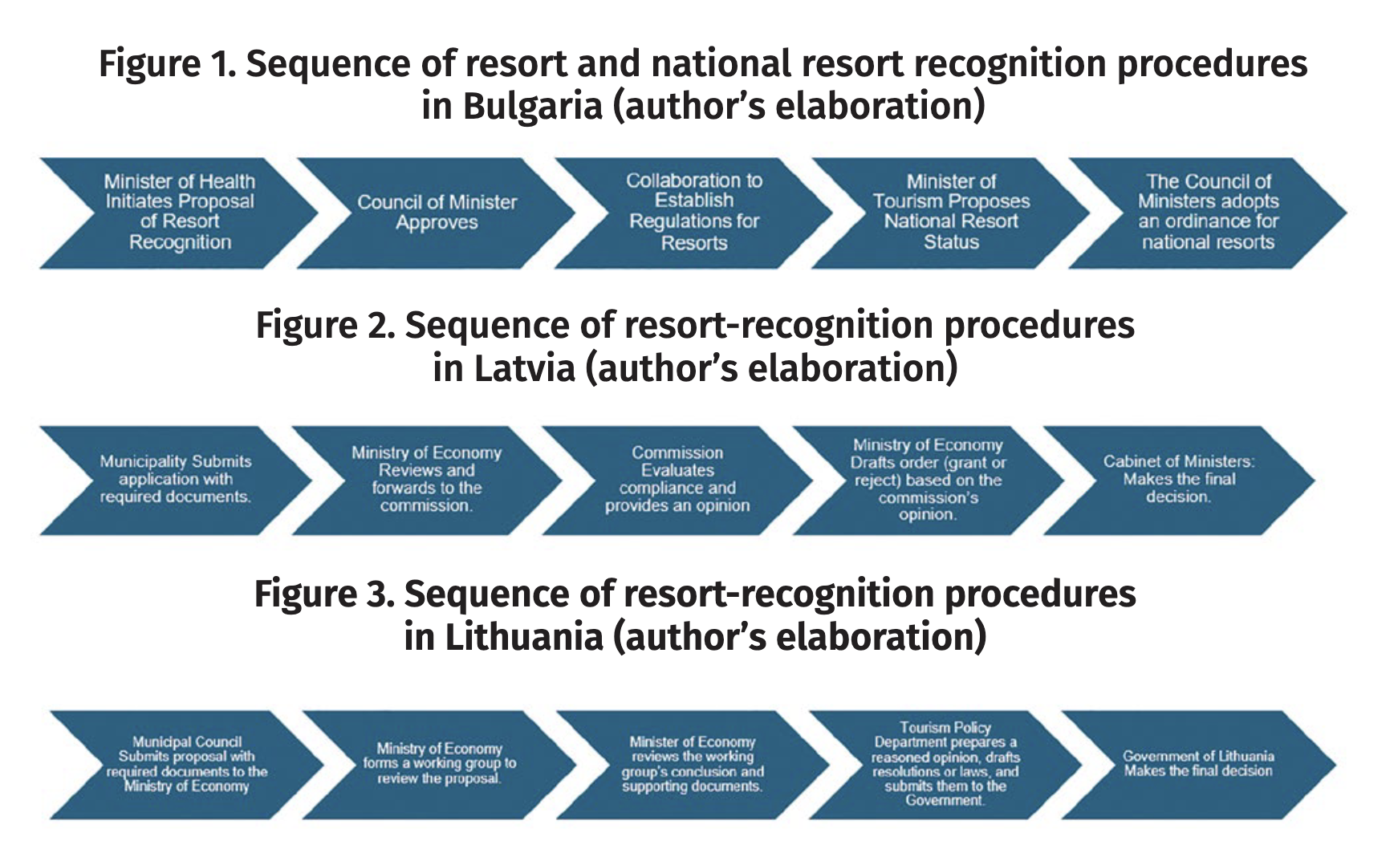
In Latvia, the process is initiated by municipalities and regulated through the Cabinet of Ministers’ decisions. Local councils submit applications including development plans, spatial documentation, and compliance evidence. The Ministry of Economy conducts the preliminary review and forwards qualified cases to an inter-ministerial commission, which evaluates conformity with the Tourism Law within two months. Based on its findings, the Ministry drafts an order for the Cabinet, which issues the final designation. Municipalities must submit biennial progress reports; non-compliance can result in revocation of status.
In Lithuania, the municipal council submits a proposal to the Ministry of Economy and Innovation, together with planning and explanatory documents. The Ministry forms a working group to review the submission within sixty days and prepares a recommendation for the Government, which makes the final decision. This clear and transparent process allows the gradual recognition of new destinations through the resort-area category.
In Romania, resort recognition is regulated by the general tourism law through ministerial certification of natural or cultural resources. The process is officially defined, but less transparent than in the other three countries.
Overall, these procedures show different levels of institutional development. Bulgaria focuses on medical evaluation; Latvia and Lithuania combine local initiative with national oversight; and Romania follows a simpler, resource-based system.
Criteria for Resort Recognition
The four selected countries differ widely in the specificity, transparency, and formality of their resort-recognition criteria. In Lithuania, the criteria are written into law and clearly connected to spatial planning and environmental policy. In Bulgaria and Romania, by contrast, the criteria are not published or are set mainly through administrative practice. Latvia lies in between, providing general rules for compliance and development planning but without detailed technical standards.
Compared with other countries, Lithuania has much more detailed criteria available in regulations for resort recognition. There are two types of requirements for areas seeking resort or resort-area status—general and specific. The general criteria focus on several key areas, including environmental protection, public health and safety, land-use planning, and tourism infrastructure. Furthermore, they follow sustainable principles by including measures such as limiting pollution, improving accessibility, and keeping high standards of cleanliness and safety. In contrast, the specific criteria address the practical side of the development by focusing on the quality of infrastructure, like pedestrian and bicycle paths, parking and storage facilities, and well-maintained public spaces that create a comfortable and attractive resort environment. In addition, areas aiming for full resort status must also provide bypass routes for transit traffic, developed tourism infrastructure, and a mix of public and private services. Key elements include healthcare and wellness centers, accommodation, and cultural, leisure, and dining facilities. Resort areas, on the other hand—seen as developing or transitional destinations—have fewer requirements and mainly focus on basic recreation facilities and public services for visitors. This two-level system helps Lithuania develop new resorts gradually while supporting national goals for sustainability and spatial planning.
Latvia’s criteria for resort designation are defined in the Regulations on Resorts issued by the Cabinet of Ministers. While the regulations do not set precise quantitative or qualitative benchmarks, they require municipalities to submit comprehensive documentation—such as spatial-development plans, evidence of resource protection, and medium-term resort strategies—demonstrating the feasibility and long-term vision of the proposed resort. The focus on planning and environmental management helps keep resort policy consistent, even without detailed technical standards.
In Bulgaria and Romania, there is no complete or publicly available list of resort-recognition criteria. In fact, the process in Bulgaria focuses mainly on the balneological evaluation of natural healing resources, while Romania regulates resorts through the general tourism law, without clearly defined standards for eligibility, sustainability, or quality. Due to the fact that these rules are not published, decisions often depend on administrative judgment, making the process less consistent than in Lithuania.
In summary, these differences that that resort related regulations in Eastern Europe have developed at different speeds and in different ways. Lithuania’s model is the most complete because it brings together health, environmental, and infrastructure aspects. Latvia’s approach is more focused on local planning and management, while Bulgaria and Romania still struggle with unclear procedures and a lack of detailed legal guidance.
Developing a Resort Regulation Framework for Georgia
Reforming resort regulations in Georgia requires more than just updating legal terms or setting new recognition criteria. For real impact, the entire tourism governance system needs bigger, more comprehensive change and optimization. The conceptual framework below is based on the analysis of resort-related regulations of Eastern European countries and is adapted to Georgia’s recent institutional and economic context.
Aim and Definition of Resorts
As mentioned earlier, the Law of Georgia on Tourism (2023) keeps the old definitions of resorts and resort areas but contains several important flaws. To solve this problem, the law should clearly list what counts as curative resources. Another important step would be the introduction of the term National Resort, allowing the government to distinguish resorts by their tourism potential without changing the current list of resorts. A proposed legal formulation could read as follows:
“A resort is an urbanized area initially declared as a resort and subsequently recognized as a National Resort based on a proposal by the Georgian National Tourism Administration and a decision of the Cabinet of Ministers. National resorts are important for the sustainable development of tourism in Georgia. They are characterized by essential tourism infrastructure, accessibility, and valuable tourism resources. These resources include components of the natural and anthropogenic environment (geological formations, climate, flora and fauna, landscapes, and cultural or historical sites) used for tourism unless subject to full protection regimes. In special cases, areas with high-value tourism resources may be nominated for national resort status without prior resort designation”.
The concept of “National Resorts” is similar to Bulgaria’s approach, where they are considered as an important drivers for sustainable tourism and economic growth. It is also partly in line with Romania’s system, which defines resorts based on their tourism resources. However, the paper suggests going a step further by allowing exceptional destinations without curative resources to be nominated directly for national status. For example, destinations without resort status but with high tourism potential, like Gudauri, would also have the opportunity to be declared as national resorts.
Procedures for Resort Recognition
The paper proposes a national resort recognition system using practices observed in Bulgaria, Latvia, and Lithuania, while taking into consideration the local governance system:
- Nomination – The Georgian National Tourism Administration (GNTA), together with the local municipality, submits a nomination for national resort status. As a result, both expert knowledge and local perspectives are reflected in the proposal;
- Formation of a Working Group – A multidisciplinary team composed of ministry representatives, technical experts, and local authorities evaluates the proposal;
- Evaluation of Compliance – The working group evaluates accessibility, sustainability, infrastructure quality, and distinctive tourism resources and prepares a formal opinion for the Ministry of Economy and Sustainable Development;
- Drafting of the Decision – Based on the group’s findings, the Ministry prepares a draft decision to either approve or reject the nomination and adds recommendations if needed;
- Final Approval – The Cabinet of Ministers makes the final decision, ensuring that it aligns with national tourism policy and broader development goals.
The suggested framework provides a simple and transparent process that is designed to help agencies work together more effectively. Furthermore, it makes responsibilities clearer and brings Georgia closer to international tourism management standards.
Criteria for Resort Recognition, Including Ski Resorts
The recognition criteria should reflect the main purpose of each resort while still keeping a single, unified national framework. All National Resorts must satisfy general quality and sustainability standards, supplemented by type-specific indicators.
General Criteria (applicable to all resorts) are the following:
- Accessibility and connectivity;
- Quality of infrastructure (roads, parking, public spaces);
- Availability of tourism services and facilities;
- Environmental protection and sustainable management practices;
- Existence and quality of tourism resources;
- Availability of healthcare and emergency services;
- Compliance with spatial and territorial planning standards;
- Existence of a medium-term strategy for resort growth.
Specific Criteria are the following:
- National Ski Resorts – quality, safety, and reliability of ski slopes; maintenance of lifts and snow-making systems; proximity of emergency services; variety of winter sports and après-ski facilities; and environmental safeguards in mountain ecosystems;
- National Seaside Resorts – beach quality, water safety, coastal protection, and waste-management systems ensuring sustainable use;
- National Wellness Resorts – quality and diversity of spa and therapeutic services based on natural healing resources such as mineral waters or therapeutic muds;
- National Tourism Resorts – distinctiveness and attractiveness of natural or cultural resources, quality of supporting infrastructure, and capacity to offer recreation, learning, and leisure experiences.
The working group should apply these criteria fairly, taking into account the size, type, and potential of each destination. A clear but flexible system will make the process more balanced and help create a variety of good-quality Georgian resorts that meet international standards.
It is also important to note that simply following Lithuania’s example and adopting stricter criteria to existing resorts without bringing new terms could improve quality control of the resorts, but it would likely remove the status of about 95% of existing resorts, resulting in a long, costly, and politically sensitive process.
Institutional Roles after National Resort Recognition
It’s important to note that National Resort is a real tool, not a formal label for developing and improving resort competitiveness. In practice, it is a brand giving high-quality information to visitors travelling to destinations for tourism purposes. In order to make this idea work, effective cooperation between agencies is of paramount importance.
Firstly, the GNTA and local DMOs should support these resorts with marketing and promotion and include them in training programs. The two agencies should also assess and control indicators of infrastructure and service quality, environmental conditions, and visitor satisfaction. In case standards drop, the GNTA should have the authority to suspend or withdraw resort status in order to maintain high quality.
Secondly, the regulations should focus on safety and climate resilience activities. With the increasing number of winter and adventure visitors, the improvement of safety management becomes essential. Furthermore, as a result of Climate change, warmer winters and less snow threaten ski destinations such as Bakuriani and Gudauri, while erosion affects Black Sea resorts. For these reasons, monitoring climate risks and improving disaster preparedness should become a national goal.
Finally, Enterprise Georgia can also play an important role. It can support national resorts through funding, infrastructure upgrades, and workforce training activities. At the same time, the government can help through tax incentives, public infrastructure improvement, and better access to finance. These steps would encourage both public and private investment in the sustainable growth of resorts.
To summarize, effective coordination between the GNTA, DMOs, Enterprise Georgia, and other agencies is essential to keep everyone working toward the same goal. Through the clearer roles, stronger management, and the inclusion of climate planning and safety measures, the National Resort title can be turned into a sign of quality that helps attract investment and improves Georgia’s long-term competitiveness. Utilizing this approach, the country can move from its old Soviet-style resort system toward a modern, European model that supports sustainable tourism growth.
References:
Scientific Articles:
- Azmaiparashvili, M., Davituliani, T. (2023). Ecological Safety of Georgian Tourism. Globalization and Business, 8(16);
- Azmaiparashvili, M., Goderdzishvili, I. (2024). Sustainable development of Georgian resorts: modern trends and challenges. Proceedings of the 6th International Scientific and Practical Conference “Scientific Goals and Purposes in XXI Century”, 6(193);
- Bregadze, G. (2023). Climate Change Impacts on the Tourism Industry in Georgia, Globalization and Business, Vol. 8, No. 16. <https://doi.org/10.35945/gb.2023.16.005>;
- Conterio, J. (2019). Curative nature: Medical foundations of Soviet nature protection, 1917–1941. Slavic Review, 78(1);
- Ņitavska, N., Skujāne, D. (2019). Re-branding landscapes of forgotten resorts: Case of the healing resort Kemeri in Latvia. Landscape Architecture and Art, 15(15);
- Tutberidze, M. (2021). The Georgian resorts as a basis for wellness tourism development. Georgian Geographical Journal, 1(1);
- Varadzhakova, D., Naidenov, A., Ilieva, N., Raykova, M. (2023). The Bulgarian national Black Sea resorts in the context of domestic tourism. GeoJournal of Tourism and Geosites, 49(4).
Normative Acts:
- Decree No. 428 of the Government of Georgia On the Approval of the List of Resorts and Resort Areas of Georgia (3 July 2014);
- Law of Georgia on Protective Sanitary Zones of Health Resorts and Resort Areas No. 1308-IIs (7 September 2000). Legislative Herald of Georgia. <www.matsne.gov.ge>;
- Law of Georgia on Tourism (15 December 2023). Legislative Herald of Georgia. <www.matsne.gov.ge>;
- Law of Georgia on Tourism and Resorts No. 1662-IIs. (28 November 1997). Legislative Herald of Georgia. <www.matsne.gov.ge>;
- Law of Romania on Tourism (nr. 70/2023, 30 March 2023; published in the Official Gazette of Romania, Part I, No. 256/2023), legislatie.just.ro – Official Legislative Portal of Romania. <https://legislatie.just.ro/Public/DetaliiDocumentAfis/256247>;
- Law of the Republic of Bulgaria on Health (SG No. 70/2004; last amended SG No. 98/2018), Republic of Bulgaria. lex.bg – Official Legislation Database of Bulgaria. <https://lex.bg/bg/laws/ldoc/2135489147>;
- Law of the Republic of Bulgaria on Tourism (State Gazette No. 30 of 26 March 2013; last amended State Gazette No. 20 of 12 March 2021), lex.bg – Official Legislation Database of Bulgaria. <https://lex.bg/bg/laws/ldoc/2135845281>;
- Law of the Republic of Latvia on Tourism (19 June 1998; last amended 1 July 2022). likumi.lv – Official Legislation Database of Latvia. <https://likumi.lv/ta/id/50026-turisma-likums>;
- Law of the Republic of Lithuania on Tourism (18 March 1998; last amended 23 January 2023). e-Seimas – Official Portal of Legal Acts of the Republic of Lithuania. <https://e-seimas.lrs.lt/portal/legalAct/lt/TAD/3a2b7132f9f611edbc0bd16e3a4d3b97>;
- Order No. 630/2022 of the Ministry of Economy, Entrepreneurship and Tourism of Romania On the Certification of Tourist Resorts of National or Local Interest. Official Gazette of Romania, No. 330/04.04.2022. <https://legislatie.just.ro/Public/DetaliiDocumentAfis/256247>;
- Regulations of the Cabinet of Ministers of the Republic of Latvia No. 451, “Regulations on Resorts” (2 August 2016; last amended 8 June 2021). likumi.lv – Official Legislation Database of Latvia. <https://likumi.lv/ta/en/en/id/253701>;
- Resolution No. 1459 of the Government of the Republic of Lithuania On the Approval of the Procedure for Granting and Revoking the Status of Resorts and Resort Areas (23 December 2008; last amended 2 December 2020). e-TAR – Official Register of Legal Acts of Lithuania. <https://www.e-tar.lt/portal/lt/legalAct/f94027a07d0111e7827cd63159af616c/asr>;
- Resolution No. 350 of the Government of the Republic of Lithuania On the Approval of the Description of the Procedure for Granting the Status of a Resort and a Resort Territory (12 April 2006; last amended 15 December 2021). e-TAR – Official Register of Legal Acts of Lithuania. <https://www.e-tar.lt/portal/en/legalAct/TAR.B4B629EF1E3E/WHPJjFiPBK>.
Web Resources:
- Georgian Resorts Development Agency. (n.d.). Mission and Vision. Government of Georgia. Last access: October 31, 2025. <https://resorts.gov.ge/mission?menu_id=45&target=_self>;
- Mountain Trails Agency. (n.d.). About the Agency. Government of Georgia. Last access: October 31, 2025. <https://mta.ski/en/about>.
Footnotes
[1] Conterio, J. (2019). Curative nature: Medical foundations of Soviet nature protection, 1917–1941. Slavic Review, 78(1), p. 30.
[2] Azmaiparashvili, M., Goderdzishvili, I. (2024). Sustainable development of Georgian resorts: modern trends and challenges. Proceedings of the 6th International Scientific and Practical Conference “Scientific Goals and Purposes in XXI Century”, 6(193), p. 30.
[3] Ņitavska, N., Skujāne, D. (2019). Re-branding landscapes of forgotten resorts: Case of the healing resort Kemeri in Latvia. Landscape Architecture and Art, 15(15), pp. 32–33.
[4] Tutberidze, M. (2021). The Georgian resorts as a basis for wellness tourism development. Georgian Geographical Journal, 1(1), pp. 23–24.
[5] Law of Georgia on Tourism and Resorts No. 1662-IIs. (28 November 1997). Legislative Herald of Georgia, Articles 1–7. <www.matsne.gov.ge>.
[6] Decree No. 428 of the Government of Georgia On the Approval of the List of Resorts and Resort Areas of Georgia (3 July 2014).
[7] Law of Georgia on Protective Sanitary Zones of Health Resorts and Resort Areas, No. 1308-IIs (7 September 2000). Legislative Herald of Georgia. <www.matsne.gov.ge>.
[8] Law of Georgia on Tourism (15 December 2023). Legislative Herald of Georgia. <www.matsne.gov.ge>.
[9] Ibid., Article 4.
[10] Georgian Resorts Development Agency. (n.d.). Mission and Vision. Government of Georgia. Last access: October 31, 2025. <https://resorts.gov.ge/mission?menu_id=45&target=_self>.
[11] Mountain Trails Agency. (n.d.). About the Agency. Government of Georgia. Last access: October 31, 2025. <https://mta.ski/en/about>.
[12] Varadzhakova, D., Naidenov, A., Ilieva, N., Raykova, M. (2023). The Bulgarian national Black Sea resorts in the context of domestic tourism. GeoJournal of Tourism and Geosites, 49(4), p. 1088.
[13] Law of the Republic of Bulgaria on Tourism (State Gazette No. 30 of 26 March 2013; last amended State Gazette No. 20 of 12 March 2021), Chapter Four “A” – National Resorts. lex.bg – Official Legislation Database of Bulgaria. <https://lex.bg/bg/laws/ldoc/2135845281>.
[14] Law of the Republic of Latvia on Tourism (19 June 1998; last amended 1 July 2022), Article 6¹ – “Resort and Granting of its Status”. likumi.lv – Official Legislation Database of Latvia. <https://likumi.lv/ta/id/50026-turisma-likums>.
[15] Law of the Republic of Lithuania on Tourism (18 March 1998; last amended 23 January 2023), Article 2 – “The Main Concepts of This Law”. e-Seimas – Official Portal of Legal Acts of the Republic of Lithuania. <https://e-seimas.lrs.lt/portal/legalAct/lt/TAD/3a2b7132f9f611edbc0bd16e3a4d3b97>.
[16] Law of Romania on Tourism (nr. 70/2023, 30 March 2023; published in the Official Gazette of Romania, Part I, No. 256/2023), Chapter I – “General Provisions”. legislatie.just.ro – Official Legislative Portal of Romania. <https://legislatie.just.ro/Public/DetaliiDocumentAfis/256247>.
[17] Law of the Republic of Bulgaria on Health (SG No. 70/2004; last amended SG No. 98/2018), Section VIII – “Resort Resources and Resorts”, Articles 75–76. Republic of Bulgaria. lex.bg – Official Legislation Database of Bulgaria. <https://lex.bg/bg/laws/ldoc/2135489147>.
[18] Law of the Republic of Bulgaria on Tourism (SG No. 30/2013; last amended SG No. 20/2021), Chapter Four “A” – National Resorts. lex.bg – Official Legislation Database of Bulgaria. <https://lex.bg/bg/laws/ldoc/2135845281>.
[19] Regulations of the Cabinet of Ministers of the Republic of Latvia No. 451, “Regulations on Resorts” (2 August 2016; last amended 8 June 2021). likumi.lv – Official Legislation Database of Latvia. <https://likumi.lv/ta/en/en/id/253701>.
[20] Resolution No. 1459 of the Government of the Republic of Lithuania On the Approval of the Procedure for Granting and Revoking the Status of Resorts and Resort Areas (23 December 2008; last amended 2 December 2020). e-TAR – Official Register of Legal Acts of Lithuania. <https://www.e-tar.lt/portal/lt/legalAct/f94027a07d0111e7827cd63159af616c/asr>.
[21] Order No. 630/2022 of the Ministry of Economy, Entrepreneurship and Tourism of Romania On the Certification of Tourist Resorts of National or Local Interest. Official Gazette of Romania, Part I, No. 330/04.04.2022. <https://legislatie.just.ro/Public/DetaliiDocumentAfis/256247>.
[22] Resolution No. 350 of the Government of the Republic of Lithuania On the Approval of the Description of the Procedure for Granting the Status of a Resort and a Resort Territory (12 April 2006; last amended 15 December 2021). e-TAR – Official Register of Legal Acts of Lithuania. <https://www.e-tar.lt/portal/en/legalAct/TAR.B4B629EF1E3E/WHPJjFiPBK>.
[23] Regulations of the Cabinet of Ministers of the Republic of Latvia No. 451, “Regulations on Resorts” (2 August 2016; last amended 8 June 2021). likumi.lv – Official Legislation Database of Latvia. <https://likumi.lv/ta/en/en/id/253701>;
[24] Azmaiparashvili, M., Davituliani, T. (2023). Ecological Safety of Georgian Tourism. Globalization and Business, 8(16), p. 69.
[25] Bregadze, G. (2023). Climate Change Impacts on the Tourism Industry in Georgia, Globalization and Business, Vol. 8, No. 16, pp. 57–59. <https://doi.org/10.35945/gb.2023.16.005>.
Downloads
ჩამოტვირთვები
გამოქვეყნებული
გამოცემა
სექცია
ლიცენზია
საავტორო უფლებები (c) 2026 Giorgi Bregadze (Author)

ეს ნამუშევარი ლიცენზირებულია Creative Commons Attribution-ShareAlike 4.0 საერთაშორისო ლიცენზიით .
როგორ უნდა ციტირება
Share