
The Role of the Entrepreneurial Ecosystem in Supporting Startups: University Incubators as a Model
DOI:
https://doi.org/10.35945/gb.2026.21.010საკვანძო სიტყვები:
Entrepreneurial ecosystems, university business incubators, startup survival and growth, innovation capacity, economic developmentანოტაცია
The study examines the pivotal role of entrepreneurial ecosystems in supporting the growth and development of startups, with a focus on university business incubators as an effective mechanism for bridging academic knowledge and market needs. Through a systematic review of multiple scholarly studies, it is evident that university incubators function as central nodes within the ecosystem, providing an integrated environment that combines effective leadership, institutional connectivity, and comprehensive support mechanisms, including mentoring, access to funding, infrastructure, and network building.
The findings indicate that these incubators significantly contribute to startup survival, enhanced innovation capacity, and local and regional economic development, particularly when they successfully coordinate the efforts of various ecosystem stakeholders, such as industry partners, investors, government agencies, and alumni networks. Despite their importance, university incubators face challenges related to financial sustainability, complex stakeholder coordination, and the transition from academic settings to market environments. The study concludes that implementing supportive policies and strategies is essential to enhancing the integration and effectiveness of university-based entrepreneurial ecosystems.
Keywords: Entrepreneurial ecosystems, university business incubators, startup survival and growth, innovation capacity, economic development.
Introduction
The entrepreneurial ecosystem has become a key framework for understanding how startups grow and succeed in today’s economies. Unlike traditional linear approaches to entrepreneurship support, this perspective emphasizes that startup success depends on complex interactions among multiple actors, institutions, resources, and cultural factors within specific geographic and institutional contexts.
Within this broader ecosystem, universities play an important role as knowledge producers, talent developers, and facilitators of entrepreneurship. University incubators are a central manifestation of this role. They act as intermediaries between the academic environment and the commercial market, providing structured support to ventures founded by students, faculty, and sometimes external entrepreneurs. As entrepreneurial ecosystems have evolved globally, incubators have transformed from simple office spaces into integrated ecosystem hubs that coordinate relationships among diverse stakeholders and deliver comprehensive support services.
Despite their importance, the main question that this study addresses is: How do university incubators contribute to the success of startups within entrepreneurial ecosystems? This research focuses on answering this question by examining the theoretical frameworks that explain how incubators operate, reviewing effective models and approaches in different contexts, and analyzing the support mechanisms they provide, along with the challenges and opportunities they face. The study aims to provide practical insights for policymakers, university administrators, and entrepreneurship practitioners to enhance the effectiveness of university-based entrepreneurial support systems.
- 1. Research Methodology
This study aims to explore the role of university business incubators in supporting the growth of startups within entrepreneurial ecosystems. To achieve this, the research is based on a systematic review of relevant scholarly literature in the fields of entrepreneurship, university incubators, research incubators, and science parks.
Research Approach
- Study Type: The research is descriptive and analytical, focusing on how university incubators function as key nodes in entrepreneurial ecosystems.
- Data Sources: The study relies on scientific articles and reports published between 2017 and 2025, emphasizing the impact of university incubators on innovation, startup growth, and ecosystem development.
Analysis Methods:
- Content Analysis: To identify the main factors that influence the success of university incubators and their contributions to entrepreneurial ventures.
- Comparative Analysis: To examine different models of university and research incubators, highlighting how academic support translates into real-world startup success.
Importance of the Methodology
This approach provides a clear understanding of how university incubators operate within entrepreneurial ecosystems, their role in fostering innovation and entrepreneurship, and their contribution to local and regional economic development. It also offers a practical foundation for recommendations to policymakers, universities, and institutions supporting entrepreneurship.
Limitation: This study faces several limitations, most notably its reliance on secondary sources that may not fully reflect the most recent practices. In addition, cross-country contextual differences may affect the accuracy of the comparisons. The absence of field data also restricts a deeper understanding of the experiences of incubators and entrepreneurs, highlighting the need for more comprehensive future studies.
2. Theoretical Foundations of Entrepreneurial Ecosystems
Entrepreneurial ecosystems comprise a set of institutions, networks, culture, policies, and resources that create favorable conditions for the emergence and growth of startups within a given region. Within this framework, university incubators play a pivotal role as strategic hubs, linking academic knowledge with market needs and channeling ecosystem resources to support startups and transform ideas into scalable ventures. The ecosystem perspective emphasizes that startup success depends not merely on individual entrepreneur characteristics or firm-level resources, but on the quality and configuration of the broader support environment.[1]
Key ecosystem components typically include entrepreneurs and startups, support organizations such as incubators and accelerators, financial capital providers, universities and research institutions, government agencies and policy frameworks, established corporations, professional service providers, and cultural attitudes toward entrepreneurship and risk-taking. The critical factors necessary for the emergence and sustainability of the entrepreneurial ecosystem include clearly defining the goals, shared values, and responsibilities of all stakeholders, while continuously monitoring their impact. Equally important is actively fostering a local culture of entrepreneurship and developing the managerial talent within the ecosystem. Creating and capturing value, supporting human and social capital, and promoting a positive attitude toward failure and learning are also essential. Building trust-based relationships among stakeholders and encouraging entrepreneurial “recycling”, where experienced entrepreneurs reinvest their time, resources, and expertise, further strengthen the system. Moreover, providing commercial opportunities for local businesses and high-growth firms, ensuring a robust business infrastructure, securing adequate funding, and implementing supportive public policies collectively create the conditions needed for the sustainable development of innovative ventures.[2]
The authors view entrepreneurial ecosystems as interconnected networks of institutions, culture, policies, and resources that support startup growth, with university incubators serving as strategic hubs linking academic knowledge to market needs. They emphasize that shared goals, entrepreneurial culture, managerial talent, trust-based relationships, infrastructure, funding, and supportive policies are essential for the sustainable development of innovative ventures.
3. Entrepreneurial Ecosystems and the Role of University Incubators in Supporting Startups
Research on entrepreneurial ecosystems shows that startup success is strongly influenced by the combined effect of funding access, mentorship, networking opportunities, government support, and entrepreneurial culture.[3] Access to finance and mentorship are major predictors of startup growth, while strong networks and relational capacity are especially important for innovation outcomes.[4] High‑quality ecosystems not only support local startups but also attract entrepreneurial talent from other regions, acting as “escalators” where entrepreneurs move from good to better ecosystems to benefit from richer resources and networks.[5] Ecosystems are thus dynamic and relational, built from cumulative entrepreneurial successes and failures that generate investment capital, skilled workers, and entrepreneurial knowledge for future ventures.
The authors conclude that startup success relies on the interplay of funding, mentorship, networking, government support, and entrepreneurial culture, with a high-quality ecosystem attracting talent and fostering innovation being essential for sustainable growth.
4. University Incubators as Key Ecosystem Nodes
Universities are “engines of economic development” and primary producers of scientific knowledge that can support entrepreneurial ventures.[6] With the rise of the entrepreneurial university, university business incubators (UBIs) have become central tools for converting research and student ideas into startups.[7]
These incubators typically provide a range of services to support entrepreneurs. They act as intermediaries within the ecosystem, bridging knowledge and business subsystems and helping to address “weak network” issues by creating dense startup–investor networks through meetings, networking, and field-building activities.[8] They also embed constrained or high-risk startups into financial support networks, which is essential when technology or impact constraints are high.[9]
Physical and technical resources—including space, laboratories, equipment, and shared services—help lower startup entry costs.[10] Incubators also provide business support and mentoring, which reduces market risks and enhances startup performance and sustainability, conceptualized as the “support capability” of academic incubators.[11]
Moreover, these incubators are connected to technology transfer and industry links, tying research outcomes to economic development and accelerating commercialization.[12] They also foster entrepreneurial education and mindset formation by integrating incubators with curricula, moving students from an “employee” mindset to an “employer” mindset.[13]
The following table illustrates the role of university business incubators.
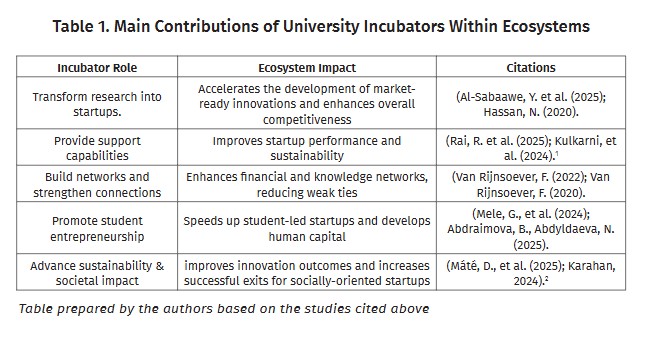
Similarly, incubators that allocate more resources to societal startups tend to demonstrate stronger innovation performance and higher successful exit rates, indicating that aligning commercial objectives with societal goals can enhance both economic and social outcomes.[16]
The following table presents the components of the entrepreneurial ecosystem and their impact on the entrepreneurial experience.
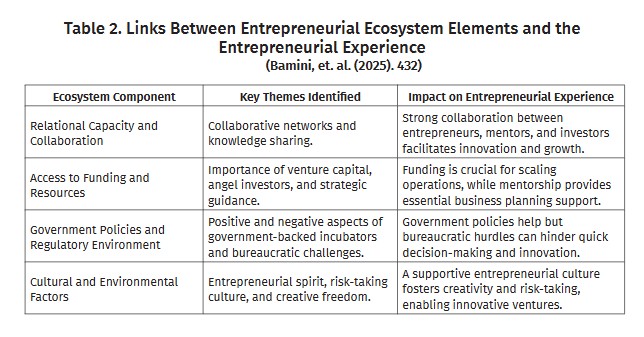
Based on the above, the researchers conclude that university incubators are key nodes in entrepreneurial ecosystems, connecting research to innovation and supporting startup growth. Their success depends on strong networks, access to resources, and integration with the university’s mission, rather than simply following generic models.
- 5. Models and Frameworks for University-Based Incubation
Structural connectivity involves the formal organizational setups, business models, and mechanisms that link the incubator to investors and external partners. Agentic connectivity, on the other hand, depends on the experience and networks of key individuals, such as managers and directors, who connect startups to resources and opportunities through personal relationships. Research shows that the most successful incubators combine both types, with agentic connectivity often laying the groundwork for structural systems to function effectively and sustainably.[17]
Researchers have developed multi-level frameworks to explain the role of university incubators within the entrepreneurial ecosystem. These frameworks focus on three levels: the micro-level for individual founders and startups, the meso-level for the incubator and its immediate support network, and the macro-level for the regional, national, and international ecosystem characteristics.[18] A key example is the I5 Framework, which links Institutions, Industries, Interactions, Innovations, and Incubators, highlighting the importance of proactive university involvement and systematic support for startups. The lifecycle model also shows that incubators[19] start by building basic infrastructure and attracting their first cohorts, and as they mature, they expand their networks and become active orchestrators within the ecosystem.[20]
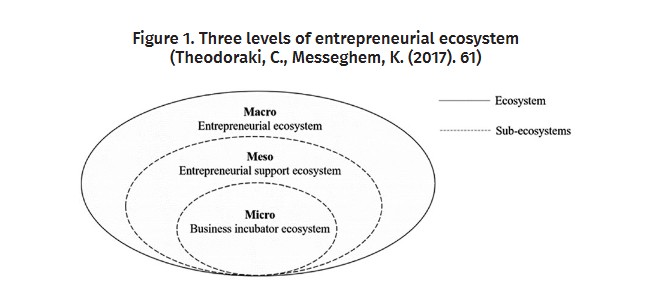
Based on the above, the authors rgue that the success of university incubators depends on combining structural connectivity with personal (agentic) connections, as the relationships of key individuals lay the foundation for effective institutional systems.
They also emphasize that multi-level frameworks, such as the I5 Framework and the lifecycle model, help to understand the role of incubators at individual, organizational, and regional levels, highlighting the importance of active university involvement in supporting innovation and coordinating the entrepreneurial ecosystem sustainably.
6. Comparative Analysis: University Incubators Across Contexts
University incubation models vary considerably according to geographic context, institutional orientation, and levels of economic development. Comparative studies indicate that university incubators in North America, especially in the United States, primarily focus on technology commercialization, attracting external investment, and supporting high-growth startups.[22] This model is reinforced by mature venture capital ecosystems, strong intellectual property protection, and a culture that is generally open to entrepreneurial risk-taking.[23] Nevertheless, these incubators face several challenges, including intense competition to attract promising ventures, strong pressure for rapid financial returns, and the risk of drifting away from their educational mission.
In the European context, university incubators are more diverse in their structures and objectives, reflecting differences in national higher education systems and innovation policies[24]. Many European programs place greater emphasis on regional economic development, social entrepreneurship, and sustainable business models when compared to North American incubators.[25] They also tend to maintain closer relationships with government innovation programs and regional development agencies. However, these programs often encounter limitations such as restricted access to venture capital, complex regulatory frameworks, and, in some cases, cultural environments that are less supportive of entrepreneurial risk-taking.[26]
University incubators operating in emerging and developing economies face unique challenges and opportunities. They frequently function within entrepreneurial ecosystems that are still underdeveloped, characterized by limited venture capital, weak intellectual property protection, and institutional gaps in support infrastructure. At the same time, these incubators play an essential role in addressing local development needs and in stimulating entrepreneurial ecosystems where few alternatives exist. Successful initiatives in these contexts tend to focus on capacity building, adapting to local resource constraints, and finding ways to overcome institutional barriers[27]. Research also highlights innovative practices such as partnerships with international organizations, mobilizing diaspora networks, and adopting hybrid models that link incubation with broader economic development strategies.[28]
Institutional characteristics further influence the design of incubation models. Research-intensive universities with strong science and engineering programs usually emphasize technology commercialization and faculty entrepreneurship[29]. In contrast, teaching-oriented institutions often prioritize student entrepreneurship and regional engagement[30]. Specialized institutions, such as business schools, develop distinctive incubation models by leveraging their specific expertise and professional networks.[31] Overall, evidence suggests that the most effective incubation models are those that align closely with the institution’s mission and strengths, rather than simply adopting generic best practices.[32] Figure 02 illustrates the distribution of business incubators across different countries.[33]
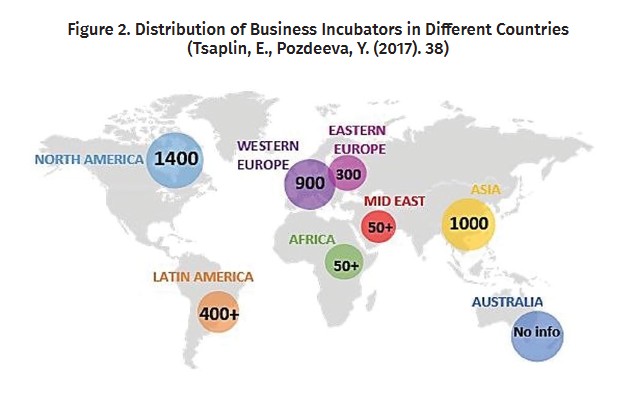
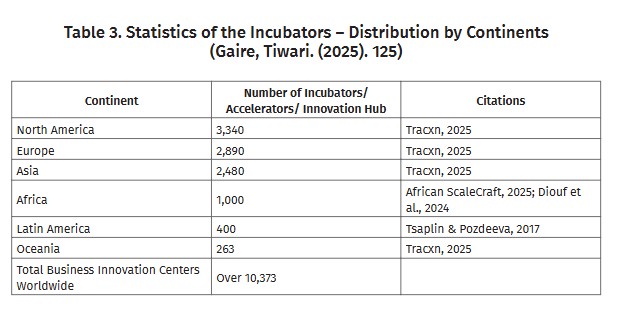
The following table, Reproduced exactly as published in (Gaire, Tiwari (2025)) illustrates the Incubators - Distribution by Continents.[34]
From the literature, it is clear that university incubation models differ widely depending on geographic context, the type of institution, and the level of economic development.
In North America, incubators mainly focus on turning technological innovations into commercial products, attracting external funding, and supporting high-growth startups.
European incubators, on the other hand, tend to emphasize regional development, social entrepreneurship, and sustainable business models. In emerging and developing economies, incubators often face resource constraints and underdeveloped entrepreneurial ecosystems, so they prioritize building local capacities, adapting to limitations, and adopting innovative approaches such as international partnerships and hybrid models. The nature of the institution also shapes the design of incubation programs: research-oriented universities focus on faculty entrepreneurship and technology commercialization, while teaching-focused institutions give more attention to student entrepreneurship and community engagement. Overall, the evidence shows that the most successful incubators are those that align closely with the university’s mission and strengths, rather than simply following generic models.
Conclusion
The entrepreneurial ecosystem plays a fundamental role in providing the necessary infrastructure to support entrepreneurship, including finance, culture, policies, and talent. University incubators operationalize these resources on the ground, transforming ideas and research into scalable startups. They do not merely offer physical space and basic services; they also serve as a bridge connecting academia, industry, and society, facilitating knowledge transfer and developing entrepreneurial skills, thus providing a practical model for how ecosystems can systematically support startup creation, growth, and sustainable innovation.
Evidence shows that university incubators operate within multi-level frameworks combining strong organizational structures, effective leadership, comprehensive support mechanisms, and deep integration with the surrounding ecosystem. They contribute to startup success by reducing operating costs, providing access to specialized resources and expertise, building extensive networks, signaling credibility that attracts investors and partners, and offering educational programs that enhance entrepreneurial capabilities. The outcomes of these programs demonstrate tangible impacts on venture survival, growth, funding success, as well as broader contributions to regional innovation, knowledge transfer, and the development of a strong entrepreneurial culture.
However, university incubators face significant challenges, including difficulties in achieving financial sustainability, the need to coordinate multiple stakeholders, cultural gaps between academic and commercial environments, and dependence on key individuals, which can threaten program continuity
Key Findings
- University incubators transform ideas and research into scalable ventures and connect academia, industry, and society.
- They support startup success through financial resources, expertise, networks, and educational programs.
- They have tangible effects on venture survival, growth, funding success, innovation, and knowledge transfer.
- They face financial, cultural, and managerial challenges that require strategic solutions.
Practical Recommendations
- Develop sustainable funding models to reduce dependence on university support or external grants.
- Strengthen ecosystem integration through systematic stakeholder coordination.
- Build strong leadership and management teams to ensure program continuity and reduce reliance on individuals.
- Adapt to digital and global entrepreneurial environments to expand networks and support innovation.
- Balance multiple objectives, including educational missions, research commercialization, regional development, and financial sustainability.
University incubators are a powerful tool for supporting startups and driving sustainable innovation, as improving their mechanisms strengthens venture success while also advancing regional innovation, economic growth, and societal development.
References:
Abdraimova, B., Abdyldaeva, N. (2025). Business Incubators and Entrepreneurial Education in Universities: the Need for an Integrated Approach. Bulletin of Science and Practice, 11(7). <https://doi.org/10.33619/2414-2948/116/69>;
Al-Sabaawe, Y., Albayati, N., Al-Obaidy, N. (2025). University Industry Incubators: Igniting Global Startup
Revolutions. JBMP (Jurnal Bisnis, Manajemen dan Perbankan), vol. 11, no. 2.
<https://doi.org/10.21070/jbmp.v11i2.2109> ;
Allahar, H. et al. (2019). A University Business School as an Entrepreneurial Ecosystem Hub. Technology Innovation Management Review, vol. 9, no. 11. <https://doi.org/10.22215/timreview/1280>;
Badzinska, E. (2021). Providing a Nurturing Environment for Start-up Incubation: an Explorative Study of a University-based Entrepreneurial Ecosystem. European Research Studies Journal Volume XXIV Special Issue 2, Part 3. <https://doi.org/10.35808/ersj/2701>;
Bamini, J., Choudari, S., Joy, A., Chawla, N., Yabaluri, B., Shankar, S. D., Singh, R. (2025). The Role of
Entrepreneurial Ecosystems in Supporting Startup Growth and Innovation. Journal of Information Systems
Engineering and Management, vol. 10, no. 3. <https://doi.org/10.52783/jisem.v10i3.5002>;
Breznitz, S. M. et al. (2019). Fostering the growth of student start-ups from university accelerators: An entrepreneurial ecosystem perspective. Industrial and Corporate Change, vol. 28, no. 4. <https://doi.org/10.1093/ICC/DTZ033>;
Bronstein, Y. V. et al. (2021). Toward a Framework for University-Based Entrepreneurial Ecosystems and Human Capital Development in Sub-Saharan Africa. In book: Resilience, Entrepreneurship and ICT. <https://doi.org/10.1007/978-3-030-78941-1_2>;
Casanova-Villalba, C. et al. (2025). Modelo de vinculación academia-empresa para facilitar la creación y sostenibilidad de start-ups tecnológicas en Ecuador. Journal of Economic and Social Science Research (JESSR), vol. 5, no. 2. <https://doi.org/10.55813/gaea/jessr/v5/n2/197>;
Gaire, P. N., Tiwari, U. (2025). Evolution and Distribution of Business Incubators: A Literature Review, BIC Journal of Management, 2(1);
Harun, H. et al. (2024). ICCubeX: A Structured University Incubation Model to Accelerate the Lab-to-Market Process. International journal of academic research in business & social sciences, vol. 14, no. 1. <http://dx.doi.org/10.6007/IJARBSS/v14-i1/20546>;
Hassan, N. (2020). University business incubators as a tool for accelerating entrepreneurship: theoretical
perspective. Review of Economics and Political Science, vol. 9, no. 5. <https://doi.org/10.1108/reps-10-2019-0142>;
Jurgelevičius, A. et al. (2025). Developing an entrepreneurial ecosystem framework for student-led start-ups in higher education. Neveléstudomány, 15(7). <https://doi.org/10.3390/educsci15070837>;
Karahan, M. (2024). Advancing sustainable entrepreneurial universities: sustainability transformations of university business incubators in Germany. Small Business Economics. <https://doi.org/10.1007/s11187-023-00860-5;
Kambanou, M., Hajoary, P., Lindfors, A. (2025). Supporting start‐ups in the circular economy: An analysis of university‐led incubators in India. Journal of Industrial Ecology, 29. <https://doi.org/10.1111/jiec.70032>;
Kulkarni, P., Tigadi, B., Gokhale, P., K., L. (2024). University incubators performance through the lens of institutional theory. Vilakshan - XIMB Journal of Management. <https://doi.org/10.1108/xjm-02-2024-0029>;
Ricard, L. et al. (2022). Lacunes et apports des accélérateurs et des incubateurs universitaires aux écosystèmes entrepreneuriaux. Revue organisations & territoires, vol. 31, no. 2. <https://doi.org/10.1522/revueot.v31n2.1482>;
Máté, D., Estiyanti, N., Novotny, Á., Vveinhardt, J. (2025). University business incubators in Indonesia: Navigating commercial viability and societal contributions. Sustainable Futures, vol. 10. <https://doi.org/10.1016/j.sftr.2025.101138>;
Maulidian, R. et al. (2024). Green Entrepreneurship Incubation Model for Students at Trilogy University Business Incubator: A Literature Review. E3S web of conferences, vol. 483, The 3rd International Seminar of Science and Technology (ISST 2023). <https://doi.org/10.1051/e3sconf/202448301017>;
Mazzoni, L., Riccaboni, M., Stam, E. (2025). Entrepreneurial ecosystems and interregional flows of
entrepreneurial talent. Small Business Economics, 65. <https://doi.org/10.1007/s11187-025-01022-5>;
McAdam, M. et al. (2016). Situated regional university incubation: A multi-level stakeholder perspective. Technovation, vol. 50-51. <https://doi.org/10.1016/j.technovation.2015.09.002>;
Mele, G., Sansone, G., Secundo, G., Paolucci, E. (2024). Speeding Up Student Entrepreneurship: The Role of
University Business Idea Incubators. IEEE Transactions on Engineering Management, 71.
<https://doi.org/10.1109/tem.2022.3175655>;
Nicholls-Nixon, C. L. et al. (2021). Entrepreneurial ecosystems and the lifecycle of university business incubators: An integrative case study. International Entrepreneurship and Management Journal, vol. 17, issue 2. <https://doi.org/10.1007/s11365-019-00622-4>;
Patil, S. et al. (2023). I5 Framework: Institutions-Industries-Interactions Innovations-Incubators for Strengthening Start-up Ecosystem in Higher Education Institutions. International Journal of Emerging Technologies in Learning (IJET), vol. 18, no. 8. <https://doi.org/10.3991/ijet.v18i08.36647>;
Rai, R., Prasad, A., Murthy, B. (2025). Incubation support for academia-based entrepreneurship: an empirical study. Journal of Asia Business Studies, vol. 19, no. 2. <https://doi.org/10.1108/jabs-02-2024-0102>;
Sohail, S. et al. (2025). Multi-level entrepreneurial ecosystem framework: Founder, incubator, and country characteristics for start-up performance. Journal of Small Business Management. <https://doi.org/10.1080/00472778.2025.2581669> ;
Spigel, B. (2017). The Relational Organization of Entrepreneurial Ecosystems. Entrepreneurship Theory and Practice, 41(01). <https://doi.org/10.1111/etap.12167>;
Theodoraki, C., Messeghem, K. (2017). Exploring the entrepreneurial ecosystem in the field of entrepreneurial support: a multi-level approach. Int. J. Entrepreneurship and Small Business, vol. 31, no. 1;
Tsaplin, E., Pozdeeva, Y. (2017). International strategies of business incubation: The USA, Germany and Russia. International journal of innovation (IJI Journal), São Paulo, vol. 5, no. 1;
Van Rijnsoever, F. (2020). Meeting, mating, and intermediating: How incubators can overcome weak network
problems in entrepreneurial ecosystems. Research Policy, vol. 49, issue 1, 103884. <https://doi.org/10.1016/j.respol.2019.103884>;
Van Rijnsoever, F. (2022). Intermediaries for the greater good: How entrepreneurial support organizations can
embed constrained sustainable development startups in entrepreneurial ecosystems. Research Policy, vol. 51, issue 2, 104438. <https://doi.org/10.1016/j.respol.2021.104438>;
Vassileva, J., Tsafack Nanfosso, R. (2025). L’incubation entrepreneuriale au sein de l’université entrepreneuriale: Études de cas en Europe et en Afrique. Revue Internationale des Économistes de Langue Française, vol. 10, no. 1. <https://doi.org/10.18559/rielf.2025.1.2277>;
Wright, M. et al. (2017). An emerging ecosystem for student start-ups. Journal of Technology Transfer, vol. 42, no. 4. DOI: <10.1007/s10961-017-9558-z>.
Footnotes
[1] Harun, H. et al. (2024). ICCubeX: A Structured University Incubation Model to Accelerate the Lab-to-Market Process. International journal of academic research in business & social sciences, vol. 14, no. 1, 1339-1354. <http://dx.doi.org/10.6007/IJARBSS/v14-i1/20546>.
[2] Badzinska, E. (2021). Providing a Nurturing Environment for Start-up Incubation: an Explorative Study of a University-based Entrepreneurial Ecosystem. European Research Studies Journal Volume XXIV Special Issue 2, Part 3, 15-29. <https://doi.org/10.35808/ersj/2701>.
[3] Spigel, B. (2017). The Relational Organization of Entrepreneurial Ecosystems. Entrepreneurship Theory and Practice, 41(01), 49-72. <https://doi.org/10.1111/etap.12167>.
[4] Bamini, J., Choudari, S., Joy, A., Chawla, N., Yabaluri, B., Shankar, S. D., Singh, R. (2025). The Role of
Entrepreneurial Ecosystems in Supporting Startup Growth and Innovation. Journal of Information Systems
Engineering and Management, vol. 10, no. 3, 427-434. <https://doi.org/10.52783/jisem.v10i3.5002>.
[5] Mazzoni, L., Riccaboni, M., Stam, E. (2025). Entrepreneurial ecosystems and interregional flows of
entrepreneurial talent. Small Business Economics, 65, 1327-1361. <https://doi.org/10.1007/s11187-025-01022-5>.
[6] Al-Sabaawe, Y., Albayati, N., Al-Obaidy, N. (2025). University Industry Incubators: Igniting Global Startup
Revolutions. JBMP (Jurnal Bisnis, Manajemen dan Perbankan), vol. 11, no. 2, 229-254.
<https://doi.org/10.21070/jbmp.v11i2.2109>.
[7] Mele, G., Sansone, G., Secundo, G., Paolucci, E. (2024). Speeding Up Student Entrepreneurship: The Role of
University Business Idea Incubators. IEEE Transactions on Engineering Management, 71, 2364-2378.
<https://doi.org/10.1109/tem.2022.3175655>.
[8] Van Rijnsoever, F. (2020). Meeting, mating, and intermediating: How incubators can overcome weak network
problems in entrepreneurial ecosystems. Research Policy, vol. 49, issue 1, 103884. <https://doi.org/10.1016/j.respol.2019.103884>.
[9] Van Rijnsoever, F. (2022). Intermediaries for the greater good: How entrepreneurial support organizations can
embed constrained sustainable development startups in entrepreneurial ecosystems. Research Policy, vol. 51, issue 2, 104438. <https://doi.org/10.1016/j.respol.2021.104438>.
[10] Kambanou, M., Hajoary, P., Lindfors, A. (2025). Supporting start‐ups in the circular economy: An analysis of university‐led incubators in India. Journal of Industrial Ecology, 29, 997-1012. <https://doi.org/10.1111/jiec.70032>.
[11] Rai, R., Prasad, A., Murthy, B. (2025). Incubation support for academia-based entrepreneurship: an empirical study. Journal of Asia Business Studies, vol. 19, no. 2, 289-314 (26). <https://doi.org/10.1108/jabs-02-2024-0102>.
[12] Hassan, N. (2020). University business incubators as a tool for accelerating entrepreneurship: theoretical
perspective. Review of Economics and Political Science, vol. 9, no. 5, 434-453. <https://doi.org/10.1108/reps-10-2019-0142>.
[13] Abdraimova, B., Abdyldaeva, N. (2025). Business Incubators and Entrepreneurial Education in Universities: the Need for an Integrated Approach. Bulletin of Science and Practice, 11(7): 481-487. <https://doi.org/10.33619/2414-2948/116/69>.
[14] Karahan, M. (2024). Advancing sustainable entrepreneurial universities: sustainability transformations of university business incubators in Germany. Small Business Economics, 1-35. <https://doi.org/10.1007/s11187-023-00860-5>.
[15] Kulkarni, P., Tigadi, B., Gokhale, P., K., L. (2024). University incubators performance through the lens of institutional theory. Vilakshan - XIMB Journal of Management. <https://doi.org/10.1108/xjm-02-2024-0029>.
[16] Máté, D., Estiyanti, N., Novotny, Á., Vveinhardt, J. (2025). University business incubators in Indonesia: Navigating commercial viability and societal contributions. Sustainable Futures, vol. 10. <https://doi.org/10.1016/j.sftr.2025.101138>.
[17] Ricard, L. et al.(2022). Lacunes et apports des accélérateurs et des incubateurs universitaires aux écosystèmes entrepreneuriaux. Revue organisations & territoires, vol. 31, no. 2. 29-42. <https://doi.org/10.1522/revueot.v31n2.1482>.
[18] Sohail, S. et al. (2025). Multi-level entrepreneurial ecosystem framework: Founder, incubator, and country characteristics for start-up performance. Journal of Small Business Management, 1-31. <https://doi.org/10.1080/00472778.2025.2581669>.
[19] Patil, S. et al. (2023). I5 Framework: Institutions-Industries-Interactions Innovations-Incubators for Strengthening Start-up Ecosystem in Higher Education Institutions. International Journal of Emerging Technologies in Learning (IJET), vol. 18, no. 8, 4-22. <https://doi.org/10.3991/ijet.v18i08.36647>.
[20] Nicholls-Nixon, C. L. et al. (2021). Entrepreneurial ecosystems and the lifecycle of university business incubators: An integrative case study. International Entrepreneurship and Management Journal, vol. 17, issue 2, 809-837. <https://doi.org/10.1007/s11365-019-00622-4>.
[21] Theodoraki, C., Messeghem, K. (2017). Exploring the entrepreneurial ecosystem in the field of entrepreneurial support: a multi-level approach. Int. J. Entrepreneurship and Small Business, vol. 31, no. 1, 61.
[22] Breznitz, S. M. et al. (2019). Fostering the growth of student start-ups from university accelerators: An entrepreneurial ecosystem perspective. Industrial and Corporate Change, vol. 28, no. 4, 855-873. <https://doi.org/10.1093/ICC/DTZ033>.
[23] Wright, M. et al. (2017). An emerging ecosystem for student start-ups. Journal of Technology Transfer, vol. 42, no. 4, 909-922. DOI: <10.1007/s10961-017-9558-z>.
[24] Vassileva, J., Tsafack Nanfosso, R. (2025). L’incubation entrepreneuriale au sein de l’université entrepreneuriale: Études de cas en Europe et en Afrique. Revue Internationale des Économistes de Langue Française, vol. 10, no. 1, 37-55. <https://doi.org/10.18559/rielf.2025.1.2277>.
[25] Maulidian, R. et al. (2024). Green Entrepreneurship Incubation Model for Students at Trilogy University Business Incubator: A Literature Review. E3S web of conferences, vol. 483, The 3rd International Seminar of Science and Technology (ISST 2023). <https://doi.org/10.1051/e3sconf/202448301017>.
[26] Vassileva, J., Tsafack Nanfosso, R. (2025). op. cit.
[27] Bronstein, Y. V. et al. (2021). Toward a Framework for University-Based Entrepreneurial Ecosystems and Human Capital Development in Sub-Saharan Africa. In book: Resilience, Entrepreneurship and ICT. <https://doi.org/10.1007/978-3-030-78941-1_2>.
[28] Casanova-Villalba, C. et al. (2025). Modelo de vinculación academia-empresa para facilitar la creación y sostenibilidad de start-ups tecnológicas en Ecuador. Journal of Economic and Social Science Research (JESSR), vol. 5, no. 2, 189-204. <https://doi.org/10.55813/gaea/jessr/v5/n2/197>.
[29] Harun, H. et al. (2024). op. cit.
[30] Jurgelevičius, A. et al. (2025). Developing an entrepreneurial ecosystem framework for student-led start-ups in higher education. Neveléstudomány, 15(7), 837. <https://doi.org/10.3390/educsci15070837>.
[31] Allahar, H. et al. (2019). A University Business School as an Entrepreneurial Ecosystem Hub. Technology Innovation Management Review, vol. 9, no. 11, 15-25. <https://doi.org/10.22215/timreview/1280>.
[32] McAdam, M. et al. (2016). Situated regional university incubation: A multi-level stakeholder perspective. Technovation, vol. 50-51, 69-78. <https://doi.org/10.1016/j.technovation.2015.09.002>.
[33] Tsaplin, E., Pozdeeva, Y. (2017). International strategies of business incubation: The USA, Germany and Russia. International Journal of Innovation (IJI Journal), São Paulo, vol. 5, no. 1, 38.
[34] Gaire, P. N., Tiwari, U. (2025). Evolution and Distribution of Business Incubators: A Literature Review, BIC Journal of Management, 2(1), 125.
Downloads
ჩამოტვირთვები
გამოქვეყნებული
გამოცემა
სექცია
ლიცენზია

ეს ნამუშევარი ლიცენზირებულია Creative Commons Attribution-ShareAlike 4.0 საერთაშორისო ლიცენზიით .
როგორ უნდა ციტირება
Share