
From Individual to Collective: A Critical Review of Technology Acceptance and Organizational Knowledge
DOI:
https://doi.org/10.35945/gb.2026.21.005Keywords:
Technology Acceptance Model, organizational knowledge, information technologyAbstract
The Technology Acceptance Model is one of the most employed frameworks applied by academics worldwide to explain why individuals accept or do not use technology. Since then, several studies have confirmed the influence of Internal Beliefs on Attitude and Behavioral Intention toward technology, preceded by a wide range of external factors. Domain-relevant knowledge is a crucial external factor in determining users’ behavioral intention to use enterprise resource technology systems, corroborating findings from the technology acceptance model. From a literature scope review, we explore a different and complementary approach regarding knowledge, not only as an external factor, but as a component of the organizational cycle of knowledge creation. The consideration of organizational knowledge creation processes and the nature of the technology used by individuals may bring new light to behavioral intention studies, tying together different study fields, and allowing further academic research work to provide constructive insights and contributions in the quest to determine where the individual’s technology acceptance fits in dynamic organizational knowledge creation.
Keywords: Technology Acceptance Model, organizational knowledge, information technology.
Introduction
The proliferation of knowledge and information technologies has profoundly reshaped work and economic structures,[1] transforming practices across industries and professions.[2] The main reason behind the development and adoption of technologies in organizations is the increase in human efficiency and effectiveness in the practice of routines.[3] The advancement of information system technologies enables organizations to enhance efficiency, reduce costs, and improve information management, strengthening decision-making and enabling novel operational capabilities,[4] making research on the adoption and use of systems relevant in academic and working realms.
Research on individual information system adoption is mature, providing established theories that explain adoption determinants and emphasizing the significance of technology acceptance behavior for successful system implementation.[5] The Technology Acceptance Model (TAM) is a widely recognized and highly predictive framework for understanding technology adoption and use,[6] characterized by its parsimony, specific constructs, robust theoretical foundation, applied across various technologies, expertise levels, and countries.[7]
While individual system use is often considered voluntary, organizational contexts frequently dictate adoption, driven by organizational needs rather than solely individual beliefs.[8] Consequently, organizational technology acceptance reflects both individual preferences and organizational dynamics that foster knowledge development.[9] The use of information systems can involve individuals in organizational knowledge creation, where systems process and disseminate information, thereby amplifying knowledge scope.[10] Outside organizational contexts, understanding adoption at an individual level has limited practical value.[11] Recognizing these organizational and individual factors within firms, this paper investigates the influence of organizational dynamics and information system characteristics on individual technology acceptance.
This research integrates literature conceptualization findings from the TAM with the Organizational Dynamic Knowledge Creation theory to understand the evolution of beliefs and intentions toward information systems as a process shaped by organizational dynamics driving knowledge creation. This study highlights findings in the literature of the potential influence of organizational group-thinking on individual adoption, a recognized limitation in TAM research.[12]
The present manuscript is divided as follows: We first work on finding organizational knowledge creation factors explored and considered in technology acceptance theory literature. By applying a scope analysis, we aim to provide an organizational explanation to technology acceptance factors, such as behavioral intention, beliefs, and attitude, followed by a conceptualization of organizational knowledge from a technology individual use perspective. Finally, we close by elaborating on discussion points regarding organizational dynamics and technology acceptance and providing theoretical and practical implications.
1. Literature Review
1.1. Technology Acceptance Model
The TAM aims to capture critical aspects of information technology through a set of quantitative surrogates -beliefs, attitudes, and intention - to understand what motivates users to accept and use new technology.[13] The judgments regarding the usefulness and ease of use of a technology generate behavioral intentions that affect the individual’s willingness to use and the actual use behavior.[14] The TAM is deemed capable of explaining user behavior across a broad range of research contexts[15] while at the same time being both parsimonious and theoretically justified[16] thanks to its core variables – perceived usefulness and perceived ease of use,[17] with substantial empirical support.[18]
1.2. Behavioral intention
Behavioral Intention (BI) is a function of salient information or beliefs set to measure the strength of an individual’s intention to perform a specified behavior.[19] The TAM postulates that BI is the major determinant of usage behavior; that behavior should be predictable from measures of BI, and any other factors influencing use behavior do so indirectly by influencing BI.[20] Technology use intention is based on the rational intention that captures the motivational factors that influence users’ behavior, indicating how much effort an individual could exert to perform a behavior[21] and to initiate and formalize knowledge.[22] Technology use, action, and practice[23] are the factors that give shape to the flow of information acquired by individuals, organizing and creating knowledge, anchored on the commitment and beliefs of the holder.[24]
An undesirable outcome of the application of the TAM has been the intensive focus on the prediction or explanation of system use, defined and operationalized as an amount or frequency.[25] In fact, most system acceptance studies do not measure system use, but rather measure variance in self-reported use, hence the construct Intention becomes a non-precise measure of actual system use.[26] The relationship between intention and usage appears to be dependent on the measurement method: when usage is measured as self-report, intentions do predict usage, but when actual usage is measured, intentions do not predict usage.[27] In theory, the construct Intention must work as a precise measure of future, or even present use; however, it rather shows different results in the literature.[28] TAM measures of behavioral intention are not focused on an overall behavioral measure; hence, the interpretation of the TAM must keep in mind a “narrower conceptualization of intended behavior”.[29] Literature explains that time is the basis of the difference between intentions and action;[30] in this way, when intentions measure system’s pre-implementation usage, they cannot include the additional information that the subjects may acquire by the time of the post-implementation intention measures, information accumulated by experiencing system use.[31] By treating BI as a terminal goal for human action, researchers fail to consider the fact that several actions are taken not as ends in and of themselves, rather as means of more fundamental ends or goals.[32]
1.3. Beliefs
In TAM, beliefs are defined as the individual’s subjective probability that performing a target behavior will result in a certain consequence,[33] suggesting two main determinants: Perceived Ease of Use (PEOU) and Perceived Usefulness (PU). PEOU indicates the cognitive effort needed to learn and to utilize the new system, while PU measures the individual subjective assessment of the utility offered by the new system,[34] with PEOU being an antecedent of PU.[35]
As users’ beliefs about their ability to successfully complete tasks by using a system increase, they will perceive the system as being easier to use.[36] Similarly, as users’ beliefs about the positive relationship between system’s use and performance increase, they will perceive that using a system provides benefits within organizational contexts.[37] TAM literature conceptualizes a hierarchy between the two belief variables, where PU is a major determinant of people’s intentions to use a system, while PEOU works on a secondary level.[38] The implication of this hierarchy of beliefs is that, unless users perceive a system as being useful at first, its ease of use has no effect on the formation of intentions; however, ease of use does have some effect on how useful an individual perceives a system,[39] it doesn’t matter for them how easy it could be to operate the system if it does not perform a useful function within their organizational context.[40] Likewise, the more experience regarding system use over time, the less relevant the system’s ease of use will be, while, at the same time, it will increase the beliefs of the system’s usefulness,[41] leading to knowledge from a process of creation and manipulation of beliefs that conveys to users with perspectives that help them with their context’s perceptions and definitions.[42]
1.4. Attitude
Attitude is defined as an individual’s positive or negative feelings about performing a target behavior.[43] Attitude as a predictor of human behavior is determined by the product of the user’s salient beliefs about the consequences of performing the behavior multiplied by the evaluation of those consequences.[44] Both intention and behavior are motivated by attitude as an overall affective evaluation toward a system, based on a set of cognitive beliefs about the system in question.[45] Individuals with higher levels of knowledge about a system will manifest enhanced beliefs about the system’s perceived ease of use and perceived usefulness, subsequently influencing a stronger attitude toward it.[46]
Revised versions of the TAM make no consideration of attitude as a predictor of behavioral intention.[47] Within organizational settings, system users form intentions toward behaviors they believe will increase their job performance, over and above whatever positive or negative feeling may be evoked toward the very behavior.[48] Hence, the attitude formed by personal beliefs about a system is of secondary relevance regarding the intention of using a system to perform job-related operations.[49] Direct belief-intention relationships have been observed, contrary to the fact that attitudes fully mediate the effects of beliefs on intention.[50]
1.5. Organizational knowledge
From an organizational perspective, knowledge refers to the relatively formal and facts, rules, policies, and procedures within the organization,[51] as an emergent product of a situated context of individuals’ lives and work.[52] Every activity performed by people working in an organization creates and gives shape to the organization’s knowledge. The creation, transfer, and integration of knowledge is an important reason firms exist,[53] being embedded in the skills of employees, as well as in processes, policies, and information repositories.[54]
Organizations exist because they reduce the cost of using the “price mechanism” to organize production and the cost of negotiating and concluding transactions individually.[55] To solve economic problems by constructing “a rational economic order”, individuals within an organization “must make use of the knowledge of circumstances” that exists dispersed, incomplete, and frequently contradictory by individuals.[56] Securing the best use of knowledge implies communication between individuals aimed at building mutual understanding; thus, the communication factor of knowledge consequently builds, amplifies, and develops new knowledge from individuals within the organization.[57] Communication among individuals leads to organizational alignment of mission, objectives, and plans,[58] creating knowledge readily available that enhances individuals’ information-processing capabilities in a great way.[59]
By establishing communities with shared identity, norms, sequences, and patterns, organizations lower the cost of communication and coordination of knowledge, creating a shared knowledge context that enables the development of new knowledge and capabilities through the recombination of existing knowledge,[60] fostering regular and predictable patterns of activity -organizational routines- that govern coordinated activities within organizations.[61] Thus, decision making in group contexts refers to acting out of congruence between one’s own and group’s shared values or goals, in a process of internalization that is developed through processes of socialization, psychological development, education, training, and indoctrination in organizations, developing a combination of compliance and internalization within the reference group, operating when a person sees oneself as an individual but in a relationship to a group.[62]
Collective intentions related to technology acceptance are rooted in everyone’s self-conception as a member of an organization, where the individual’s actions are conceived as either the group acting as a unit or the person acting as an agent of the group.[63] Such collective behavior can be understood thanks to the concept of organizational commitment, which represents a psychological bond that individuals form with an organization that stabilizes their behaviors toward the organization. Thus, regarding organizational knowledge and acceptance of technology, the limitation of TAM, as a technology proxy study, deals with technologies through surrogates -factors that conceptualize internal beliefs, attitudes, and intentions toward technologies-, it tends not to conceive of historical or cultural variations in information technology artifacts, given that those variations may not be evident in the surrogates’ measures.[64]
2. Discussions
2.1. The sufficiency of the Technology Acceptance Model
Much of human behavior is not best characterized by an individual action in isolation, where decisions regarding technology acceptance and actual usage are often made collaboratively or with an aim to how they fit in with, or affect other people or group requisites.[65] A limitation of the TAM is the fact that the model considers information system acceptance to be an independent individual issue rather than part of organizational dynamics.[66] Therefore, while measuring individual intentions, how to ensure the consideration of organizational knowledge effects? Figure 1 illustrates the proposed path within the theorized influence of knowledge on behavior: knowledge gain system and training affect users’ beliefs about their own ability to successfully use a system, the amount of effort required to use a system, and the direct benefits of using a system, beliefs that in turn shape the overall attitude toward the system, and ultimately influence their intentions and behaviors.
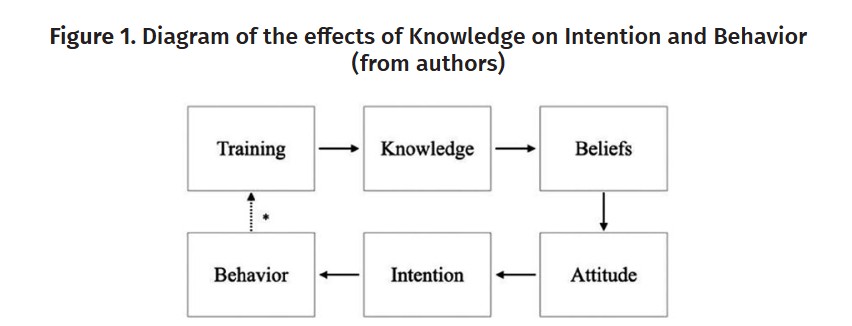
* The work from Mullins & Cronan (2021) addresses the importance of domain-relevant knowledge in the formation of beliefs and attitudes toward a system, developing a model of informed technology acceptance. The hypothesized path form Behavior to Training responds to the process of amplification of knowledge created by individuals, crystallizing it as part of the knowledge network of the organization (Nonaka, 1994)
Over the years, the individual construct additions made to the TAM have been justified by researchers; however, in the final analysis, this construct-addition approach has basically provided explanations or antecedents for the core TAM belief perceptions -PU and PEU- via another set of belief perceptions, without increasing the knowledge of what makes an information technology useful,[67] lacking the means to account for temporal and contextual variations in socio-psychological and socio-economical patterns.[68]
To continue using the life-long TAM constructs in a changing technology context threatens our capability to understand present and future phenomena.[69] Some other limitations present in most of the TAM research works are related to self-reported use as a measurement of actual use, for it does not accurately reflect actual behavior and actual usage.[70] The constructs employed in technology acceptance research are inferred indirectly from behavioral proxies rather than measured explicitly, creating a sense of speculation about their conclusions.[71]
2.2. The relevance of organizational knowledge in technology acceptance
Based on the resource-based view of the firm, organizational knowledge creates competitive advantage and organizational capability, comprising the training, experience, relationships, and insights of organizational human resources.[72] Information technologies do not influence organizations’ performance directly, but the relationships existing between these technologies and other resources and organizational capabilities mediate the value creation process.[73] The knowledge derived from individual use of technology may not only contribute to organizational performance, but also the organization’s workflow may depend more heavily on the individual’s knowledge.[74] The account for the impact of organizational dynamics that create knowledge within the organization is yet to be addressed by employing quantitative methods in academic literature. Hence, we propose the continuation of research work on this field, furthermore needed due to the new holistic capabilities from modern information systems employed in organizations.
2.3. The relevance of the information technology instrument in technology acceptance
The core premise of information system studies is based on the centrality of emerging technologies reshaping management practices and changing the nature of work in an organization.[75] However, the economic analysis of technological innovation includes several factors that might be expected to influence innovation, except for any discussion of the technology itself.[76]
The implementation and effective application of information systems must follow a correct analysis of how the technological instrument fits within the dynamics of the organization and how this implementation process is going to affect such dynamics, following a pattern where the management proceeds with disjoint periods of intensive implementation, rather than with continuous improvement.[77] The fact that information systems are becoming increasingly complex has implications for IT adoption decision processes and managerial implementation decisions,[78] where organizational institutions and processes support the sharing of knowledge within institutions and facilitate collaboration in linking available knowledge into practice.[79] Therefore, it is important to mention that the proper application of technological change in an organization requires important leadership skills, such as awareness, acceleration, and harmonization of digital transformation.[80]
3. Limitations
While this review provides a comprehensive analysis of existing literature, we acknowledge certain limitations.
Firstly, despite the theoretical proposition of a link between “Behavior” and “Training” within our framework (as depicted in Figure 1), the current review is constrained by the absence of quantitative data to empirically validate this hypothesized relationship. While literature provides conceptual support for this connection, the lack of quantitative evidence requires further investigation. A mixed-methods approach, combining qualitative literature insights with quantitative empirical evidence, would offer a more comprehensive understanding of the organizational nature of technology acceptance.
Secondly, this research has focused on examining the constructs within the TAM and their relevance to organizational knowledge creation dynamics. While this analysis provides valuable insights, it does not include a comparative analysis of other important technology acceptance models and their applicability to understanding organizational knowledge creation. Future academic work could explore alternative models, such as the Unified Theory of Acceptance and Use of Technology (UTAUT) or the Innovation Diffusion Theory, in the context of organizational knowledge dynamics, offering a more comprehensive understanding of different perspectives on technological adoption within organizations and its impact on knowledge creation processes.
Thirdly, the well-established nature of technology acceptance theories presents both advantages and limitations. TAM literature provides a robust theoretical foundation, but it also raises the potential for findings to appear repetitive, diminishing the perceived novelty of current research. This review focuses on analyzing influential publications within the TAM domain to explore evidence of the organizational character of individual technology adoption in renowned academic papers. By re-evaluating these established contributions through the lens of organizational knowledge creation, this research aims to offer a fresh perspective on the insights provided by these foundational works, acknowledging the evolutionary nature of academic inquiry, where established theories are continually re-examined and re-interpreted, considering evolving organizational contexts.
Conclusion
From a thorough scoping review of academic literature, we conclude that individual information system acceptance is shaped by organizational dynamics that create and amplify organizational knowledge. There is sufficient evidence in the literature to affirm that the acceptance and use of information systems in organizational contexts respond to organizational goals and commitments rather than individual beliefs and attitudes alone. Likewise, users adapt their behavior and use practices to the complex characteristics of modern information systems, which not only serve a single determined task, but combine several levels of action to collect, process, analyze, share, visualize, and recommend improvement at once.
Technology acceptance is a vibrant field of academic research, much needed to bring understanding of the fast-paced development of technologies that become more complex and autonomous. Investigating current trends in technology adoption by applying older methods, such as TAM, could impact the credibility of the studies by resulting in reporting significant results that may not happen when applying novel methods. Thus, the need to perform analysis with different models and methodologies and comparing the results of the mentioned could bring a clear understanding of current technology acceptance that shows change over time.
References:
- Ajzen, I. (1991). The Theory of Planned Behavior. Organizational Behavior and Human Decision Processes, 50(2);
- Alsharida, R. A., Hammood, M. M., Al-Emran, M. (2021). Mobile Learning Adoption: A Systematic Review of the Technology Acceptance Model from 2017 to 2020. International Journal of Emerging Technologies in Learning, 16(5);
- Anthony, C. (2018). To Question or Accept? How Status Differences Influence Responses to New Epistemic Technologies in Knowledge Work. Academy of Management Review, 43(4);
- Bagozzi, R. P. (2007). The Legacy of the Technology Acceptance Model and a Proposal for Paradigm Shift. Journal of the Association for Information Systems, 8(4);
- Bandura, A. (2001). Social Cognitive Theory: An Agentic Perspective. Annual Review of Psychology, 52;
- Benbasat, I., Barki, H. (2007). Quo Vadis, TAM? Journal of the Association for Information Systems, 8(4);
- Bharadwaj, A. S. (2000). A Resource-Based Perspective on Information Technology Capability and Firm Performance: An Empirical Investigation. MIS Quarterly, 24(1);
- Coase, R. H. (1937). The Nature of the Firm. Economica. Blackwell Publishing, 4(16);
- Compeau, D., Correia, J., Thatcher, J.B. (2022). When Constructs Become Obsolete: A Systematic Approach to Evaluating and Updating Constructs for Information Systems Research. MIS Quarterly, 46(2);
- Davis, F., Bagozzi, R., Warshaw, P. (1989). User Acceptance of Computer Technology: A Comparison of Two Theoretical Models. Management Science, 35(8);
- Felipe, C. M., Leidner, D. E., Roldan, J. L., Leal-Rodriguez, A. L. (2020). Impact of IS Capabilities on Firm Performance: The Roles of Organizational Agility and Industry Technology Intensity. Decision Sciences, 51(3);
- Figueiredo, D., Schonewille, M. (2025). Instructor-centered Case Generation with GenAI: A Design-based Exploration. Journal of Ethics in Entrepreneurship and Technology. <DOI:10.1108/JEET-06-2025-0038>;
- Gefen, D., Kaharanna, E., Straub, D. W. (2003). Trust and TAM in Online Shopping: An Integrated Model. MIS Quarterly, 27 (1);
- Hanelt, A., Bohnsack, R., Marz, D., Antunes Marante, C. (2021). A Systematic Review of the Literature on Digital Transformation: Insights and Implications for Strategy and Organizational Change. Journal of Management Studies, 58(5);
- Hayek, F. A. (1945). The Use of Knowledge in Society. American Economic Review, 35(4);
- Jen, W., Lu, T., Liu, P. T. (2009). An Integrated Analysis of Technology Acceptance Behavior Models: Comparison of Three Major Models. MIS Review, 15(1);
- Karim, S., Kaul, A. (2015). Structural Recombination and Innovation: Unlocking Intraorganizational Knowledge Synergy Through Structural Change. Organization Science, 26(2);
- Kork, A-A., Martinnen, M., Laihonen, H., Ruusuvuori, J., Ahonen, J. E., and Kankaanpää, E. (2025). Implementing Clinical Practice Guidelines into Action: A Qualitative Study of Managing Knowledge Translation in Primary Care Organizations. Health Research Policy and Systems (2025) 23:130. <DOI:10.1186/s12961-025-01402-z>;
- Legris, P., Ingham, J., Collerette, P. (2003). Why do People use Information Technology? A Critical Review of the Technology Acceptance Model. Information & Management, 40 (2003);
- Monteiro, E., Parmiggiani, E. (2019). Synthetic Knowledge: The Politics of the Internet of Things. MIS Quarterly, 43(1);
- Muller, S., von Kramer, A., Tonnies, J., Wildenauer, A., Wensing, M., Friederich, H. C., Haun, M. K. (2025). Engaging Underrepresented Patient Groups in Specialized Treatment – Qualitative Results from the PROVIDE-C Randomized Trial on Integral Mental Health Video Consultations for Depression and Anxiety. BMC Public Health (2025) 25:3817. <DOI:10.1186/s12889-025-25235-1>;
- Mullins, J. K., Cronan, T. P. (2021). Enterprise Systems Knowledge, Beliefs, and Attitude: A Model of Informed Technology Acceptance. International Journal of Information Management, 59 (2021), 102348;
- Murray, A., Rhymer, J., Sirmon, D.G. (2021). Humans and Technology: Forms of Cojoined Agency in Organizations. Academy of Management Review, 46(3);
- Nass, C. (1994). Knowledge or Skills: Which do Administrators Learn from Experience? Organization Science, 5(1);
- Nonaka, I. (1994). A Dynamic Theory of Organizational Knowledge Creation. Organization Science, 5(1).
- Orlikowski, W., Iacono, C. S. (2001). Research Commentary: Desperately Seeking the “IT” in IT Research - A Call to Theorizing the IT Artifact. Information Systems Research, 12(2);
- Philip, J. (2022). A Perspective of Embracing Emerging Technologies Research for Organizational Behavior. Organization Management Journal, 19(3);
- Powell, W. W., Snellman, K. (2004). The Knowledge Economy. Annual Review of Sociology, (30);
- Reich, B. H., Benbasat, I. (2000). Factors that Influence the Social Dimension of Alignment Between Business and Information Technology Objectives. MIS Quarterly, 24(1);
- Stadler, C., Helfat, C., Verona, G. (2022). Transferring Knowledge by Transferring Individuals: Innovative Technology Usage and Organizational Performance in Multi-Unit Firms. Organizational Science, 33(1);
- Swanson, E. B. (2019). Technology as a Routine Capability. MIS Quarterly, 43(3);
- Szajna, B. (1996). Empirical Evaluation of the Revised Technology Acceptance Model. Management Science, 42(1);
- Venkatesh, V., Bala, H. (2008). Technology Acceptance Model 3 and a Research Agenda on Interventions. Decision Sciences, 39(2);
- Yang, L., Sheng, X., Lin, J., Wang, W., Wu, W., Lin, R., Liu, A., Liu, L. (2025). Acceptance Scale for Traditional Chinese Medicine Techniques in Cancer Patients: Development and Validation. Patients: Preference and Adherence, 2025(19). <DOI:10.2147/PPA.S550541>.
Footnotes
[1] Powell, W. W., Snellman, K. (2004). The Knowledge Economy. Annual Review of Sociology, (30), 199-220.
[2] Swanson, E. B. (2019). Technology as a Routine Capability. MIS Quarterly, 43(3), 1007-1024.
[3] Murray, A., Rhymer, J., Sirmon, D.G. (2021). Humans and Technology: Forms of Cojoined Agency in Organizations. Academy of Management Review, 46(3), 552-571.
[4] Anthony, C. (2018). To Question or Accept? How Status Differences Influence Responses to New Epistemic Technologies in Knowledge Work. Academy of Management Review, 43(4), 661-679.
[5] Jen, W., Lu, T., Liu, P. T. (2009). An Integrated Analysis of Technology Acceptance Behavior Models: Comparison of Three Major Models. MIS Review, 15(1), 89-121.
[6] Venkatesh, V., Bala, H. (2008). Technology Acceptance Model 3 and a Research Agenda on Interventions. Decision Sciences, 39(2), 273-315.
[7] Gefen, D., Kaharanna, E., Straub, D. W. (2003). Trust and TAM in Online Shopping: An Integrated Model. MIS Quarterly, 27 (1), 51-90.
[8] Davis, F., Bagozzi, R., Warshaw, P. (1989). User Acceptance of Computer Technology: A Comparison of Two Theoretical Models. Management Science, 35(8), 982-1003.
[9] Nonaka, I. (1994). A Dynamic Theory of Organizational Knowledge Creation. Organization Science, 5(1), 14-37.
[10] Ibid.
[11] Venkatesh, V., Bala, H. (2008). Ibid.
[12] Mullins, J. K., Cronan, T. P. (2021). Enterprise Systems Knowledge, Beliefs, and Attitude: A Model of Informed Technology Acceptance. International Journal of Information Management, 59 (2021), 102348.
[13] Orlikowski, W., Iacono, C. S. (2001). Research Commentary: Desperately Seeking the “IT” in IT Research - A Call to Theorizing the IT Artifact. Information Systems Research, 12(2), 121-134.
[14] Yang, L., Sheng, X., Lin, J., Wang, W., Wu, W., Lin, R., Liu, A., Liu, L. (2025). Acceptance Scale for Traditional Chinese Medicine Techniques in Cancer Patients: Development and Validation. Patients: Preference and Adherence, 2025(19), 305-3225. <DOI:10.2147/PPA.S550541>.
[15] Muller, S., von Kramer, A., Tonnies, J., Wildenauer, A., Wensing, M., Friederich, H. C., Haun, M. K. (2025). Engaging Underrepresented Patient Groups in Specialized Treatment – Qualitative Results from the PROVIDE-C Randomized Trial on Integral Mental Health Video Consultations for Depression and Anxiety. BMC Public Health (2025) 25:3817. <DOI:10.1186/s12889-025-25235-1>.
[16] Davis et al. (1989). Ibid.
[17] Alsharida, R. A., Hammood, M. M., Al-Emran, M. (2021). Mobile Learning Adoption: A Systematic Review of the Technology Acceptance Model from 2017 to 2020. International Journal of Emerging Technologies in Learning, 16(5), 147-162.
[18] Venkatesh, V., Bala, H. (2008). Ibid.
[19] Davis et al. (1989). Ibid.
[20] Ibid.
[21] Ajzen, I. (1991). The Theory of Planned Behavior. Organizational Behavior and Human Decision Processes, 50(2), 179-211.
[22] Nonaka, I. (1994). Ibid.
[23] Monteiro, E., Parmiggiani, E. (2019). Synthetic Knowledge: The Politics of the Internet of Things. MIS Quarterly, 43(1), 167-184.
[24] Nonaka, I. (1994). Ibid.
[25] Benbasat, I., Barki, H. (2007). Quo Vadis, TAM? Journal of the Association for Information Systems, 8(4), 211-218.
[26] Legris, P., Ingham, J., Collerette, P. (2003). Why do People use Information Technology? A Critical Review of the Technology Acceptance Model. Information & Management, 40 (2003), 191-204.
[27] Szajna, B. (1996). Empirical Evaluation of the Revised Technology Acceptance Model. Management Science, 42(1), 85-92.
[28] Legris et al. (2003). Ibid.
[29] Gefen et al. (2003). Ibid.
[30] Bandura, A. (2001). Social Cognitive Theory: An Agentic Perspective. Annual Review of Psychology, 52, 1-26.
[31] Szajna, B. (1996). Ibid.
[32] Bagozzi, R. P. (2007). The Legacy of the Technology Acceptance Model and a Proposal for Paradigm Shift. Journal of the Association for Information Systems, 8(4), 244-254.
[33] Davis et al. (1989). Ibid.
[34] Gefen et al. (2003). Ibid.
[35] Venkatesh, V., Bala, H. (2008). Ibid.
[36] Mullins, J. K., Cronan, T. P. (2021). Ibid.
[37] Davis et al. (1989). Ibid.
[38] Ibid.
[39] Szajna, B. (1996). Ibid.
[40] Davis et al. (1989). Ibid.
[41] Venkatesh, V., Bala, H. (2008). Ibid.
[42] Nonaka, I. (1994). Ibid.
[43] Davis et al. (1989). Ibid.
[44] Ibid.
[45] Mullins, J. K., Cronan, T. P. (2021). Ibid.
[46] Ibid.
[47] Venkatesh, V., Bala, H. (2008). Ibid.
[48] Davis et al. (1989). Ibid.
[49] Szajna, B. (1996). Ibid.
[50] Venkatesh, V., Bala, H. (2008). Ibid.
[51] Nass, C. (1994). Knowledge or Skills: Which do Administrators Learn from Experience? Organization Science, 5(1), 38-50.
[52] Monteiro, E., Parmiggiani, E. (2019). Ibid.
[53] Karim, S., Kaul, A. (2015). Structural Recombination and Innovation: Unlocking Intraorganizational Knowledge Synergy Through Structural Change. Organization Science, 26(2), 439-455.
[54] Bharadwaj, A. S. (2000). A Resource-Based Perspective on Information Technology Capability and Firm Performance: An Empirical Investigation. MIS Quarterly, 24(1), 169-196.
[55] Coase, R. H. (1937). The Nature of the Firm. Economica. Blackwell Publishing, 4(16), 386-405.
[56] Hayek, F. A. (1945). The Use of Knowledge in Society. American Economic Review, 35(4), 519-520.
[57] Nonaka, I. (1994). Ibid.
[58] Reich, B. H., Benbasat, I. (2000). Factors that Influence the Social Dimension of Alignment Between Business and Information Technology Objectives. MIS Quarterly, 24(1), 81-113.
[59] Nass, C. (1994). Ibid.
[60] Karim, S., Kaul, A. (2015). Ibid.
[61] Bharadwaj, A. S. (2000). Ibid.
[62] Bagozzi, R. P. (2007). Ibid.
[63] Ibid.
[64] Orlikowski, W., Iacono, C. S. (2001). Ibid.
[65] Bagozzi, R. P. (2007). Ibid.
[66] Legris et al. (2003). Ibid.
[67] Benbasat, I., Barki, H. (2007). Ibid.
[68] Orlikowski, W., Iacono, C. S. (2001). Ibid.
[69] Compeau, D., Correia, J., Thatcher, J.B. (2022). When Constructs Become Obsolete: A Systematic Approach to Evaluating and Updating Constructs for Information Systems Research. MIS Quarterly, 46(2), 679-711.
[70] Szajna, B. (1996). Ibid.
[71] Figueiredo, D., Schonewille, M. (2025). Instructor-centered Case Generation with GenAI: A Design-based Exploration. Journal of Ethics in Entrepreneurship and Technology. <DOI:10.1108/JEET-06-2025-0038>.
[72] Bharadwaj, A. S. (2000). Ibid.
[73] Felipe, C. M., Leidner, D. E., Roldan, J. L., Leal-Rodriguez, A. L. (2020). Impact of IS Capabilities on Firm Performance: The Roles of Organizational Agility and Industry Technology Intensity. Decision Sciences, 51(3), 575-619.
[74] Stadler, C., Helfat, C., Verona, G. (2022). Transferring Knowledge by Transferring Individuals: Innovative Technology Usage and Organizational Performance in Multi-Unit Firms. Organizational Science, 33(1), 253-274.
[75] Philip, J. (2022). A Perspective of Embracing Emerging Technologies Research for Organizational Behavior. Organization Management Journal, 19(3), 88-98.
[76] Orlikowski, W., Iacono, C.S. (2001). Ibid.
[77] Legris et al. (2003). Ibid.
[78] Venkatesh, V., Bala, H. (2008). Ibid.
[79] Kork, A-A., Martinnen, M., Laihonen, H., Ruusuvuori, J., Ahonen, J. E., and Kankaanpää, E. (2025). Implementing Clinical Practice Guidelines into Action: A Qualitative Study of Managing Knowledge Translation in Primary Care Organizations. Health Research Policy and Systems (2025) 23:130. <DOI:10.1186/s12961-025-01402-z>.
[80] Hanelt, A., Bohnsack, R., Marz, D., Antunes Marante, C. (2021). A Systematic Review of the Literature on Digital Transformation: Insights and Implications for Strategy and Organizational Change. Journal of Management Studies, 58(5), 1159-1197.
Downloads

Published
Issue
Section
License

This work is licensed under a Creative Commons Attribution-ShareAlike 4.0 International License.
How to Cite
Share