
International Commodity Price Shocks and the Inflation, Consumption, and Investment Effects in Africa
DOI:
https://doi.org/10.35945/gb.2026.21.001Keywords:
Commodity prices, inflation, investment, consumption, Africa, local projectionsAbstract
African countries’ participation in the global value chain and trade has evolved steadily. Amidst the recent spike in commodity prices, this trend has important implications for the propagation of trade-price shocks in African economies. This study examines how commodity price shocks shape inflation, consumption, and investment in Africa. We find that the effects of commodity price shocks on inflation, consumption, and investment exhibit significant heterogeneity and qualitative commonalities across countries. We tested the possibility that different commodities may have a disparate bearing on a country’s economic development. The analysis shows that price increases in all commodity types - energy, non-energy, and food commodities–produce similar influences qualitatively, but not in magnitude. Interestingly, non-energy commodities exert greater quantitative effects than energy commodities. Our results indicate that, in most instances, disruptions in the international commodity market may reflect global economic uncertainty, with attendant effects on consumption, investment, and policy decisions in the domestic economy.
Keywords: Commodity prices, inflation, investment, consumption, Africa, local projections.
JEL classification: C22, E21, E22, E31, F62, Q02.
Introduction
The global economy has increasingly been characterized by internationally fragmented production processes. The globalization of production processes has given rise to global value chains (GVCs) with many suppliers located in several countries. This trend has important implications for the transmission of trade shocks across countries. Recently, the crisis-plagued world has faced three parallel shocks: energy, fertilizer, and food price shocks. These overlapping crises have renewed interest in the impact of commodity market dynamics on the economy.
African countries have made little but growing strides in GVCs.[1] Siba estimates that Africa’s performance in global value chain trade averaged 8% of GDP over the period 2000-2015. Africa’s participation in GVCs is concentrated in a few resource-based and light-manufacturing sectors. Agricultural products, transport services, and mining and related sectors (e.g., petroleum and minerals) were among the leading GVC participation sectors in all African regions in 2015.[2] Africa’s limited integration into global value chains (GVCs) is consistent with the continent’s trade patterns. According to ElGanainy et al.,[3] Africa’s recorded cross-border trade has grown relatively modestly in recent decades, with limited growth in merchandise trade, whereas the continent’s exports to the rest of the world are commodity-dominated. Africa’s involvement in global trade and GVCs has important implications for the region’s vulnerability to external shocks, including commodity-price shocks.
The globalization of production processes naturally births the analysis of the international propagation of adverse external shocks. This includes policy-oriented studies on the effects of globalization.[4] In recent years, an increasing number of studies have investigated the role of GVCs in the international transmission of business cycle shocks.[5] According to Kim, Lee, and Park;[6] Athukorala and Kohpaiboon;[7] and Pula and Peltonen,[8] East Asia has become more vulnerable to business cycle movements in the EU and the U.S. as the region has become increasingly integrated in GVCs. The large trade collapse during the Great Recession of 2008–2009 was attributed to the growing role of GVCs in international trade.[9]
Other global trade-related studies have analyzed the propagation of trade shocks to the domestic economy. Kilian[10] observes that energy price shocks may have immediate and large effects on the U.S. economy, despite recent observations that the impacts of energy price shocks may have weakened since the second half of the 1980s. Wei[11] demonstrates the effects of oil prices on the stock market, whereas Polgreen and Silos[12] study the propagation of oil price shocks to labour market outcomes. Parra and Wodon[13] argued that while the issue of oil prices remains important, recent attention has focused on food prices. Parra and Wodon reported that oil prices may have larger multiplier effects than food prices, whereas food prices tend to have a larger direct impact on consumers. These findings have important implications for the macroeconomic impact of recent commodity-price crises.
Testament to the nature of globalization, the food, energy, and fertilizer crises are not just overlapping but also reinforcing. Energy and fertilizers are notable inputs in industrial food production and supply. At the same time, fertilizer production relies heavily on energy.[14] Thus, the energy crisis has exacerbated the fertilizer crisis. The much costlier fertilizers, together with the fuel crisis, add to the mounting pressure on the global food supply chains. The unfolding triple crisis highlights the central role of global commodity price shocks in driving domestic production, consumption, and economic progress. In addition, commodity exports are major revenue sources for most commodity-dependent African countries, and the dynamics in international commodity markets have important implications for public finances and fiscal measures that can affect private consumption and investments. These caveats are important because they provide anecdotal evidence to support the supply and demand channels through which global commodity price shocks are expected to exert major impacts on the domestic economy.
This current contribution addresses the question of the vulnerability of price takers to external shocks and adds to the debate on commodity dependence syndrome. In contrast to previous studies, we provide a comparative analysis of the dynamic impacts of energy, non-energy, and food price shocks on consumer and producer prices. This study relates to previous analyses that highlight how the dynamics of international commodity prices affect domestic prices and the challenges posed to price stabilization policies. However, we advance the discussion and examine whether different commodities exert disparate effects on domestic inflation.
Kilian indicates that while recent literature has yielded many insights, there is still more to be learned about how energy price shocks are transmitted through the economy. Against this backdrop, this study provides an in-depth analysis of the quantitative importance of the effects of international commodity prices on domestic consumption and investment. This analysis is important because changes in commodity prices affect the domestic economy through their effects on consumption and investment decisions. Meanwhile, the consumption and investment effects of commodity market dynamics have received little attention. Our contribution covers both private and public consumption and investments, and includes whether various commodities affect consumption and investment decisions differently in different countries.
Our empirical analysis employs the local projection method and reveals highly heterogeneous and common impacts of international commodity price shocks on inflation, consumption, and investment. We find no general pass-through of these shocks to headline CPI inflation, with inflationary effects primarily observed in The Gambia, a net-importer. This reflects potential monetary policy responses and exchange rate appreciation, which may directly reduce imported inflation and overall CPI. Producer price inflation responses varied, being largely negative for most countries but positive for South Africa, though nearly all eventually showed some upward pressure. Crucially, both household and government consumption, as well as public and private investment, exhibited significant cross-country variations in their responses. These diverse findings underscore the critical importance of country-specific macroeconomic structures and policy frameworks in mediating external shocks. Practically, this implies that policy architecture in these commodity-dependent African economies must be highly tailored, recognizing that a ‘one-size-fits-all’ approach is ineffective. Understanding these specific transmission channels is crucial for designing targeted interventions that can effectively manage inflation, stabilize consumption, and foster investment in the face of volatile global commodity markets.
The remainder of this paper is organized as follows. In Section 2, we discuss the related literature. In Section 3, we present our measures of prices, consumption, and investment, and then present some stylized facts. In Section 4, we introduce the econometric methods. Section 5 presents our empirical results and discussion. Section 6 concludes the paper.
Related literature: Macroeconomic Impacts of Commodity Price Shocks
Commodity market disruptions tend to have large and far-reaching real effects. Energy is an essential input for all industrial production processes. In addition, energy and food account for a considerable portion of consumption baskets: approximately 25% in advanced economies (AEs), 50% in Low-Income and Developing Economies (LIDE), and almost 40% in Emerging Market Economies (EMEs).
According to Avalos et al.,[15] two economic features underscore the variations in the macroeconomic impact of trade price shocks. The first is reliance on imports: for net importing countries, high prices represent a loss of real purchasing power. For net exporting countries, although consumers also face higher prices, real income increases for the entire country. Industrial structure is another dimension of differential impact; energy-intensive sectors, such as manufacturing, may experience more severe impacts than other sectors. Although most African countries are particularly vulnerable to the first count, the prospect of spillover effects of energy price shocks on industrial applications is high.
Kilian explains that the traditional view of trade price shocks is that they act as technological or aggregate-supply shocks. Despite important advances, the nature of this supply channel of transmission and its quantitative importance remain unexhausted. An alternative proposition is that trade price shocks affect the economy primarily through their effects on producer and consumer expenditures. From this alternative view, higher energy prices cause both a shift in expenditure and a reduction in aggregate demand. This causes firms to adjust their production plans, with attendant ripple effects throughout the economy. The demand channel of transmission is consistent with anecdotal evidence that oil price shocks are typically perceived as adverse demand shocks at the industry level.
Hamilton[16] posited that energy price shocks are transmitted not only through adjustments in consumer expenditures but through similar shifts in firms’ investment expenditures. Energy price shocks may affect non-residential investments via two main channels. First, the cost channel through which an increase in the price of energy raises the marginal cost of production. This channel depends on the energy share of the cost structure. The second channel is the demand channel. Through this channel, a fall in consumer expenditure leads to a decline in the demand for firm output. The literature on the macroeconomic effects of commodity price variability in developing countries has primarily focused on two aspects of variability: ex ante uncertainty about future prices and discrete ex post price shocks.[17] These two manifestations of variability affect investment decisions. Collier and Gunning[18] show that commodity price shocks strongly impact investment. Similarly, Dixit and Pindyck[19] find evidence supporting the view that investment decisions may be very sensitive to the uncertainty generated by commodity market dynamics.
Empirically, few studies have sought to ascertain the impact of commodity price shocks on investment decisions. In his work, Dehn showed that the positive effects of commodity price shocks on private investment rates in low-income developing countries are conditional on commodity price levels. On the other hand, Collier and Gunning argue that both the quantity and quality of investment are reduced during shocks due to a combination of factors, including excessive and misdirected public expenditures. In this study, we examine the dynamic impact of commodity price shocks on both public and private investments and ascertain whether different commodities exert disparate influences.
Our study builds on the literature regarding the macroeconomic effects of energy price shocks. Park et al.[20] employed a structural vector autoregressive model to examine the impact of oil price variations on Korean macroeconomic indicators and discovered a negative reaction to industrial output and prices. In related studies, He and Lee;[21] and Greenwood-Nimmo et al.[22] concluded that the real economy and financial markets are extremely sensitive to fluctuations in oil prices in South Korea. In their study of the US, Kilian and Zhou[23] found no evidence that gasoline price shocks caused persistent inflationary effects or moved long-run household inflation expectations. Roch[24] determined that macroeconomic volatility and business cycle fluctuations are influenced by commodity price shocks while Qian, Zhang and Li[25] demonstrated that the impact of international commodity price shocks on macro fundamentals in the US and China exhibits temporal variation.
Data and Stylized Facts
Data sources
The data for the analysis include world commodity prices in real terms (all commodities, energy, non-energy, and food), consumer and producer prices, household consumption, government consumption, private investment, and public investment. The dataset is yearly and runs over the period 1960-2022. The data were sourced from the World Bank database (World Development Indicators and the World Bank Commodity Price Data). The analysis included a sample of six (6) countries, selected solely based on data availability. These countries included Ethiopia (ETH), Ghana (GHA), The Gambia (GMB), Senegal (SEN), Mauritius (MUS), and South Africa (ZAR). We proxy consumer and producer prices using consumer (CPI) and producer (PPI) inflation, gauge household and government consumption using household final and government consumption expenditures, respectively, and private and public investment using fixed capital formations.
Evolution of trade[26] in major African economies
African countries have had divergent experiences in global trade. The wide disparity in the trade experiences of individual countries reflects the fragmented trade policy landscape in Africa and an overall trade environment that has limited greater trade integration both within the continent and with the rest of the world. Trade is highest in Mauritius, with trade as a percentage of GDP remaining above 100 percent in the last six decades (see Figure 1). In contrast, Ethiopia has experienced very limited trade openness, with trade accounting for less than 40 percent of GDP in the last 60 years. Trade in Ghana has almost doubled over the last two decades, largely because of the emergence of crude oil exports. In sharp contrast, trade has declined considerably in Gambia, from an average of about 87 percent to 49 percent in the last 22 years. Trade in the six countries has expanded only modestly, reflecting the modest growth in trade in Africa as a whole in recent decades.[27]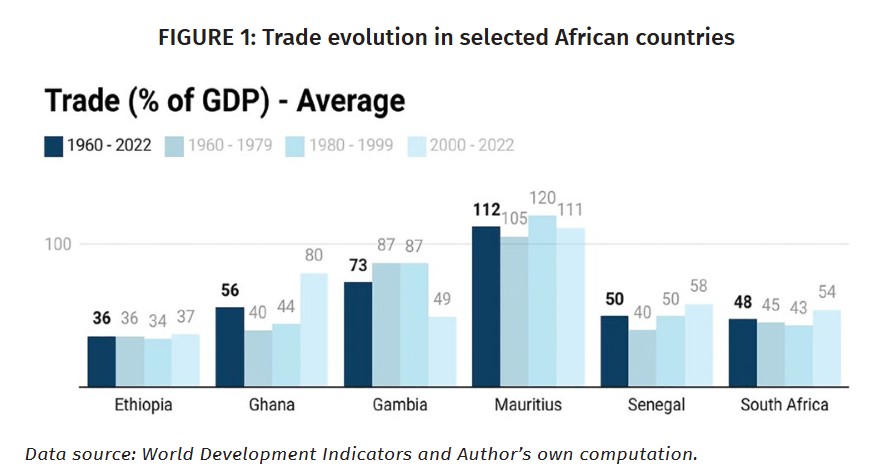
Energy, Food, and fertilizer markets developments
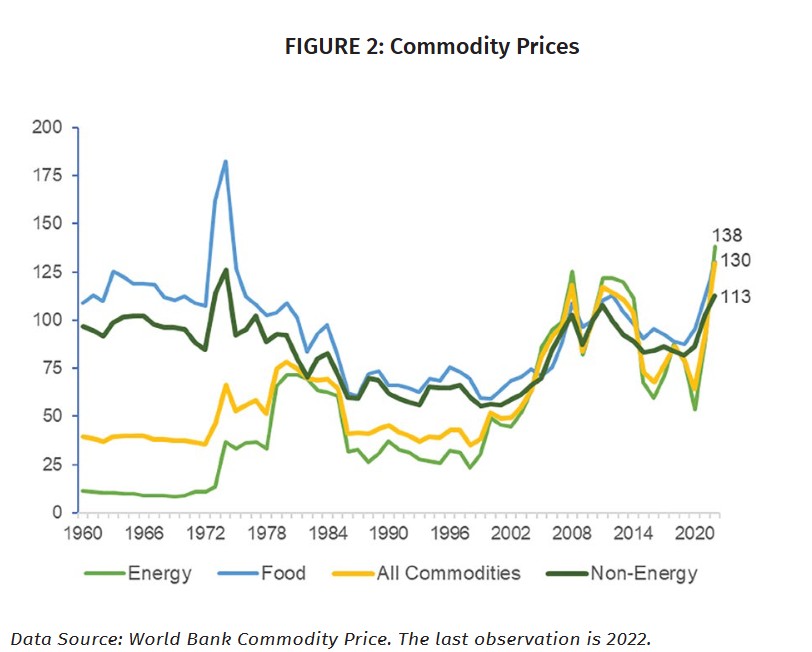
Energy and food prices have historically co-moved (See Figure 2). Nonetheless, the recent surges in energy and food market prices differ from recent historical precedents in several respects. Notably, prices have increased further. The World Bank’s real food price index stood at 130 in 2022, an increase of 36.7% from 2020, and the highest value since 1975. Energy prices rose more than twice, while non-energy prices rose 31 percent above their troughs in 2020, dwarfing all previous episodes except for the price surges between 1972 and 1981 (Figure 2). But for the 1972-1981 episode of commodity price rise, energy prices experienced the most increases.
Econometric Methodology
The question of the economic impact of trade price shocks may be an empirical one. Thus, this research seeks a data-driven answer to the question. The empirical analysis considers that commodity market development depends on global macroeconomic aggregates such as global real economic activity and interest rates. Thus, the correlation between macroeconomic outcomes and energy, fertilizer, and food prices does not imply causation. One solution is to extract the exogenous components of trade prices via appropriate statistical transformations[28] and quantify the dynamic impacts of commodity price shocks using impulse responses.
Our framework uses Jordà’s[29] local projection method to estimate the impulse responses. Jordà’s local projection approach requires estimating a series of regressions for each horizon, h, for each variable. For h = 0,…,H, we estimated the following linear model:
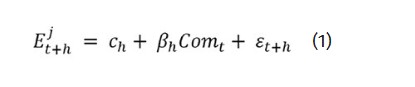
where E is the economic aggregate of interest for country j, and Com is the commodity price. The local projection model directly forecasts E using covariates on the right-hand side of Equation (1). Hence, all estimated coefficients are indexed by h, which is the horizon considered when estimating Equation (1). The coefficient captures the response of E at time t + h to a shock to commodity prices at time t. Thus, we can construct the impulse response function as a sequence of the coefficients , which are estimated in a series of single regressions for each horizon.
In contrast, the standard vector auto-regressions (VAR) method provides the parameters for horizon 0 and then uses them to iterate forward to construct the impulse response functions. The local projection method has the advantage of being relatively robust to misspecification of the structural vector auto-regression (SVAR) and does not constrain the shape of the impulse response function. Thus, local projections (LP) do not require any restrictions on VAR systems and are less sensitive to lag length misspecifications. Second, LP does not require all variables to enter all equations, allowing for a more parsimonious specification. Finally, the left-hand side variables do not have to be in the same form as those on the right-hand side. Ramey and Zubairy;[30] and Montiel Olea and Plagborg-Møller[31] provide a more comprehensive comparison of VAR and LP impulse responses.
We follow Ramey and Zubairy; and Castelnuovo[32] use Newey and West’s[33] correction for our standard errors as a remedy for the serial correlation in the error terms because of the successive leading of the dependent variable. Finally, we set H = 6 so that the maximum horizon considered for our impulse responses was six years.
The variables are expressed as annual growth rates (log-differences). Thus, the impulse responses represent the impact of a 1 percentage point change in commodity price growth on the annual growth rate of the respective macroeconomic variable (CPI, PPI, consumption, or investment). This transformation is standard practice for macroeconomic time series and allows for a clear interpretation of impulse responses as percentage point changes in growth rates.
Empirical Results and Discussions
In our framework, the commodity price shock is treated as an exogenous variable. This is particularly appropriate for small open economies, where the findings of Arezki et al.[34] underline the role of international commodity prices as external drivers rather than outcomes of domestic macroeconomic variables. This approach is consistent with Jordà and Taylor,[35] who argue that the exogeneity of such shocks ensures the consistency of estimates, even in a two-variable system. This is because omitted macroeconomic or financial factors do not bias the coefficients since they do not predict the shock. While we also experimented with treating the shock as endogenous, it did not significantly alter the impulse responses. This robustness aligns with findings in the literature on local projection (LP) models, which are known to be resilient to misspecification. Several studies, including Montiel Olea and Plagborg-Møller; Møntiel Olea et al.;[36] Li et al.,[37] and Plagborg-Møller et al.,[38] have found no evidence of systematic changes in impulse response estimates when control variables are added. As Jordà emphasizes, LP models often include lags of variables as controls to account for autocorrelation and dynamic effects, ensuring that residuals are white noise. However, these controls are primarily for robustness and efficiency and do not fundamentally change the impulse response itself. Following the methodology of Montiel Olea and Plagborg-Møller, we include up to four lags of the variables as controls to ensure robustness and account for autocorrelation.
Impact on consumption
The relationship between international commodity prices and government expenditure is profoundly significant for commodity-exporting African countries. These economies heavily rely on commodity exports as a primary source of fiscal revenue, implying that positive price shocks directly translate into increased government income and expanded fiscal space for public spending, including consumption and investment. However, this dependence often leads to pro-cyclical fiscal policies, where spending surges during booms but faces abrupt cuts during busts, contributing to macroeconomic instability and increased debt burdens, as seen in countries like Ethiopia and Ghana. Furthermore, windfall revenues can sometimes fuel discretionary spending driven by political cycles. Understanding this direct channel through which commodity-price shocks influence domestic public finances and aggregate demand is therefore crucial for assessing fiscal sustainability, designing effective fiscal rules, and implementing counter-cyclical policies to mitigate volatility and foster stable economic development.
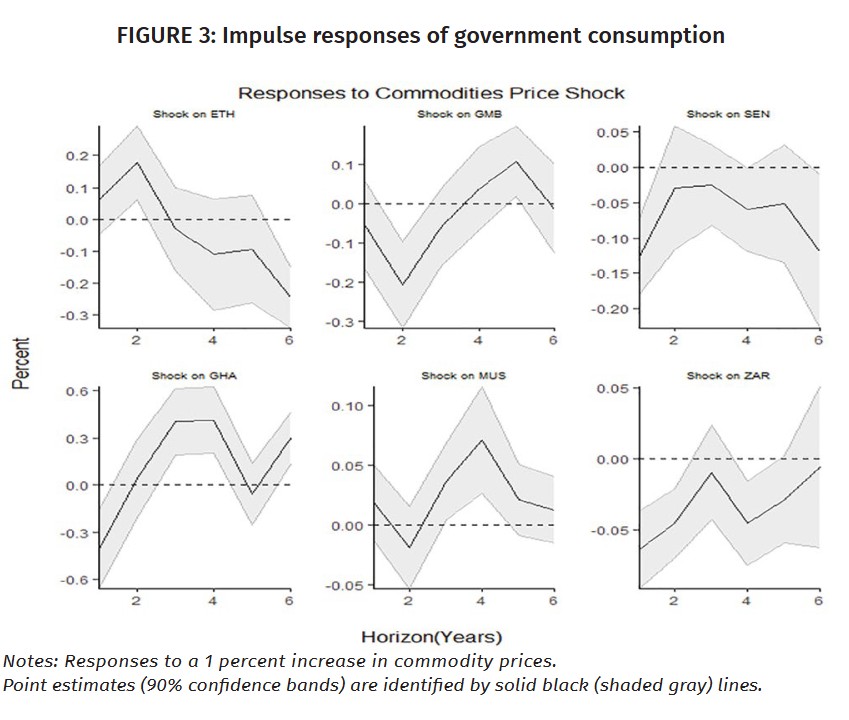
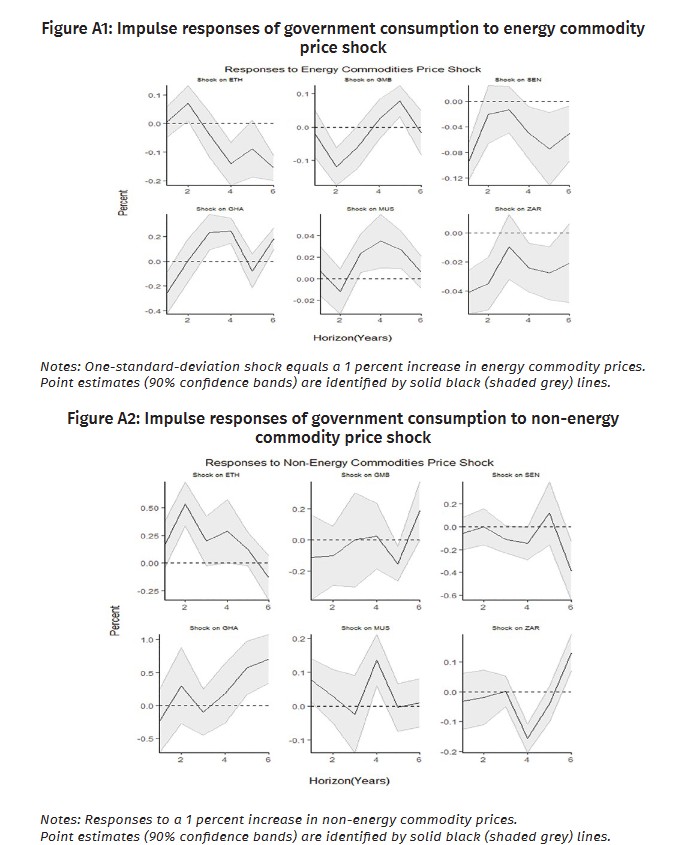
The impulse response plots for government consumption are shown in Figure 3. The magnitude of commodity price shock diffusion on government consumption is negative for most countries, except for Ethiopia and Mauritius. In 2 years after 1 percent increase in commodity prices, government consumption decreased by 0.2 percentage points for The Gambia, 0.12 percentage points for Senegal, 0.4 percentage points for Ghana, and 0.07 percentage points for South Africa. For Ethiopia and Mauritius, government consumption increased by 0.2 and 0.08 percentage points, respectively. We examine whether the impact of commodity price shocks differs according to commodity type. The impulse response plots (Appendix – Figures A1, A2, and A3) show that the impact of energy, non-energy, and food commodity price shocks on government consumption are qualitatively indistinguishable. In terms of size, non-energy commodities have a greater impact on government consumption than energy commodities.
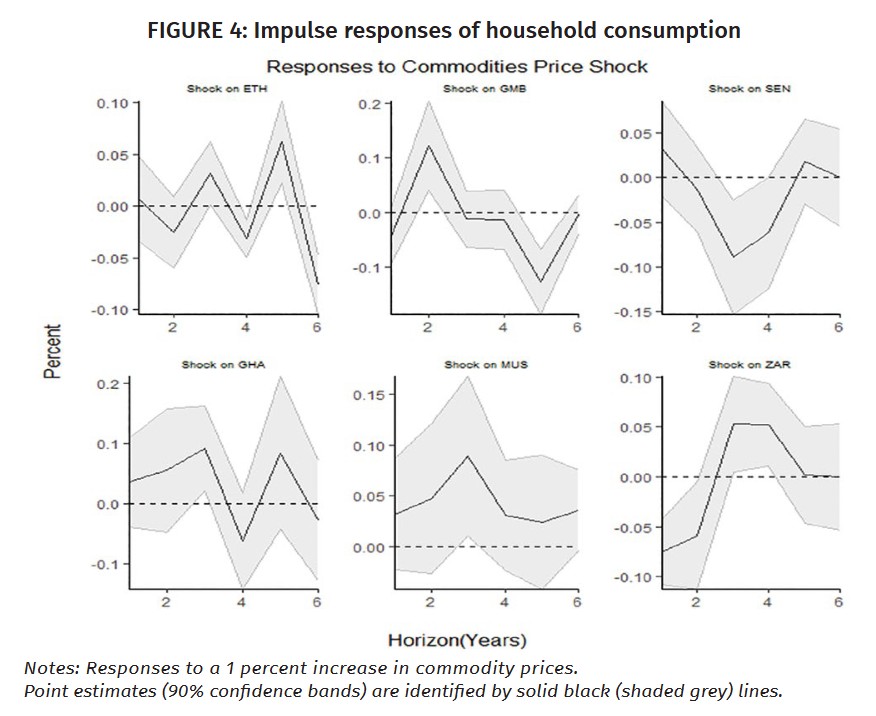
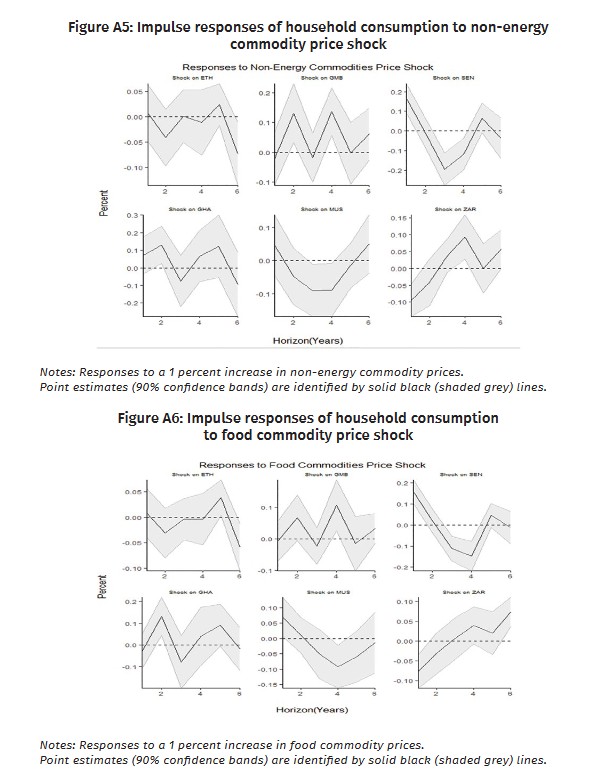
Furthermore, we test the propagation of commodity price shocks on household consumption; the impulse responses are shown in Figure 4. For Senegal, we observed a delayed but negative and significant response. In Senegal, household consumption slumped by 0.09 percentage points, 3 years after a 1 percent unanticipated increase in commodity prices, before returning to pre-shock levels 5 years after the shock. However, for Ghana and Mauritius, household consumption increased in reaction to a positive commodity price shock, reaching a peak of about 0.1 percentage points 3 years after the shock.
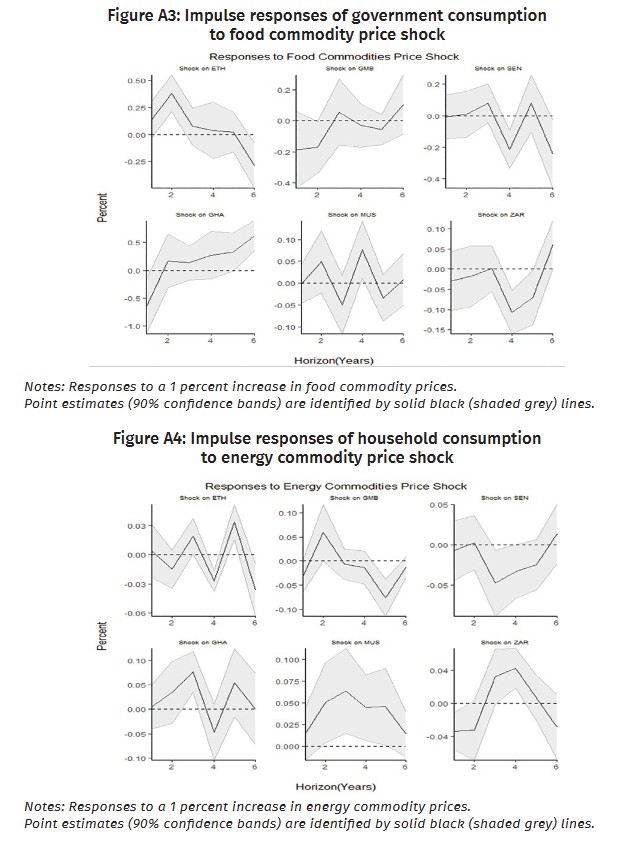
In Ethiopia, The Gambia, and South Africa, household consumption declines initially on impact but increases in the second to fourth years after the commodity price shock. This response pattern may suggest that, in the short run, commodity price increases directly decrease consumer expenditures, but in the second-round effect, there is an increase in consumption given the relatively inelastic demand for energy and food commodities. Disaggregating commodities into energy, non-energy, and food commodities exerts similar impacts in shape (Appendix – Figures A4, A5, and A6). However, in terms of size, price increases for non-energy commodities, including food, exert a greater impact than energy commodities. Kilian explains that higher energy prices are expected to shift consumption expenditures by reducing discretionary income, as consumers have less money to spend after paying their energy bills. However, the less elastic the demand for energy, the larger this discretionary income effect will be, all else being equal. The quantitative effect of energy price changes is bounded by the energy share in consumption, even with a perfectly inelastic energy demand.
For commodity-dependent countries like Ghana, the fall in government consumption from a surge in commodity prices is surprising. However, it is noteworthy that for Ghana, after the initial fall, government consumption increased between the third and fifth years, reaching a peak of about 0.2 percentage points. This response pattern may suggest that the reaction of government consumption is conditional on the level of commodity price surges.
Income, cost, and uncertainty effects are manifested in the response of government and household consumption to commodity price shocks among African countries. High commodity prices may translate into improved real income and cause a northward movement in consumption expenditures. Through the cost-effect, increased commodity prices would raise the cost of imported energy and non-energy goods and lead to higher consumption expenditure. However, this is dependent on the availability of substitutes and the elasticity of demand for the affected goods. Changing commodity prices may heighten economic uncertainty, causing consumers and governments to consolidate and increase precautionary savings. This is consistent with the submissions by Bernanke,[39] Pindyck, and Solimano[40] that prompted by heightened uncertainties from commodity price dynamics, consumers may postpone irreversible purchases of consumer durables.
Impact on investment
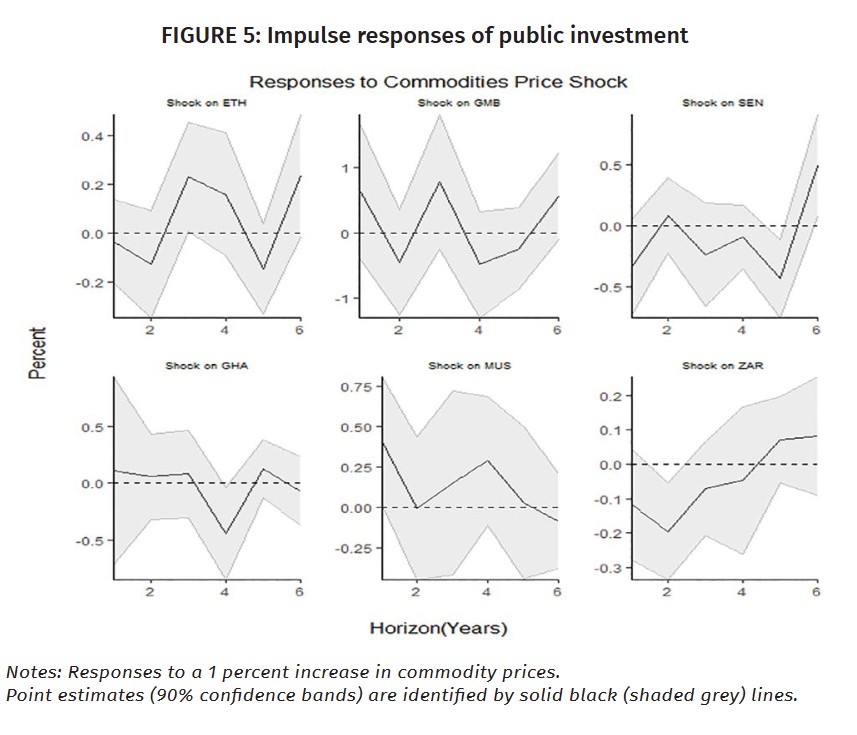
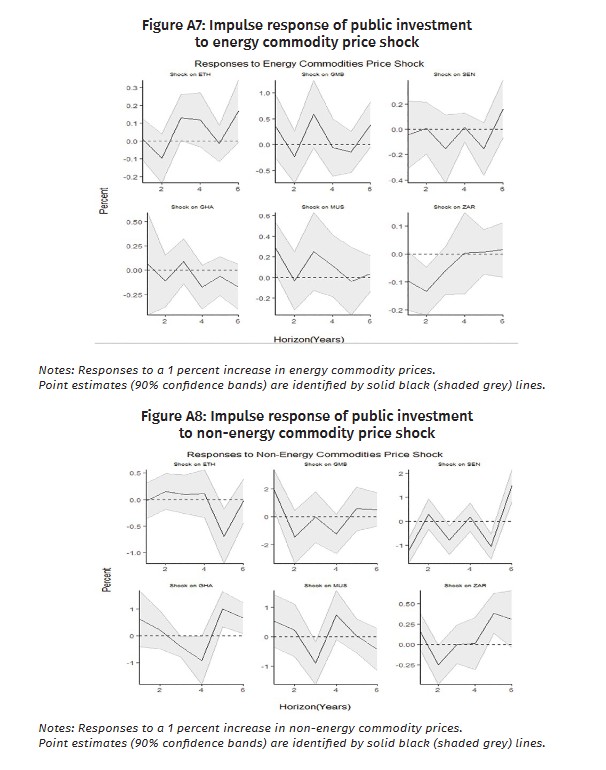
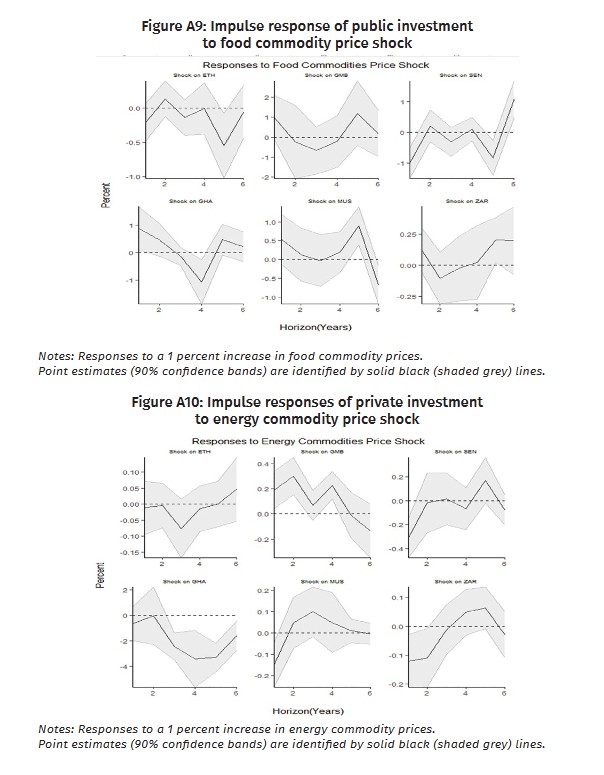
Figure 5 shows the results of public investment responses to commodity price hikes. The responses are positive for Ethiopia, The Gambia, and Mauritius, and negative for Senegal, Ghana, and South Africa, though not statistically significant. When we examine the effects of different commodities separately, we find that the pattern of responses to energy commodity price shocks is very similar to that obtained for all commodity price shocks (the impulse responses are shown in Appendix Figures A7, A8, and A9). We observe that non-energy community price shocks have a greater impact on public investment than unanticipated hikes in energy commodities for all countries, except for The Gambia and Mauritius. In contrast to energy commodities, the impact of non-energy commodity price increases on public investment in Ethiopia is delayed and negative. In Ghana, public investment increased at some points in reaction to upsurges in non-energy commodity prices, in contrast to the influence of energy price increases.
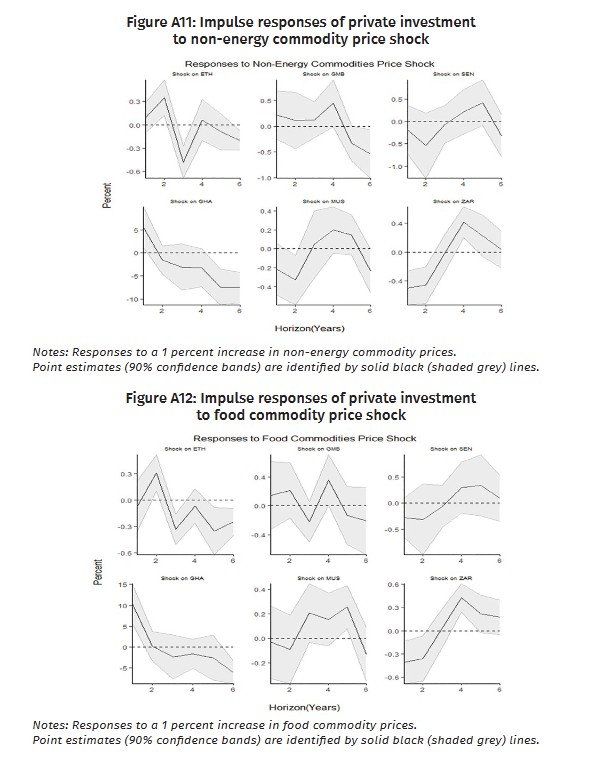
We examine the impact of commodity price hikes on industrial investment. As illustrated in Figure 6, commodity price shocks negatively impacted industrial production in most of the sample countries. In contrast, private investment in The Gambia has been positively impacted. Our results are consistent with those of Inoue, Okimoto,[41] and Kim.[42] Kim discovered that an oil price increase has led to a decline in both the level of industrial output and the price level of goods, and demonstrated that a rise in oil prices had a negative effect on industrial production activities by slowing demand. The respective effects of energy and non-energy commodity price shocks on private investment are almost the same quantitatively and qualitatively (see the impulse response plots in Appendix -Figures A10, A11, and A12). However, food price shocks exerted initial positive effects in Ethiopia and Ghana and a delayed but positive impact in Mauritius.
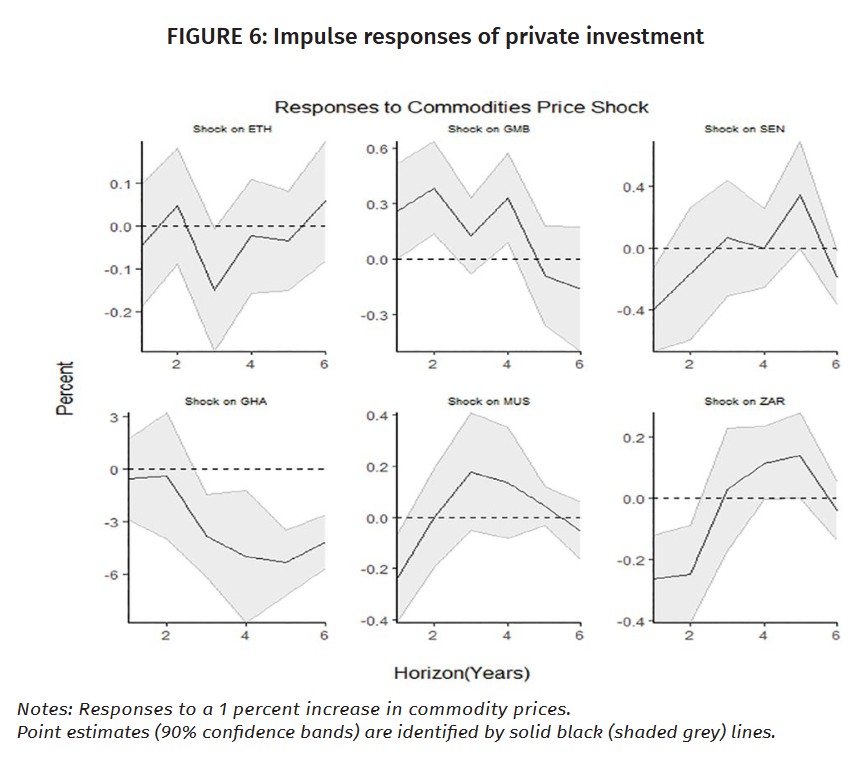
For most commodity-exporting countries, the a priori expectation is that the bulk of the transitory gains from high commodity prices is saved and invested; therefore, investment should increase. Therefore, the observed fall in investment rates during shocks, which occur when prices are high, may be surprising. Instructively, commodity price hikes have increased investment at some point for all the sampled countries except Ghana. This pattern may suggest that a commodity price shock has both growth-enhancing and growth-declining effects on the economy. On the one hand, an unanticipated expansion of the business cycle in global commodity markets may stimulate investment and growth via improved global demand, real income, and savings. However, it raises the cost of energy and non-energy goods, creates uncertainty, and thereby slows investment and growth. Our findings indicate that even resource-rich countries are subject to the volatility of commodity prices, which may undermine investments and growth.
The evidence from our analysis is in line with the findings of Gubler and Hertweck[43] and shows that fluctuations in the international commodities market are necessary signals of impending economic downturns and significantly drive consumption and investment decisions. Consistent with Dehn and other studies, we find that commodity prices have a strong effect on investment. Our results show that, contrary to Dehn’s observations, commodity price uncertainty matters for investment decisions in developing countries.
Impact on inflation
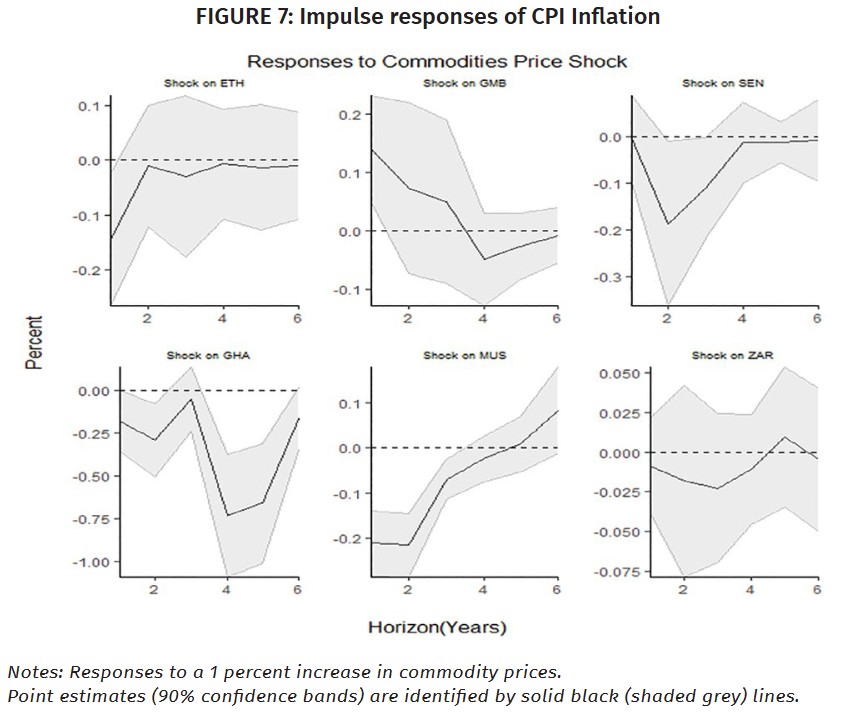
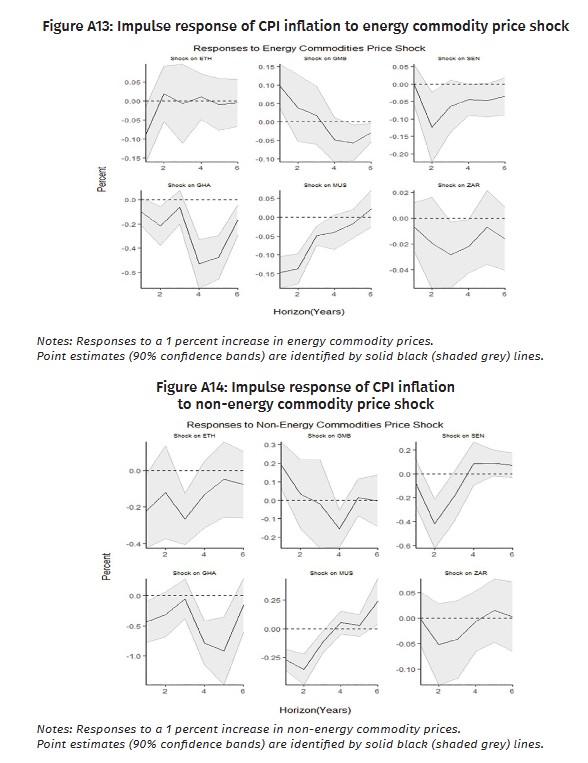
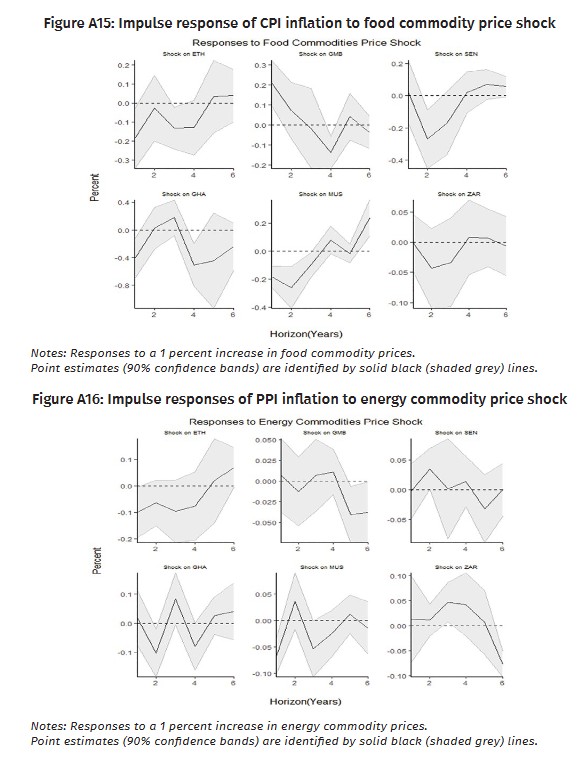
Figure 7 shows a plot of the responses of headline CPI inflation among the sampled African countries. The magnitude of the commodity price shock diffusion on headline CPI inflation is negative for most countries, except for The Gambia. A one percent increase in commodity prices raises the headline CPI inflation by 0.14 percentage points for The Gambia. For other African countries, Ghana responds the most (-0.75 percentage point), followed by Mauritius (-0.21 percentage point), Senegal (-0.19 percentage point), Ethiopia (-0.14 percentage point), and South Africa (-0.03 percentage point). We also examine the responses of headline CPI inflation to different commodity price shocks. The responses of headline CPI inflation to the energy commodity price shock (Appendix – Figure A13), non-energy commodity price shock (Appendix – Figure A14), and food price shock (Appendix - Figure A15) resemble those of the all-commodity price shock qualitatively. In terms of magnitude, non-energy and food price shocks generate larger effects for all countries except for Ghana. This may suggest that energy products exert a relatively great pressure on CPI inflation in Ghana.
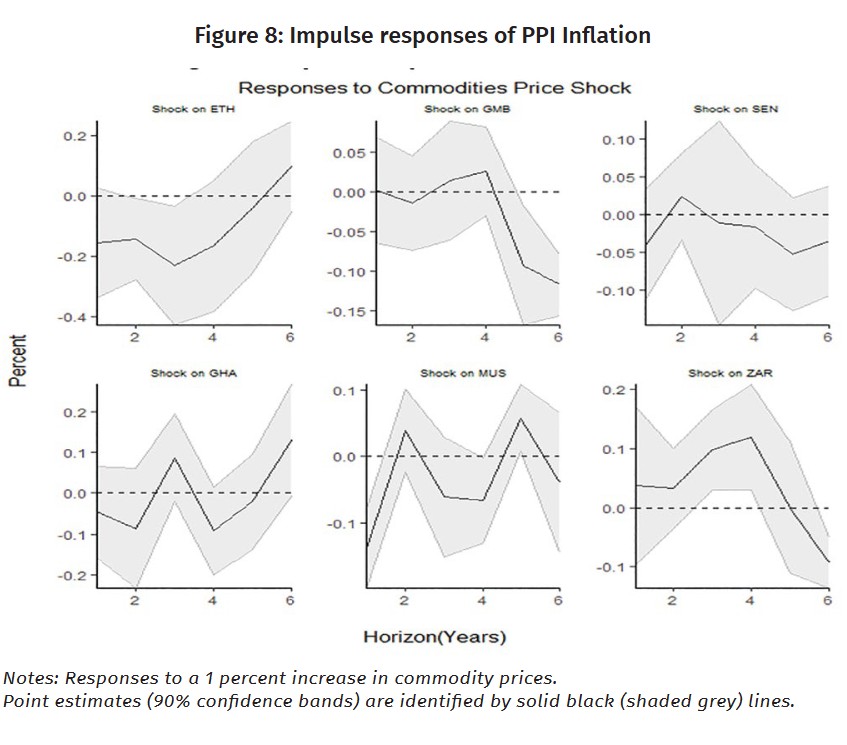
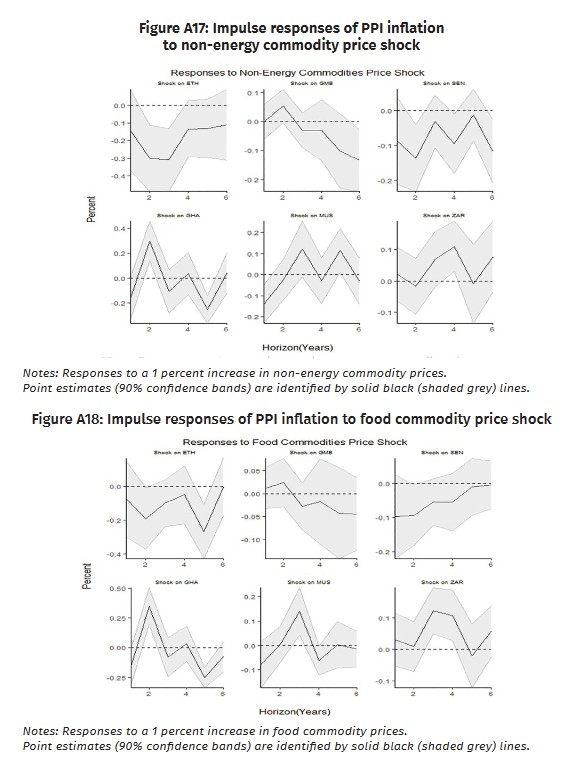
We investigate the responses of PPI inflation, as shown in Figure 8. We observe negative and significant responses for all the countries, except for South Africa. Except for The Gambia, the rest of the countries with negative responses exhibit a positive response at some point within the five years after the shock. Non-energy commodities wielded greater quantitative effects on PPI inflation than energy commodities in all the countries. The impulse response plots for the effects of energy, non-energy, and food commodity price hikes on PPI inflation are shown in the Appendix, Figures A14, A15, and A16, respectively.
Our empirical estimates are consistent with theory and other results in the literature. Kilian and Zhou[44] estimated that the energy price shocks were not primarily responsible for the 2021 and 2022 inflationary pressures in the US. In Korea, Greenwood-Nimmo et al.[45] found that oil price shocks have had a minor effect on inflation. Sekine and Tsuruga[46] observed that the effect of commodity price shocks on inflation varies across country groups and is transitory, suggesting a low risk of a persistent second-round effect on inflation.
Despite popular opinion and expectations, there was no general evidence of a pass-through of commodity prices, including energy and food price shocks to inflation. Conventionally, an increase in commodity prices, especially energy, is expected to feed into domestic inflation through increased production costs (for PPI) and higher consumer prices (for CPI). The evidence from our analysis shows that international commodity price surges would, in most instances, not be likely to create persistent inflation. For commodity-exporting countries like Ghana, Senegal, or South Africa, a positive commodity price shock can lead to an appreciation of the domestic currency, backed by increased foreign exchange inflows. A stronger currency makes imported goods cheaper, which directly reduces imported inflation and overall CPI, especially in economies heavily reliant on imports. This supply-side disinflationary effect could outweigh demand-side inflationary pressures.
Do our estimates suggest any role for policy in moderating the dynamic impacts of commodity price changes on the macroeconomy? One possible explanation for our results is that policy tightening in response to the expected inflationary pressures and the uncertainty generated by the commodity market turmoil may have kept inflationary impulses muted. While this is confirmed by the fiscal consolidation in reaction to unanticipated commodity price surges, the case for monetary policy would have to be tested. Besides, governments in commodity-rich countries might use increased revenues from commodity booms to subsidise essential goods, including fuel and food, thereby dampening inflationary pressures on consumers and producers. This is a common policy response aimed at mitigating the cost of living.
Notwithstanding, our results show that external drivers, including international commodity dynamics, play a considerable role in the inflation transformation in The Gambia. The results confirm the findings of Nachega et al.[47] that there is a strong co-movement between global food inflation and CPI inflation in The Gambia, which can be explained by the fact that The Gambia is a net importer of essential foods and energy, and the weight of food items and non-alcoholic beverages in The Gambia’s CPI basket is around 50 percent. In South Africa, the cost channel appears to be important, making the prospect of spillover effects of commodity price shocks on industrial applications high. However, it appears the shifts in producer prices are not passed on to consumers.
These results have important implications for policymakers. The sensitivity of the domestic economy to international commodity dynamics may not be entirely dependent on the integration into GVCs and global trade per se. But more importantly, it is the fact that international commodity markets’ dynamics reflect global economic uncertainty and demand, with the attendant reactions in the domestic economy. The results suggest that a combination of the policy stance at the time of the shock and policy changes made in response to the shock is critical in maintaining economic stability and mitigating any adverse effects from the international commodity markets’ dynamics.
Conclusions
The sharp rise in energy and food prices in recent years has renewed interest in the question of how much higher commodity prices affect economic development. Our analysis allows us to assess the overall effects of such a price increase on CPI and PPI inflation, household and government consumption, and public and private investments.
First, we find no evidence of a general pass-through of commodity prices, including energy and food price shocks to inflation. Indeed, the inflationary impacts of commodity price shocks on headline CPI inflation are confirmed for only one country, The Gambia, a net-importer of essential foods and energy. Concerning the PPIs, the responses are negative and significant for all the sampled countries except South Africa. For South Africa, the PPI inflation responded positively to commodity price hikes. Even for the countries with negative responses, only The Gambia has not exhibited a positive response at some point within the five years following an unanticipated increase in commodity prices. This implies that the surge of commodity prices has generated some inflationary pressure on a country’s PPI.
Secondly, we find cross-country differences in the response of household and government consumption to commodity price shocks. On impact, government consumption initially increased in Ethiopia and Mauritius after a positive shock to commodity prices. For Ghana, The Gambia, Senegal, and South Africa, the response of government consumption was negative. Similarly, the response of household consumption to increases in commodity prices shows considerable cross-country variations. The initial response of household consumption was negative for Senegal, Ethiopia, The Gambia, and South Africa. For Ghana and Mauritius, the response was positive.
Lastly, we investigate the impact of a commodity price hike on investment. For public investment, the responses are significantly positive for Ethiopia, The Gambia, and Mauritius, and negative for Senegal, Ghana, and South Africa. Private investment, on the other hand, responded negatively in all countries except in The Gambia.
Our analysis includes separating energy and non-energy commodities and evaluating their dynamic impacts. While energy, non-energy, and food commodities exert similar effects qualitatively, non-energy commodities have wielded greater quantitative impacts than energy commodities do. This is quite instructive given that the literature has generally focused on the effects of energy commodities. While energy products have important applications in the economy and are therefore the subject of concern, our empirical estimates show that the dynamics of non-energy commodities have equal prospects in affecting the domestic economy.
The overriding conclusion from the analysis is that propagation of commodity price shocks is dominantly through the uncertainty channel, and their ripple effect on the domestic economy is via adjustments in consumer and firm expenditures. This uncertainty has implications for both supply-side and demand-side accounts of the transmission of commodity price shocks. Specifically, consumption expenditures may shift as consumers increase their precautionary savings, while firms may scale back investment in response to uncertainty about demand, cost, and the general economic environment. Thus, when commodity prices rise, the uncertainty effect will reinforce the decline in firms’ investment expenditures due to reduced consumer demand and higher costs.
Given the profound structural reliance of many African economies on commodity exports, the fluctuations in commodity prices directly affect fiscal revenues, affect government consumption and investments, influence exchange rate dynamics, and alter household incomes, thereby posing substantial challenges to economic management. Practically, our findings reflect the need for robust fiscal frameworks, including stabilisation funds and debt management strategies, to manage commodity revenue volatility and avoid pro-cyclical spending. The analysis re-establishes the importance of economic diversification and strengthening non-commodity sectors to reduce vulnerability to commodity price fluctuations.
The inherent vulnerability of commodity-dependent economic structures means that international commodity price movements are not merely minor disturbances but represent a fundamental driver of business cycle fluctuations and broader macroeconomic instability. This underscores the critical policy relevance of the current research, moving beyond a general statement of importance to highlight the deep-seated structural challenges faced by these nations.
In the future, it is worth examining the importance of endogenous policy responses in the macroeconomic implications of commodity price shocks. Thus, we need to understand how the configuration and the response of key policy instruments, especially monetary policy, moderate the macroeconomic dynamics caused by commodity price shocks. The bivariate approach provides the total effect of commodity price shocks, which may implicitly capture omitted channels. Notwithstanding, future empirical work that incorporates a more comprehensive set of control variables within a multivariate LP framework or a Structural Vector Autoregression (SVAR) model is also likely to be promising. This would allow for a more nuanced understanding of the shock transmission mechanisms and address potential endogeneity concerns.
References
- Allard, C., Kriljenko, M. J. I. C., Gonzalez-Garcia, M. J. R., Kitsios, E., Trevino, M. J. P., Chen, M. W. (2016). Trade integration and global value chains in sub-Saharan Africa: In pursuit of the missing link. International Monetary Fund;
- Arezki, R., Imam, P. A., Kpodar, K., Le-Van, D. (2025). Shocks and shields: Macroeconomic institutions during commodity price swings (Working Paper No. 25/15). International Monetary Fund. <https://www.imf.org/en/Publications/WP/Issues/2025/01/24/Shocks-and-Shields-Macroeconomic-Institutions-During-Commodity-Price-Swings-560031>;
- Athukorala, P. C., Kohpaiboon, A. (2011). East Asia in world trade: The decoupling fallacy, crisis, and policy challenges (FIW Working Paper No. 52). Research Centre International Economics;
- Avalos, F., Cap, A., Igan, D., Kharroubi, E., Nodari, G. (2022). Energy markets: Shock, economic fallout and policy response (BIS Quarterly Review No. 64). Bank for International Settlements;
- Bems, R., Johnson, R. C., Yi, K. M. (2010). Demand spillovers and the collapse of trade in the global recession. IMF Economic Review, 58(2). <https://doi.org/10.1057/imfer.2010.16>;
- Bernanke, B. S. (1983). Irreversibility, uncertainty, and cyclical investment. Quarterly Journal of Economics, 98(1). <https://doi.org/10.2307/1885568>;
- Castelnuovo, E. (2019). Yield curve and financial uncertainty: Evidence based on U.S. data. Australian Economic Review, 52(3). <https://doi.org/10.1111/1467-8462.12324>;
- Collier, P., Gunning, J. W. (1999). Trade shocks in developing countries. Oxford University Press;
- Dehn, J. (2000). Private investment in developing countries: The effects of commodity shocks and uncertainty (Working Paper No. 2000-11). Centre for the Study of African Economies, University of Oxford;
- Dixit, A. K., Pindyck, R. S. (1994). Investment under uncertainty. Princeton University Press;
- El Ganainy, A., Hakobyan, S., Liu, F., Weisfeld, H., Allard, C., Balima, H. W., Bteish, C., Giri, R., Kanda, D. S., Meleshchuk, S., Ramirez, G. (2023). Trade integration in Africa: Unleashing the continent’s potential in a changing world (IMF Departmental Paper No. 2023/003). International Monetary Fund;
- Gangnes, B., Ma, A. C., Van Assche, A. (2012). Global value chains and the transmission of business cycle shocks (Economics Working Paper Series No. 29). Asian Development Bank;
- Greenwood-Nimmo, M., Nguyen, V. H., Shin, Y. (2012). Probabilistic forecasting of output growth, inflation and the balance of trade in a GVAR framework. Journal of Applied Econometrics, 27(4). <https://doi.org/10.1002/jae.1230>;
- Gubler, M., Hertweck, M. S. (2013). Commodity price shocks and the business cycle: Structural evidence for the U.S. Journal of International Money and Finance, 37. <https://doi.org/10.1016/j.jimonfin.2013.06.005>;
- Hamilton, J. D. (2013). Historical oil shocks. In R. Whaples R. E. Parker (Eds.), Routledge handbook of major events in economic history. Routledge;
- He, Y., Lee, M. (2022). Macroeconomic effects of energy price: New insights from Korea. Mathematics, 10(15). <https://doi.org/10.3390/math10152653>;
- Inoue, T., Okimoto, T. (2017). Measuring the effects of commodity price shocks on Asian economies (ADBI Working Paper No. 693). Asian Development Bank Institute;
- Jordà, Ò. (2005). Estimation and inference of impulse responses by local projections. American Economic Review, 95(1). <https://doi.org/10.1257/0002828053828518>;
- Jordà, Ò., Taylor, A. M. (2025). Local projections. Journal of Economic Literature, 63(1). <https://doi.org/10.1257/jel.20241521>;
- Kilian, L. (2008). The economic effects of energy price shocks. Journal of Economic Literature, 46(4). <https://doi.org/10.1257/jel.46.4.871>;
- Kilian, L., Zhou, X. (2022). The impact of rising oil prices on U.S. inflation and inflation expectations in 2020–2023. Energy Economics, 113, 106228. <https://doi.org/10.1016/j.eneco.2022.106228>;
- Kim, S., Lee, J. W., Park, C. Y. (2011). Emerging Asia: Decoupling or recoupling. World Economy, 34(1). <https://doi.org/10.1111/j.1467-9701.2010.01320.x>;
- Kim, Y. (2005). The impact of oil price change on the Korean manufacturing sector. Environmental and Resource Economics Review, 14(2);
- Li, D., Plagborg-Møller, M., Wolf, C. K. (2024). Local projections vs. VARs: Lessons from thousands of DGPs. Journal of Econometrics, 244(2). <https://doi.org/10.1016/j.jeconom.2023.105650>;
- Montiel Olea, J. L., Plagborg-Møller, M. (2021). Local projection inference is simpler and more robust than you think. Econometrica, 89(4). <https://doi.org/10.3982/ECTA18756>;
- Montiel Olea, J. L., Plagborg-Møller, M., Qian, E., Wolf, C. K. (2024). Double robustness of local projections and some unpleasant VARithmetic. NBER Working Paper Series, No. 32463. National Bureau of Economic Research. <https://doi.org/10.3386/w32463>;
- Montiel Olea, J. L., Plagborg-Møller, M., Qian, E., Wolf, C. K. (2025). Local projections or VARs? A primer for macroeconomists. NBER Macroeconomics Annual 2025. <https://doi.org/10.48550/arXiv.2503.17144>;
- Nachega, J. C., Kwende, G., Barroeta, F. A. M., Kemoe, L. (2024). Domestic and external drivers of inflation: The Gambia (IMF Selected Issues Paper No. 2024/004). International Monetary Fund;
- Newey, W. K., West, K. D. (1987). A simple, positive semi-definite, heteroskedasticity and autocorrelation consistent covariance matrix. Econometrica, 55(3). <https://doi.org/10.2307/1913610>;
- Park, C., Chung, M., Lee, S. (2011). The effects of oil price on regional economies with different production structures: Evidence from Korea using a SVAR model. Energy Policy, 39(12). <https://doi.org/10.1016/j.enpol.2011.09.041>;
- Parra, J. C., Wodon, Q. (2008). Comparing the impact of food and energy price shocks on consumers: A social accounting matrix analysis for Ghana (World Bank Policy Research Working Paper No. 4741). World Bank;
- Pindyck, R. S., Solimano, A. (1993). Economic instability and aggregate investment. NBER Macroeconomics Annual, 8;
- Polgreen, L., Silos, P. (2006). Crude substitution: The cyclical dynamics of oil prices and the college premium (FRB Atlanta Working Paper No. 2006–14). Federal Reserve Bank of Atlanta;
- Pula, G., Peltonen, T. A. (2011). Has emerging Asia decoupled? In The evolving role of Asia in global finance. Emerald Group Publishing;
- Qian, C., Zhang, T., Li, J. (2023). The impact of international commodity price shocks on macroeconomic fundamentals: Evidence from the U.S. and China. Resources Policy, 85, 103904. <https://doi.org/10.1016/j.resourpol.2023.103904>;
- Ramey, V. A., Zubairy, S. (2018). Government spending multipliers in good times and in bad: Evidence from U.S. historical data. Journal of Political Economy, 126(2). <https://doi.org/10.1086/696277>;
- Roch, F. (2019). The adjustment to commodity price shocks. Journal of Applied Economics, 22(1). <https://doi.org/10.1080/15140326.2019.1665316>;
- Saito, M., Ruta, M., Turunen, J. (2013). Trade interconnectedness: The world with global value chains (Policy Paper). International Monetary Fund;
- Sekine, A., Tsuruga, T. (2018). Effects of commodity price shocks on inflation: A cross-country analysis. Oxford Economic Papers, 70(4). <https://doi.org/10.1093/oep/gpy025>;
- Siba, E. (2022). Value chains in Africa: What role for regional trade? OECD Development Matters;
- Wei, C. (2003). Energy, the stock market, and the putty–clay investment model. American Economic Review, 93(1). <https://doi.org/10.1257/000282803321455223>.
Footnotes
[1] Allard, C., Kriljenko, M. J. I. C., Gonzalez-Garcia, M. J. R., Kitsios, E., Trevino, M. J. P., Chen, M. W. (2016). Trade integration and global value chains in sub-Saharan Africa: In pursuit of the missing link. International Monetary Fund.
[2] Siba, E. (2022). Value chains in Africa: What role for regional trade? OECD Development Matters.
[3] El Ganainy, A., Hakobyan, S., Liu, F., Weisfeld, H., Allard, C., Balima, H. W., Bteish, C., Giri, R., Kanda, D. S., Meleshchuk, S., Ramirez, G. (2023). Trade integration in Africa: Unleashing the continent’s potential in a changing world (IMF Departmental Paper No. 2023/003). International Monetary Fund.
[4] See for example, Saito, M., Ruta, M., Turunen, J. (2013). Trade interconnectedness: The world with global value chains (Policy Paper). International Monetary Fund.
[5] For example, Gangnes, B., Ma, A. C., Van Assche, A. (2012). Global value chains and the transmission of business cycle shocks (Economics Working Paper Series No. 29). Asian Development Bank.
[6] Kim, S., Lee, J. W., Park, C. Y. (2011). Emerging Asia: Decoupling or recoupling. World Economy, 34(1), 23–53. <https://doi.org/10.1111/j.1467-9701.2010.01320.x>.
[7] Athukorala, P. C., Kohpaiboon, A. (2011). East Asia in world trade: The decoupling fallacy, crisis, and policy challenges (FIW Working Paper No. 52). Research Centre International Economics.
[8] Pula, G., Peltonen, T. A. (2011). Has emerging Asia decoupled? In The evolving role of Asia in global finance (pp. 255–286). Emerald Group Publishing.
[9] Bems, R., Johnson, R. C., Yi, K. M. (2010). Demand spillovers and the collapse of trade in the global recession. IMF Economic Review, 58(2), 295–326. <https://doi.org/10.1057/imfer.2010.16>.
[10] Kilian, L. (2008). The economic effects of energy price shocks. Journal of Economic Literature, 46(4), 871–909. <https://doi.org/10.1257/jel.46.4.871>.
[11] Wei, C. (2003). Energy, the stock market, and the putty–clay investment model. American Economic Review, 93(1), 311–323. <https://doi.org/10.1257/000282803321455223>.
[12] Polgreen, L., Silos, P. (2006). Crude substitution: The cyclical dynamics of oil prices and the college premium (FRB Atlanta Working Paper No. 2006–14). Federal Reserve Bank of Atlanta.
[13] Parra, J. C., Wodon, Q. (2008). Comparing the impact of food and energy price shocks on consumers: A social accounting matrix analysis for Ghana (World Bank Policy Research Working Paper No. 4741). World Bank.
[14] Nitrogen fertilizers require a large amount of natural gas/fossil fuels for production.
[15] Avalos, F., Cap, A., Igan, D., Kharroubi, E., Nodari, G. (2022). Energy markets: Shock, economic fallout and policy response (BIS Quarterly Review No. 64). Bank for International Settlements.
[16] Hamilton, J. D. (2013). Historical oil shocks. In R. Whaples R. E. Parker (Eds.), Routledge handbook of major events in economic history (pp. 239–265). Routledge.
[17] Dehn, J. (2000). Private investment in developing countries: The effects of commodity shocks and uncertainty (Working Paper No. 2000-11). Centre for the Study of African Economies, University of Oxford.
[18] Collier, P., Gunning, J. W. (1999). Trade shocks in developing countries. Oxford University Press.
[19] Dixit, A. K., Pindyck, R. S. (1994). Investment under uncertainty. Princeton University Press.
[20] Park, C., Chung, M., Lee, S. (2011). The effects of oil price on regional economies with different production structures: Evidence from Korea using a SVAR model. Energy Policy, 39(12), 8185–8195. <https://doi.org/10.1016/j.enpol.2011.09.041>.
[21] He, Y., Lee, M. (2022). Macroeconomic effects of energy price: New insights from Korea. Mathematics, 10(15), 2653. <https://doi.org/10.3390/math10152653>.
[22] Greenwood-Nimmo, M., Nguyen, V. H., Shin, Y. (2012). Probabilistic forecasting of output growth, inflation and the balance of trade in a GVAR framework. Journal of Applied Econometrics, 27(4), 554–573. <https://doi.org/10.1002/jae.1230>.
[23] Kilian, L., Zhou, X. (2022). The impact of rising oil prices on U.S. inflation and inflation expectations in 2020–2023. Energy Economics, 113, 106228. <https://doi.org/10.1016/j.eneco.2022.106228>.
[24] Roch, F. (2019). The adjustment to commodity price shocks. Journal of Applied Economics, 22(1), 437–467. <https://doi.org/10.1080/15140326.2019.1665316>;
[25] Qian, C., Zhang, T., Li, J. (2023). The impact of international commodity price shocks on macroeconomic fundamentals: Evidence from the U.S. and China. Resources Policy, 85, 103904. <https://doi.org/10.1016/j.resourpol.2023.103904>.
[26] Trade is measured as the sum of exports and imports as a share of GDP.
[27] Trade in Africa as a whole has expanded from 49 percent of GDP in 2000 to 53 percent by 2019 (El Ganainy et al., 2023).
[28] Kilian, L. (2008). The economic effects of energy price shocks. Journal of Economic Literature, 46(4), 871–909.
[29] Jordà, Ò. (2005). Estimation and inference of impulse responses by local projections. American Economic Review, 95(1), 161–182. <https://doi.org/10.1257/0002828053828518>.
[30] Ramey, V. A., Zubairy, S. (2018). Government spending multipliers in good times and in bad: Evidence from U.S. historical data. Journal of Political Economy, 126(2), 850–901. <https://doi.org/10.1086/696277>.
[31] Montiel Olea, J. L., Plagborg-Møller, M. (2021). Local projection inference is simpler and more robust than you think. Econometrica, 89(4), 1789–1823. <https://doi.org/10.3982/ECTA18756>.
[32] Castelnuovo, E. (2019). Yield curve and financial uncertainty: Evidence based on U.S. data. Australian Economic Review, 52(3), 323–335. <https://doi.org/10.1111/1467-8462.12324>.
[33] Newey, W. K., West, K. D. (1987). A simple, positive semi-definite, heteroskedasticity and autocorrelation consistent covariance matrix. Econometrica, 55(3), 703–708. <https://doi.org/10.2307/1913610>.
[34] Arezki, R., Imam, P. A., Kpodar, K., Le-Van, D. (2025). Shocks and shields: Macroeconomic institutions during commodity price swings (Working Paper No. 25/15). International Monetary Fund. <https://www.imf.org/en/Publications/WP/Issues/2025/01/24/Shocks-and-Shields-Macroeconomic-Institutions-During-Commodity-Price-Swings-560031>.
[35] Jordà, Ò., Taylor, A. M. (2025). Local projections. Journal of Economic Literature, 63(1), 59–110. <https://doi.org/10.1257/jel.20241521>.
[36] Montiel Olea, J. L., Plagborg-Møller, M., Qian, E., Wolf, C. K. (2024). Double robustness of local projections and some unpleasant VARithmetic. NBER Working Paper Series, No. 32463. National Bureau of Economic Research. <https://doi.org/10.3386/w32463>.
[37] Li, D., Plagborg-Møller, M., Wolf, C. K. (2024). Local projections vs. VARs: Lessons from thousands of DGPs. Journal of Econometrics, 244(2), Article 105650. <https://doi.org/10.1016/j.jeconom.2023.105650>.
[38] Montiel Olea, J. L., Plagborg-Møller, M., Qian, E., Wolf, C. K. (2025). Local projections or VARs? A primer for macroeconomists. NBER Macroeconomics Annual 2025, 40. <https://doi.org/10.48550/arXiv.2503.17144>.
[39] Bernanke, B. S. (1983). Irreversibility, uncertainty, and cyclical investment. Quarterly Journal of Economics, 98(1), 85–106. <https://doi.org/10.2307/1885568>.
[40] Pindyck, R. S., Solimano, A. (1993). Economic instability and aggregate investment. NBER Macroeconomics Annual, 8, 259–303.
[41] Inoue, T., Okimoto, T. (2017). Measuring the effects of commodity price shocks on Asian economies (ADBI Working Paper No. 693). Asian Development Bank Institute.
[42] Kim, Y. (2005). The impact of oil price change on the Korean manufacturing sector. Environmental and Resource Economics Review, 14(2), 291–336.
[43] Gubler, M., Hertweck, M. S. (2013). Commodity price shocks and the business cycle: Structural evidence for the U.S. Journal of International Money and Finance, 37, 324–352. <https://doi.org/10.1016/j.jimonfin.2013.06.005>.
[44] Kilian, L., Zhou, X. (2022). The impact of rising oil prices on U.S. inflation and inflation expectations in 2020–2023. Energy Economics, 113, 106228.
[45] Greenwood-Nimmo, M., Nguyen, V. H., Shin, Y. (2012). Probabilistic forecasting of output growth, inflation and the balance of trade in a GVAR framework. Journal of Applied Econometrics, 27(4), 554–573.
[46] Sekine, A., Tsuruga, T. (2018). Effects of commodity price shocks on inflation: A cross-country analysis. Oxford Economic Papers, 70(4), 1108–1135. <https://doi.org/10.1093/oep/gpy025>.
[47] Nachega, J. C., Kwende, G., Barroeta, F. A. M., Kemoe, L. (2024). Domestic and external drivers of inflation: The Gambia (IMF Selected Issues Paper No. 2024/004). International Monetary Fund.
Downloads

Downloads
Published
Issue
Section
License
Copyright (c) 2026 Johnson Worlanyo Ahiadorme (Author)

This work is licensed under a Creative Commons Attribution-ShareAlike 4.0 International License.
How to Cite
Share