The impact of Big Data use on smart tourism: Economic analysis and perspective (Algeria)
DOI:
https://doi.org/10.35945/gb.2026.21.007Keywords:
Big Data, smart tourism, innovation, AlgeriaAbstract
This paper explores the role of Big Data in advancing smart tourism, focusing on experiences from leading countries such as South Korea, Spain, China, Singapore, and the United Arab Emirates. These nations have successfully integrated Big Data analytics into tourism management to improve decision-making, sustainability, and visitor experiences. By analyzing real-time information from multiple sources including IoT devices, mobile data, and social media they have developed intelligent systems that enhance competitiveness and innovation in the tourism sector. The study highlights how these global leaders use data-driven strategies to optimize resource management, personalize services, and promote sustainable tourism. It also draws lessons for developing countries, particularly Algeria, emphasizing the importance of digital infrastructure, open data governance, and collaboration between public and private sectors to achieve smart and sustainable tourism development. Advances in information and communication technologies have provided tourism researchers with a golden opportunity to access big data, which plays a pivotal role in smart tourism. Building on this reality, this paper discusses the evolution of studies related to big data in the tourism sector, with a focus on the conceptual understanding of its types and the insights derived from its analysis.
Keywords: Big Data, smart tourism, innovation, Algeria.
Introduction and Definitions
Data it can be defined as a set of letters, words, numbers, symbols, or images related to a specific subject. Data by itself has no meaning or value; it represents the raw form of information. Information, on the other hand, consists of data that has been analyzed and processed in such a way that it carries meaning and value and can be used for decision-making, for example, obtaining the total number of employees, their average age, and average years of experience, etc.
Knowledge is the process of analyzing different pieces of information, linking them together, having a clear understanding of them, and combining them with experience as illustrated in the following figure.
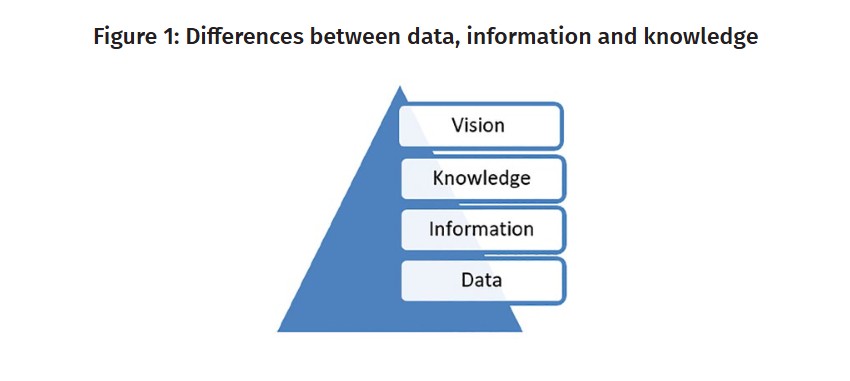
- For Data it’s mean individual facts, figures, signals, measurements.
- For Information, we transform Data to Information (organized, structrured, categorized, calculated).
- Knowledge that means notion, concept, idea.
- Vision (accumulated, applied, integration…).
In the context of smart tourism, the transformation of raw data into information, then into knowledge, plays a critical role in supporting evidence-based and intelligent decision-making. Data refers to raw, unprocessed facts collected from various digital sources such as sensors, mobile devices, social media platforms, and Internet of Things (IoT) systems. When these data are analyzed and organized, they become information that provides meaningful insights into tourism patterns and behaviors.[1] By interpreting and integrating this information with contextual understanding and expertise, it evolves into knowledge, which enables tourism stakeholders to make informed strategic and operational decisions.[2]
In smart tourism ecosystems, this flow from data to knowledge supports decisions such as optimizing resource allocation, personalizing tourist experiences, and improving destination management.[3] Consequently, data-driven knowledge becomes a key enabler of innovation, sustainability, and competitiveness in modern tourism development.[4]
In the era of digital transformation, the tourism sector increasingly relies on the intelligent use of data to enhance innovation, efficiency, and sustainability. Within the framework of smart tourism, the process of converting raw data into meaningful knowledge plays a vital role in supporting strategic decision-making.
In smart tourism ecosystems, this transformation from data to knowledge directly influences decision-making by enabling real-time, data-driven decisions. For example, analyzing big data from social media and mobile applications can allow local authorities in destinations such as Algiers, Oran, or Constantine to monitor tourist satisfaction, predict demand fluctuations, and adapt marketing strategies accordingly. This process enhances both economic efficiency and visitor experience, ensuring that decisions are not based on intuition but on empirical evidence.[5] Furthermore, in the context of developing countries such as Algeria, the integration of data analytics into tourism management can contribute to overcoming challenges related to information asymmetry, resource allocation, and sustainable development.[6]
Ultimately, the data–information–knowledge–decision chain forms the backbone of smart tourism governance. It empowers public and private stakeholders to design innovative policies, promote smart destination management, and foster economic growth while ensuring the sustainability of natural and cultural resources. As such, effective use of data analytics and knowledge management systems represents not only a technological evolution but also a strategic imperative for the modernization of the tourism sector in Algeria and beyond.
- Big DATA and Smart Tourism: Fast View on Leader Countries
Globally, big data analytics has become a cornerstone of smart tourism development, driving evidence-based decision-making and sustainable destination management. Several countries have emerged as leaders in integrating big data into tourism governance, innovation, and policy design.
South Korea
South Korea is considered one of the pioneers in smart tourism ecosystems, where data-driven services are central to enhancing tourist experiences and operational efficiency. The Korean government, through the Korea Tourism Organization (KTO), uses big data from mobile devices, credit card transactions, and online platforms to monitor visitor behavior and predict tourism demand in real time.[7] Seoul’s “Smart Tourism City Project” integrates IoT, AI, and big data to provide tourists with personalized recommendations and digital wayfinding services. Such initiatives enable efficient crowd management and targeted marketing, illustrating how big data transforms tourism governance.[8]
Spain
Spain has positioned itself as a European leader in smart destinations, largely through the SEGITTUR program (Sociedad Estatal para la Gestión de la Innovación y las Tecnologías Turísticas). Big data analytics are used to manage visitor flows, optimize resources, and enhance sustainability in destinations such as Benidorm and Barcelona. Data from booking systems, sensors, and social media are integrated into decision-support systems that inform infrastructure planning and environmental management.[9] Spain’s model emphasizes collaboration between public institutions, private firms, and research centers, showcasing how data governance and innovation can align to strengthen competitiveness.
China
China has also become a global powerhouse in smart tourism, leveraging big data, AI, and IoT technologies to modernize the sector. The Chinese government’s “Smart Tourism Cities” initiative collects and analyzes massive data from online travel agencies (e.g., Ctrip, Fliggy), social media, and payment platforms to understand travel behavior and preferences.[10] Destinations like Hangzhou and Shanghai use predictive analytics to manage tourist flows and provide personalized digital experiences. Moreover, China’s integration of blockchain in tourism information systems enhances data security and trust among users, positioning the country as a global innovator in tourism intelligence.[11]
Singapore
Singapore represents another leading example of data-driven tourism planning, combining advanced analytics, open data, and AI to support policy and operational decisions. The Singapore Tourism Analytics Network (STAN) consolidates data from multiple agencies and private sources, providing real-time insights on visitor demographics, spending, and mobility.[12] This centralized big data platform enables destination managers and businesses to co-create tourism products and adjust marketing strategies dynamically. Singapore’s model demonstrates how an integrated data ecosystem can sustain long-term competitiveness and resilience in tourism.
United Arab Emirates
The United Arab Emirates, particularly Dubai, illustrates how big data supports luxury and sustainable tourism. Dubai’s Department of Economy and Tourism employs big data analytics to optimize marketing campaigns, monitor visitor satisfaction, and predict global travel trends.[13] The emirate’s “Smart Dubai” strategy integrates data from tourism, transport, and hospitality systems to enhance service delivery and improve visitors’ digital experience. These innovations have positioned Dubai as one of the world’s most connected and data-driven tourism hubs.
The United Arab Emirates stands out as one of the leading Arab examples in successfully embedding innovation and artificial intelligence into its tourism policies to advance environmental sustainability. From an early stage, the country adopted a forward-looking vision centered on the transition to smart tourism, supported by substantial investments in digital infrastructure and environmentally sustainable projects that harmonize economic growth with the conservation of natural resources. A landmark initiative in this direction is the UAE Artificial Intelligence Strategy 2031, which seeks to integrate artificial intelligence across key sectors, including tourism and environmental management. In parallel, the UAE Tourism Strategy 2031 embraces the concept of “smart green tourism”, encouraging tourism establishments to cut energy and water consumption by 25% by 2030.[14]
- Digital & Smart Tourism in Algeria: Status & Perspective
Algeria is the largest country in Africa. New Government has put an emphasis on digitalisation and startups with the establishment of deputy ministries and preparation of a host of related legislations.
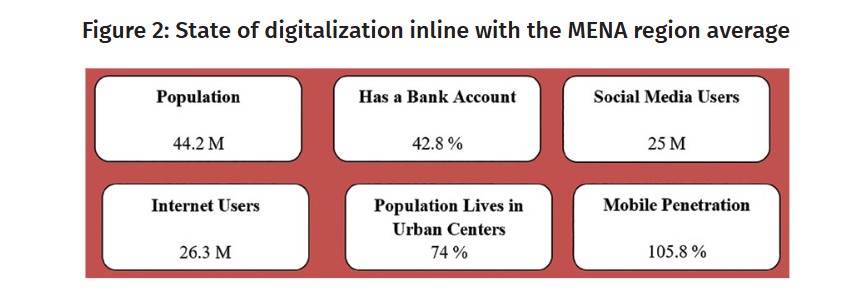
Dzigital Transformation in Algeria. Assessing Digital Transformation in the country: Overview, challenges and opportunities. <https://www.digitalarabia.network/media/pages/articles/grab-a-coffee-read/da075f7bd5-1617783451/strategy_paper_algerien_20210406.pdf>.
According to the Statista website,[15] as Algeria’s oil and gas revenues grew in the 1960s and 70s, successive governments lost interest in developing mass tourism. A descent into political strife in the 1990s pushed the country further off the beaten track. The country is also restoring its historical sites, with 249 locations earmarked for tourism expansion. Approximately 70 sites have been prepared, and restoration plans are underway for 50 additional sites, officials said. Even thought, turism and travel provided 543,500 jobs in Algeria in 2021.
3.1 Digital infrastructure and institutional readiness
Algeria has made noticeable strides in its overall digital transformation agenda. For example, more than 450 public services have been digitised, and some 338 of these services are integrated into a unified national portal for citizens. The government has also established key bodies such as a national data-protection authority and a “Supreme Custodianship for Digitalisation” to steer the process. further, recent initiatives include the creation of digital innovation hubs supporting SMEs, using big data, IoT, and automation.[16]
In the tourism domain specifically, there is the development of a GIS (geographic information system) web-platform for managing tourism zones, sites and infrastructure to assist decision-making. Additionally, digital marketing and e-platforms are being adopted in tourism, as seen in a study showing that applications and electronic platforms are being regarded as models for the sector in Algeria. But while security is now much improved, Algeria needs to tackle an inflexible visa system and poor transport links, as well as grant privileges to local and foreign private investors to enable tourism to flourish, analysts say.
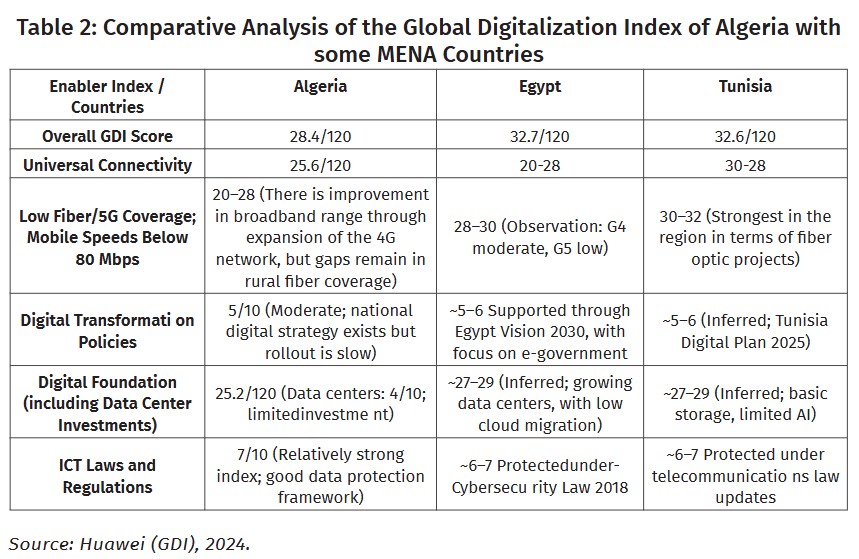
Table 2 indicates that, in terms of the overall GDI score,[17] Algeria trails its neighboring countries by approximately 4 to 6 points, reflecting a comparatively lower level of digital transformation.
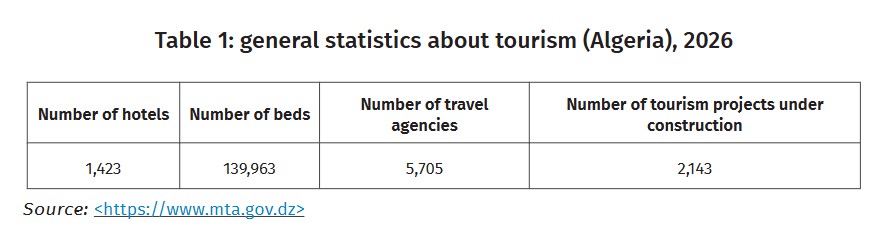
Algeria has plans to build hotels and restructure and modernize existing ones. The tourism ministry report expalain that about 2,000 tourism projects have been approved so far, 800 of which are currently under construction.
For (TI) - Technology Index- is a newly introduced component in the 2024 United Nations report. It evaluates the extent to which governments integrate emerging technologies, including Artificial Intelligence, Blockchain, Cloud Computing, Data Sharing, Cybersecurity, and Open Data.
The Technology Index is measured on a scale from 0 to 1, with higher scores indicating a stronger and more effective adoption of advanced technologies.
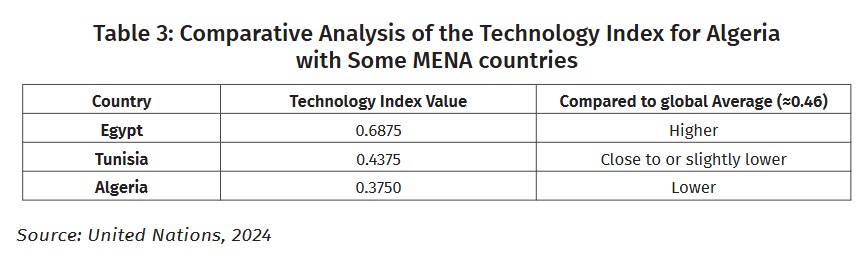
Accordingly, Algeria is positioned at a medium-to-low level in the United Nations Technology Index, with a score of 0.3750, which remains below the global average. Furthermore, it ranks last among North African countries, indicating significant challenges in the adoption of emerging technologies, particularly Artificial Intelligence and Cloud Computing.
3.2 Smart tourism applications and innovation
Within the tourism sector, Algeria is beginning to adopt more advanced digital solutions. One example: the domestic-platform Dz Trip, developed by young Algerian engineers, aims to centralise tourism services (hotel booking, airport transfers, guided tours) with digital payment options and integrated experiences. Another example: cooperation agreements signed (e.g., with Chinese partners) to digitalise the tourism and hotel product line show the intention to upgrade the tourism offering via digital promotion and services. These initiatives signal that data, information and knowledge flows are gradually becoming part of the tourism ecosystem in Algeria: generating data (booking, services), processing it (platform analytics), building knowledge (tourist behaviour, service preferences) and supporting decisions (service design, marketing), exactly the chain you describe in your section on decision-making.
Although ecotourism in Algeria remains at a developmental stage, the government has recently begun adopting a strategic approach aimed at embedding technology and innovation within the tourism sector to foster both environmental and economic sustainability. The national tourism roadmap, Destination Algeria 2030, identifies digital transformation and innovation as two central pillars for building a competitive and sustainable tourism industry. This vision is grounded in the promotion and valorization of Algeria’s rich natural and cultural heritage, ranging from the Sahara and its oases to Mediterranean coastlines and mountainous forests.
Within this framework, the Ministry of Tourism and Traditional Crafts has initiated several digital projects, most notably the national tourism promotion platform “Visit Algeria”. This initiative seeks to enhance the quality of tourism information, facilitate communication between visitors and tourism stakeholders, and strengthen the environmental branding of Algerian destinations. At the same time, tourism-oriented startups are being encouraged to design smart applications that improve the management of ecotourism sites, in coordination with the Ministry of the Knowledge Economy and Startups as part of the broader digital transformation agenda.[18]
From an environmental standpoint, Algeria has incorporated green economy principles and renewable energy solutions into its tourism policies. Emphasis has been placed on promoting eco-lodges in southern and mountainous areas, as well as advancing sustainable desert tourism that respects ecosystem carrying capacity. Parallel efforts focus on developing skilled human capital capable of leveraging technology in support of environmental protection and societal development.
The integration of artificial intelligence and tourism innovation into Algeria’s tourism system has the potential to optimize resource management, guide visitor behavior toward sustainable practices, and strike a balance between economic returns and environmental conservation. Given its strategic geographic location and ecological diversity, Algeria holds strong potential to emerge as a leading smart ecotourism destination in Africa and the Arab region—if it adopts a comprehensive national strategy grounded in innovation, digital environmental governance, and robust public–private partnerships.
Drawing on international best practices, Algeria can develop its own national model for smart ecotourism that reflects its environmental and social specificities. With its vast deserts, forests, coastlines, and oases, the country offers fertile ground for sustainable tourism initiatives supported by artificial intelligence and digital technologies.[19]
3.3 Opportunities for smart tourism development
Given Algeria’s vast and under-leveraged tourism assets (Mediterranean coast, Sahara desert, mountains, cultural/archaeological sites), the country has a significant opportunity to use digital and smart tourism technologies to gain competitive advantage. A Reuters report indicated that while neighbouring countries attract many more tourists, Algeria aims to draw up to 12 million visitors by 2030 by modernising its infrastructure and services. Smart tourism tools such as IoT sensors in heritage sites, mobile-apps for personalized itineraries, big data analytics to predict peak flows, and digital platforms to manage bookings and infrastructure can all contribute to improving the value chain: enhancing visitor experience, optimising resource use, improving sustainability (e.g., via managing flows in fragile desert or heritage zones) and enabling better decisions at destination-management level.
- Implications for Decision-making in Smart Tourism: Some Solutions
From a decision-making perspective, our analysis about Algeria’s status can be divided into:
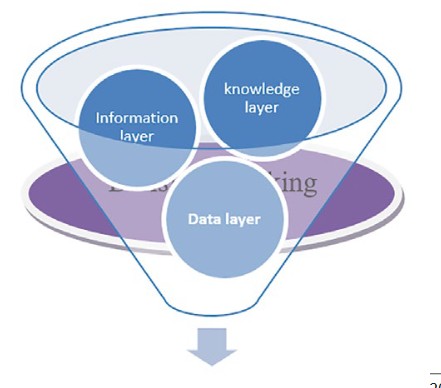
Data layer: Platforms, digital services and GIS systems are generating raw data (visitor counts, bookings, infrastructure status).
Information layer: Tools such as the GIS web-platform for tourism management provide processed information dashboards to monitor tourist areas, capacity, infrastructure.
Knowledge layer: Use of digital economy tools in agencies, analyses of digital marketing in tourism, and studies showing strong correlation between digital economy and competitiveness indicate that knowledge about how digital tools influence tourism performance is growing.
Decision-making: With investment laws pushing digital readiness, digital platforms enabling service innovations, and partnerships for digital tourism development (e.g., with China) .
Algeria is positioning itself to make more informed policy and strategic decisions. For example, destination management can use the GIS dashboards to plan infrastructure, allocate resources and monitor performance in real-time.
However, the full potential of smart tourism decision-making remains constrained by the challenges noted above: limited advanced analytics (AI, IoT) in some areas, gaps in marketing and service quality, uneven infrastructure and capacity. Closing these gaps will accelerate the transformation from information to knowledge to strategic decision-making.
Despite this potential, multiple challenges remain:
- The tourism sector’s digital maturity is still low according to academic studies: For example, one assessment notes that AI and advanced technologies are only in early stages within Algerian tourism promotion; websites are weak, content is limited, and investment in five-star accommodation and digital transformation projects is slow.[20]
- Infrastructure disparities: Algeria’s large geographic size and variable infrastructure across regions mean digital connectivity, broadband and data-centres may be unevenly distributed. For instance, some comments from local forums note delays in improving internet and data-centre availability.
- Sectoral investment and capacity: A study of tourist agencies in the east of the country found that while digital economy tools strongly correlate with competitiveness, many agencies still lack full digital tools and competences.
- Marketing, promotion and service quality: Algeria still lags neighbours in terms of tourist numbers, online presence, marketing intensity, service standardisation and one-stop digital service. For example: “online presence is weak … It’s not easy (just try to book a hotel for example)”, according to a forum user.[21]
- Data governance and ecosystem issues: Observers highlight that if Algeria fails to accelerate digitisation, risks include data sovereignty issues, outsourcing of digital lives to external players, cybersecurity vulnerabilities.
- Regulatory and investment frameworks: Although investment laws (like law 22-18) and digital portals have been introduced, the administrative processes, financing, capacity building and coherence of ecosystem still need strengthening.
Conclusion
The truth that must be said and acknowledged is that Algeria does not possess the minimum requirements or prerequisites for digital tourism.
Priority measures should encompass the development of an integrated national digital ecotourism ecosystem. This would involve the creation of a unified digital platform connecting the Ministries of Tourism, Environment, Culture, and Interior, thereby enabling real-time monitoring of visitor flows, environmental pressures, and site capacity management. Such integration would enhance inter-institutional coordination and support evidence-based governance.
Equally important is the promotion of digital entrepreneurship within the tourism sector. Emerging enterprises should be encouraged and supported in designing innovative digital applications that responsibly showcase Algeria’s natural landscapes and cultural heritage while ensuring ecological sustainability.
Furthermore, Algeria should intensify its international cooperation efforts by strengthening partnerships with institutions such as the World Tourism Organization and the Organisation for Economic Co-operation and Development. These collaborations can facilitate knowledge transfer, benchmarking, and access to global best practices in environmental digitalization and green transition strategies.
data → information → knowledge → decision
According to Arabic report,[22] Algeria’s digital transformation faces a set of structural and institutional constraints that continue to limit its full potential. First, the high cost and instability of technical infrastructure particularly in terms of hosting services and reliable internet connectivity create barriers for both digital service providers and users. These limitations increase operational costs for businesses while reducing accessibility and user confidence. In parallel, the weak development of payment infrastructure, characterized by low penetration of online payment systems and limited use of credit cards, significantly constrains the commercialization and scalability of digital services.
Moreover, the absence of a clearly articulated political vision and a coherent national digital roadmap generates uncertainty within the ecosystem. Without strategic alignment between government priorities and stakeholder needs, digital actors struggle to operate within a predictable and supportive environment, limiting Algeria’s positioning as a regional digital leader. This challenge is compounded by outdated and rigid regulatory frameworks that do not adequately accommodate innovation, experimentation, or the rapid scaling required in digital industries.
Human capital constraints further exacerbate these difficulties. Although Algeria possesses a young and dynamic population, ICT talent remains scarce relative to market demand, and university training programs often fail to match industry needs. In addition to technical gaps, deficiencies in soft skills—such as project management, communication, and entrepreneurial mindset—limit competitiveness. Access to financing also represents a critical bottleneck. Digital startups frequently encounter funding shortages, particularly at the post–Series A stage, while traditional state support mechanisms and banking products remain poorly adapted to the realities of digital business models.
Finally, structural and cultural factors continue to hinder digital adoption. Many corporations and SMEs display limited digital leadership and insufficient execution capabilities, often underestimating the strategic value of digital transformation. At the societal level, low levels of trust in online transactions, weak e-commerce culture, and limited confidence in local digital brands contribute to slow adoption rates. Together, these interconnected challenges highlight the need for comprehensive reforms that integrate infrastructure development, regulatory modernization, human capital investment, financial innovation, and trust-building measures to foster a sustainable digital ecosystem in Algeria.
References:
- Al Nuaimi, E., et al. (2015). Applications of big data to smart cities. Journal of Internet Services and Applications. 6(25). <DOI: 10.1186/s13174-015-0041-5>;
- Bassimane, A., Mahdjar, Y. (2025). Digital transformation gaps in Algeria: A comparative analysis of the global digital transformation and technology indicies for 2024. Lex localis journal of local self-govenment, 23(10);
- Buhalis, D., Amaranggana, A. (2015). Smart Tourism Destinations Enhancing Tourism Experience Through Personalisation of Services. In: Tussyadiah, I., Inversini, A. (eds.). (2015). Information and Communication Technologies in Tourism. Springer, Cham. <https://doi.org/10.1007/978-3-319-14343-9_28>;
- Del Vecchio, P., Mele, G., Ndou, V., Secundo, G. (2018). Creating value from open data: The role of smart tourism ecosystems. Information Processing & Management, 54(5). <https://doi.org/10.1016/j.ipm.2017.10.006>;
- Digital Arabia Network. (2020). Dzigital Transformation in Algeria. Assessing Digital Transformation in the country: Overview, challenges and opportunities. <https://www.digitalarabia.network/media/pages/articles/grab-a-coffee-read/da075f7bd5-1617783451/strategy_paper_algerien_20210406.pdf>;
- Dyvik, E. H. (2015). Key economic indicators of Algeria - statistics & facts. Statista. <https://www.statista.com/topics/7404/economy-in-algeria/?srsltid=AfmBOoqAJJNhAR3v6VRE2RSSEdZrULafl-Kr-H1O5RmSNnyhuP8fgfdZ>;
- Gretzel, U., Sigala, M., Xiang, Z., Koo, C. (2015). Smart tourism: Foundations and developments. Electronic Markets, 25(3). <https://doi.org/10.1007/s12525-015-0196-8>;
- Ivars-Baidal, J. A., Celdrán-Bernabeu, M. A., Mazón, J. N., Perles-Ribes, J. F. (2019). Smart destinations and the evolution of ICTs: A new scenario for destination management? Current Issues in Tourism, 22(4). <DOI:1080/13683500.2017.1388771>;
- Koo, C., Gretzel, U., Hunter, W. C., Chung, N. (2015). The role of IT in tourism: A dynamic capabilities perspective. Tourism Management, 25 (1). <DOI:14329/apjis.2015.25.1.099>;
- Li, Y., Hu, C., Huang, C., Duan, L. (2017). The concept of smart tourism in the context of tourism information services. Tourism Management, 58. <https://doi.org/10.1016/j.tourman.2016.03.014>;
- Ministry of Tourism and Handicrafts of Algeria. <https://www.mta.gov.dz/>;
- Nesrouche, A. N., Ali, B. (2026). Artificial intelligence and tourism innovation as a lever for developing sustainable ecotourism: An analytical study of leading international experiences. International Journal of Economic Perspectives, 20(1). <https://ijeponline.org/index.php/journal/article/view/1263>;
- Ressa, H., Bouharkat, B. (2024). The Role of Artificial Intelligence in Supporting and Enhancing the Tourism Sector in Algeria (2017-2023). European Economic Letters ISSN 2323-5233, 14(4). <http://eelet.org.uk>;
- Singapore Tourism Board (STB). (2023). Tourism Analytics Network: Using data to power smarter decisions. <https://www.stb.gov.sg>;
- Zeng, B., Gerritsen, R. (2014). What do we know about social media in tourism? A review. Tourism Management Perspectives, 10 (07). <DOI:1016/j.tmp.2014.01.001>.
Footnotes
[1] Gretzel, U., Sigala, M., Xiang, Z., Koo, C. (2015). Smart tourism: Foundations and developments. Electronic Markets, 25(3), 179–188. <https://doi.org/10.1007/s12525-015-0196-8>.
[2] Buhalis, D., Amaranggana, A. (2015). Smart Tourism Destinations Enhancing Tourism Experience Through Personalisation of Services. In: Tussyadiah, I., Inversini, A. (eds.). (2015). Information and Communication Technologies in Tourism. Springer, Cham. <https://doi.org/10.1007/978-3-319-14343-9_28>.
[3] Li, Y., Hu, C., Huang, C., Duan, L. (2017). The concept of smart tourism in the context of tourism information services. Tourism Management, 58, 293–300. <https://doi.org/10.1016/j.tourman.2016.03.014>.
[4] Del Vecchio, P., Mele, G., Ndou, V., Secundo, G. (2018). Creating value from open data: The role of smart tourism ecosystems. Information Processing & Management, 54(5), 847-860. <https://doi.org/10.1016/j.ipm.2017.10.006>.
[5] Gretzel, U., Sigala, M., Xiang, Z., Koo, C. (2015), Op. cit.
[6] Li, Y., Hu, C., Huang, C., Duan, L. (2017). The concept of smart tourism in the context of tourism information services. Tourism Management, 58, 293–300. <https://doi.org/10.1016/j.tourman.2016.03.014>.
[7] Gretzel, U., Sigala, M., Xiang, Z., Koo, C. (2015). Smart tourism: Foundations and developments. Electronic Markets, 25(3), 179–188. <https://doi.org/10.1007/s12525-015-0196-8>.
[8] Koo, C., Gretzel, U., Hunter, W. C., Chung, N. (2015). The role of IT in tourism: A dynamic capabilities perspective. Tourism Management, 25 (1), 99-104. <DOI:10.14329/apjis.2015.25.1.099>.
[9] Ivars-Baidal, J. A., Celdrán-Bernabeu, M. A., Mazón, J. N., Perles-Ribes, J. F. (2019). Smart destinations and the evolution of ICTs: A new scenario for destination management? Current Issues in Tourism, 22(4), 1-20. <DOI:10.1080/13683500.2017.1388771>.
[10] Li, Y., Hu, C., Huang, C., Duan, L. (2017). The concept of smart tourism in the context of tourism information services. Tourism Management, 58, 293–300. <https://doi.org/10.1016/j.tourman.2016.03.014>.
[11] Zeng, B., Gerritsen, R. (2014). What do we know about social media in tourism? A review. Tourism Management Perspectives, 10 (07), 27–36. <DOI:10.1016/j.tmp.2014.01.001>.
[12] Singapore Tourism Board (STB). (2023). Tourism Analytics Network: Using data to power smarter decisions. <https://www.stb.gov.sg>.
[13] Al Nuaimi, E., et al. (2015). Applications of big data to smart cities. Journal of Internet Services and Applications. 6(25). <DOI: 10.1186/s13174-015-0041-5>.
[14] Nesrouche, A. N., Ali, B. (2026). Artificial intelligence and tourism innovation as a lever for developing sustainable ecotourism: An analytical study of leading international experiences. International Journal of Economic Perspectives, 20(1), 145–156. <https://ijeponline.org/index.php/journal/article/view/1263>.
[15] Dyvik, E. H. (2015). Key economic indicators of Algeria - statistics & facts. Statista. <https://www.statista.com/topics/7404/economy-in-algeria/?srsltid=AfmBOoqAJJNhAR3v6VRE2RSSEdZrULafl-Kr-H1O5RmSNnyhuP8fgfdZ>.
[16] Bassimane, A., Mahdjar, Y. (2025). Digital transformation gaps in Algeria: A comparative analysis of the global digital transformation and technology indicies for 2024. Lex localis journal of local self-govenment, 23(10), 729-742.
[17] GDI score, it is a composite indicator that measures a country’s level of digital development. The score is usually calculated based on several dimensions such as: Digital infrastructure, Internet access and connectivity, Digital skills and human capital, Digital public services, Technology adoption in business and government. A higher GDI score means a country is more advanced in its digital transformation, while a lower score indicates slower digital development.
[18] Ministry of Tourism and Handicrafts of Algeria. <https://www.mta.gov.dz/>.
[19] Nesrouche, A. N., Ali, B. (2026). Artificial intelligence and tourism innovation as a lever for developing sustainable ecotourism: An analytical study of leading international experiences.International Journal of Economic Perspectives, 20(1), 145–156. <https://ijeponline.org/index.php/journal/article/view/1263>.
[20] Ressa, H., Bouharkat, B. (2024). The Role of Artificial Intelligence in Supporting and Enhancing the Tourism Sector in Algeria (2017-2023). European Economic Letters ISSN 2323-5233, 14(4). <http://eelet.org.uk>.
[21] Digital Arabia Network. (2020). Dzigital Transformation in Algeria. Assessing Digital Transformation in the country: Overview, challenges and opportunities. <https://www.digitalarabia.network/media/pages/articles/grab-a-coffee-read/da075f7bd5-1617783451/strategy_paper_algerien_20210406.pdf>.
[22] Ibid.
Downloads
Published
Issue
Section
License

This work is licensed under a Creative Commons Attribution-ShareAlike 4.0 International License.
How to Cite
Share